

“The message is loud and clear: You’re adequate to select greens or clear resort rooms, however to not go to school.”
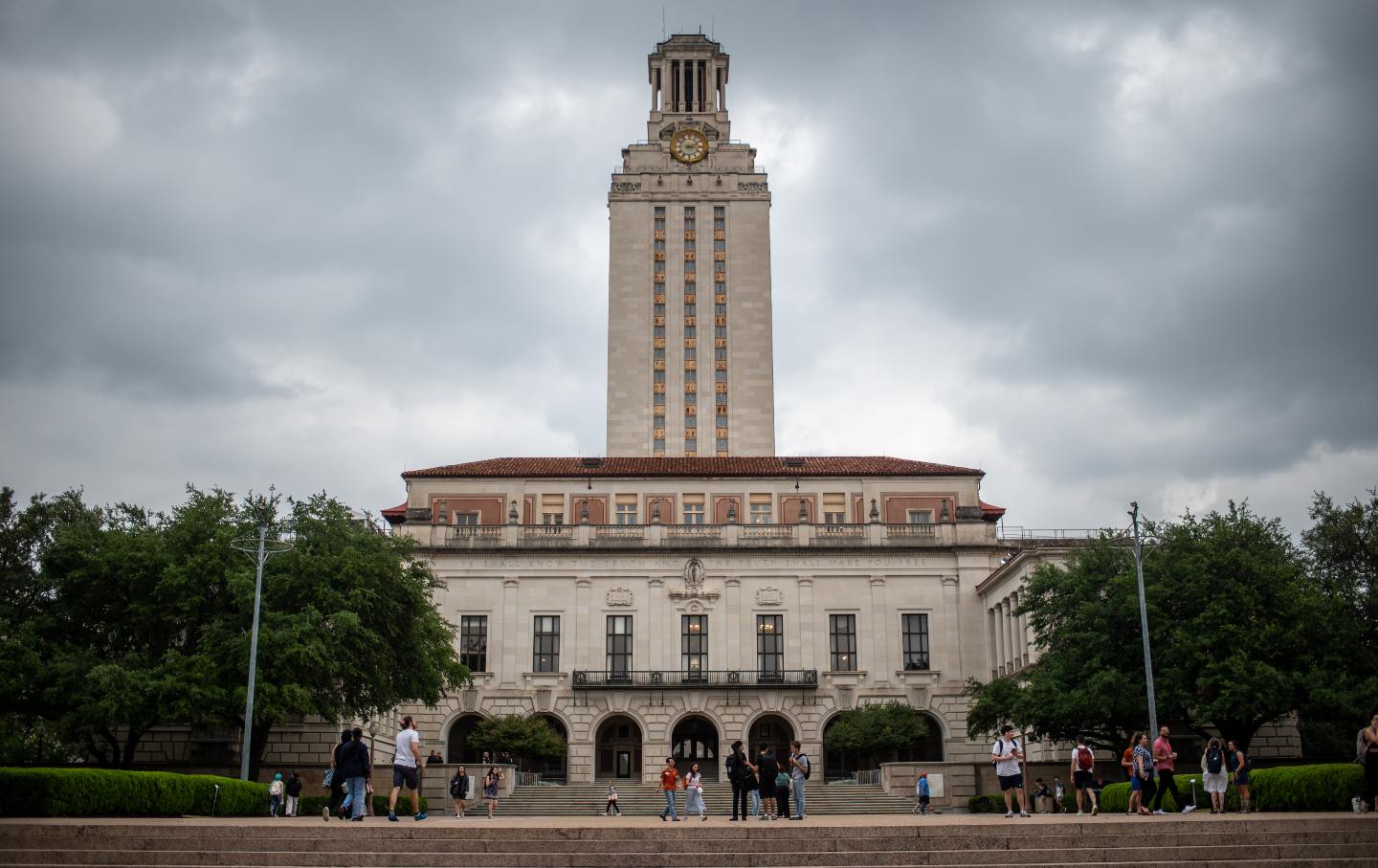
The tower on the College of Texas in April 2024 in Austin.
(Sergio Flores / Getty)
Till June, Texas was among the finest states within the nation when it got here to providing in-state tuition to undocumented college students. However after the Division of Justice filed a lawsuit in opposition to the state, officers quietly ended the coverage.
The go well with claimed that Texas violated a 1996 federal regulation that prohibits undocumented college students from receiving residency-based tuition advantages until these advantages are additionally prolonged to all US residents—no matter the place they reside. Reasonably than struggle the lawsuit, Texas officers capitulated virtually instantly. “They solely deliberated for half-hour, after which they settled,” mentioned Abraham Espinosa, director of entry to greater schooling at FIEL Houston, an immigrant and civil rights group in Texas with applications supporting undocumented college students.
The coverage, initially handed in 2001 as Home Invoice 1403, had allowed undocumented college students who lived in Texas and graduated from a Texas highschool to pay in-state tuition at public faculties and universities. Identified informally because the Texas Dream Act, it opened the doorways to greater schooling for tens of 1000’s of younger individuals who had grown up within the state however had been barred from federal monetary support and most scholarships.
The sudden reversal got here after a number of makes an attempt by the Texas Legislature to repeal the payments. “FIEL workers have been on the capitol each session since 2011 combating to guard in-state tuition,” Espinosa mentioned. “We beat it once more this 12 months. However two days later, we had been blindsided.” Now, Espinosa’s inbox is stuffed with messages from undocumented college students and households asking: What does this imply for me?
Undocumented college students and DACA recipients can nonetheless apply for state support in Texas via the Texas Utility for State Monetary Support, such because the Texas Grant—which, not like loans, don’t should be repaid. However TASFA was already restricted, paying at most round $8,000 per 12 months. That’s barely sufficient to cowl in-state tuition, and now that undocumented college students should pay out-of-state charges, it gained’t even come shut. “TASFA stays the identical,” mentioned Espinosa. “The lawsuit solely applies to the in-state tuition provision of HB 1403. So that they technically can nonetheless obtain monetary support however nonetheless should pay out-of-state charges.” That distinction makes school all however inaccessible for a lot of. “Now it’s much more of a monetary burden as a result of it should hardly cowl something,” Espinosa mentioned. “They’ll nonetheless want to seek out support elsewhere or both switch or decrease their credit score hours. However decreasing credit score hours impacts their eligibility for support, as a result of to qualify, they have to be enrolled full time. So that is the place we are actually.”
College students are actually making laborious selections. Ximena, 18, lately graduated from a highschool in Houston and had deliberate to attend the College of Texas at Tyler. A scholarship from the Honors Program, supportive professors, and a robust chemistry division made it her best choice. However with tuition already round $9,000 per semester earlier than support was processed—and out-of-state standing looming—she withdrew. “I didn’t even wish to see what it might be with out-of-state tuition,” she mentioned. “It was already fairly excessive once I was nonetheless thought of in-state. I simply didn’t wish to discover out what that quantity would flip into.”
Present Subject

As an alternative, Ximena enrolled at Houston Neighborhood Faculty. Credit score-by-exam work she accomplished in highschool helped decrease her invoice to $800, however that’s nonetheless thrice what in-district college students pay. “They quoted me $4,000 at first,” she mentioned. “Even now, it’s loads. And what I believe is reasonably priced might be one thing that’s simply inconceivable for different households.”
Ximena got here to the USA on a vacationer visa in center faculty to flee violence in her hometown in Mexico. “Most of my recollections, my socialization, my schooling, that every one occurred right here,” she mentioned. “I’ve accomplished mainly all of my education in Texas.” What struck her most, she mentioned, was how quietly the change occurred. “I noticed perhaps a 10-second phase on the information,” she mentioned. “Even the HCC workers didn’t actually have sources or info. That was regarding to me, but in addition it made me suppose, what sort of assist are colleges being given to navigate this? It felt like we had been supposed to seek out out on our personal.”
She says most of her friends aren’t coping with the identical immigration standing, however they’re nonetheless feeling the broader results of instability in greater schooling. “I’m seeing folks on-line who had a dream faculty and obtained a substantial quantity of support, and now they’re getting rescinded or dropped or delayed. A few of them can’t even enroll,” Ximena mentioned. She nonetheless hopes to switch to the College of Houston and main in chemistry.
Axel, 25, is in his last 12 months on the College of St. Thomas in Texas. He got here to the state from San Luis Potosí, Mexico, when he was three and has lived in Houston ever since. He’s a DACA recipient, that means he has a piece allow and a Social Safety quantity, however not one of the federal monetary support that residents can entry. He’s finding out studio artwork with a give attention to images and videography. However the rising price of tuition threatens to chop his last 12 months quick. “I’ve all the time needed to take part-time courses as a result of my monetary support by no means covers all of them,” he mentioned. “I nonetheless find yourself paying $500 to $1,000 out-of-pocket each semester. Typically extra.”
He described feeling caught between monetary support that doesn’t go far sufficient and scholar loans he doesn’t qualify for. “I can’t take out federal or non-public scholar loans via the college,” Axel mentioned. “I might strive for a private mortgage from a non-public firm, however these are laborious to get accepted for and the quantities are low. Even when I get one, it’d solely assist somewhat.”
Axel mentioned he crammed out TASFA with assist from native teams like FIEL Houston and Café Faculty however nonetheless discovered himself scrambling. “Each time I apply, they ask for the whole lot, earnings, family dimension, how lengthy I’ve been right here. However even once I get support, it’s by no means sufficient,” he mentioned. “I normally should go round asking folks for assist, or see if anybody is aware of about further scholarships.”
Standard
“swipe left beneath to view extra authors”Swipe →
As of late July, he hadn’t heard something from St. Thomas about how they deliberate to deal with the change. “They haven’t mentioned something—no message, no electronic mail,” he mentioned. “I’m sort of flying blind. I used to be planning to go as we speak to ask about it, but it surely’s all the time irritating. I by no means know what the quantity’s going to be.” He mentioned he was alleged to graduate subsequent 12 months, however now, he’s undecided. “I simply don’t know if I’m going to have the ability to return,” he mentioned. “That’s the place I’m at.”
Espinosa mentioned the consequences have already reached his circle of relatives. His sister, who holds a bachelor’s diploma, had deliberate to use to graduate faculty. “However she pulled again when this occurred,” he mentioned. “She seemed on the numbers and simply didn’t suppose it was price it anymore.” And for college students simply beginning out, the brand new actuality might imply leaving faculty altogether. “We’ve had college students say they’re going to give up,” Espinosa mentioned. “And that’s precisely what the state needs.”
Espinosa emphasised that being undocumented is a civil, not prison, offense. “It’s not unlawful to be right here. It’s simply that the system doesn’t enable our group to thrive,” he mentioned. “The message is loud and clear: You’re adequate to select greens or clear resort rooms, however to not go to school.”
“That is about who we expect deserves to succeed,” Espinosa mentioned. “And proper now, the message from the state is: not you.”
On this second of disaster, we’d like a unified, progressive opposition to Donald Trump.
We’re beginning to see one take form within the streets and at poll containers throughout the nation: from New York Metropolis mayoral candidate Zohran Mamdani’s marketing campaign targeted on affordability, to communities defending their neighbors from ICE, to the senators opposing arms shipments to Israel.
The Democratic Social gathering has an pressing option to make: Will it embrace a politics that’s principled and standard, or will it proceed to insist on dropping elections with the out-of-touch elites and consultants that obtained us right here?
At The Nation, we all know which aspect we’re on. Day-after-day, we make the case for a extra democratic and equal world by championing progressive leaders, lifting up actions combating for justice, and exposing the oligarchs and companies profiting on the expense of us all. Our impartial journalism informs and empowers progressives throughout the nation and helps deliver this politics to new readers prepared to affix the struggle.
We’d like your assist to proceed this work. Will you donate to assist The Nation’s impartial journalism? Each contribution goes to our award-winning reporting, evaluation, and commentary.
Thanks for serving to us tackle Trump and construct the simply society we all know is feasible.
Sincerely,
Bhaskar Sunkara
President, The Nation
Extra from The Nation
Trump has launched an all-out assault on civic freedoms, however the Democrats aren’t but giving their base one thing to vote for.

Throughout the nation, rural hospitals will shut, and the empty cities will mirror the quiet halls the place docs and nurses as soon as rushed to heal.
Within the face of escalating ICE raids, how can we honor and provides voice to immigrant laborers?
Ánh Adams and Andy Urban

Destroying DEI has a transparent motive: to cease Individuals from in search of frequent trigger.