
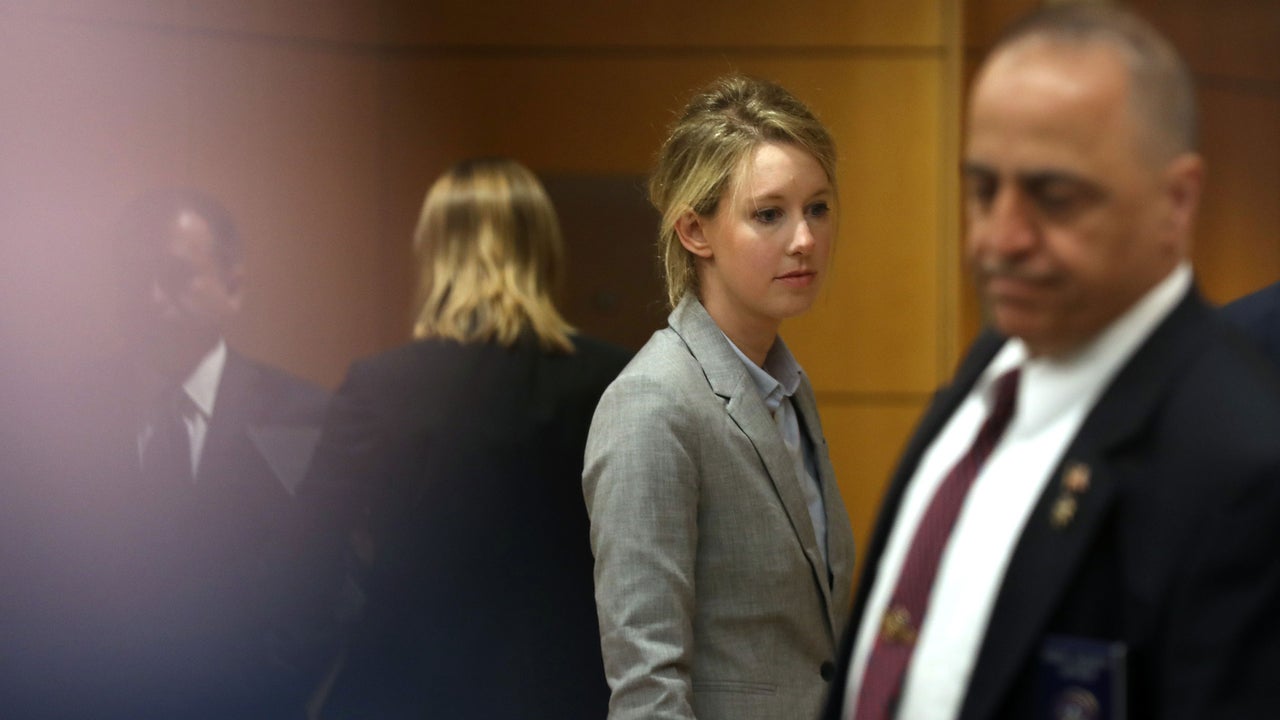
Thirty-four days before reporting to federal prison, Elizabeth Holmes opened her private life to a film crew. Nathan Fielder and Lance Oppenheim kept filming for about three years, and the result, You Can See Everything, opened in theaters this month to huge box office and wide acclaim. The title echoes a scene in which Holmes and her partner, Billy Evans, promise the camera it can indeed see everything.
The film invites a true-crime reading. But as someone who builds agentic customer experiences for brands, I see a story about how trust is won and what happens when the product can’t justify it. Theranos was a brand long before it had a working product, and every signal it sent said the same thing: Trust us. The product couldn’t back any of it up. That should worry anyone writing a brand promise right now, especially one about artificial intelligence.
Borrowed credibility runs out
Theranos collected trust the way some brands collect logos. In 2014, Fortune described its board as three former cabinet secretaries, two former senators, a retired Navy admiral, and a retired Marine general. Holmes wore the black turtleneck and called her invention the iPod of health care, and the Steve Jobs comparisons followed.
Each of those signals lent credibility. None of them created it. Borrowed trust works like a loan; the product eventually has to repay it, and when it can’t, the brand pays. Any brand that leans on a famous partner, endorser, or technology name to carry a claim should ask what happens the day the product gets examined on its own.
That test applies to my firm too. Apply has strong partnerships with Google Cloud, Anthropic, Amazon, and OpenAI, and we are proud of them. But a partner’s name is a foundation, not proof. Make every agency, including mine, prove what it can deliver.
Access isn’t proof
An open door is different from openness. Anyone can offer to show you everything and still control what you see. Brands do the same thing when they treat transparency as a performance: the trust page, the responsible AI statement, the demo built to be watched. A responsible AI page that lists principles but names no owner is a good test. If no one can say who answers for the claim, the page is merely decoration.
Ask to see everything, and ask to choose what you see; unscripted, on your own data, including the failure log. Real transparency shows you where the product falls short as clearly as where it shines.
The AI version is already here
In many agencies, using AI means people are using ChatGPT or Claude on top of the same delivery workflows they ran before. That is a faster tool inside the same process, good for a 20%-30% efficiency gain. Calling it AI-native or agentic makes the claim bigger than the change.
At Apply, we rebuilt our delivery model to be agentic-native on a proprietary platform and trained our entire workforce to work that way, instead of adding AI on top of the old workflow. I’d encourage you to ask every agency you hire what, specifically, they changed. Reimagining the model, not just the tools, is where 20%-30% can become 20x-30x.
Brands are making AI claims their products can’t support yet, and agencies like mine are helping write them. “Autonomous,” “agentic,” and “AI-powered” are easy to write and hard to back up. I’m not calling any brand a fraud. Building these systems means seeing what they can and can’t do the day after the demo.
How the gap becomes normal
After the space shuttle Challenger disaster, the sociologist Diane Vaughan described what she called the normalization of deviance: Small departures from what is safe get accepted one at a time until they are simply how the work is done.
AI claims drift the same way. The first time, the copy says “autonomous” when a person still handles the exceptions, and nothing goes wrong. The next campaign borrows the wording. By the third, the gap between the claim and the product is just the house style. I wrote about this in the context of AI governance. The people closest to the work are often the first to see the gap and the least likely to say so. Ask your agency to tell you where the work falls short before it ships.
Pressure-test the promise before it goes out
Before any AI claim goes into your campaign, ask your agency three questions.
- Can you show it working in production, failures included? Ask for evidence from real data and real workflows, including what went wrong.
- Whose name is on it? Put one person’s name behind the claim and the results that support it. People ask harder questions when they know they’ll have to answer for the outcome.
- What happens when it fails? Be clear about where the system needs human help, and make sure the promise reflects that limit. Test the handoff before launch, or your customers will be the first to find out where it breaks.
We hold ourselves to the same questions. At Apply, our teams are about half people and half agents. The agents extend the people, and every deliverable has a named human owner. That works only because accountability is assigned before the work begins, which makes it human ownership, a step beyond a human in the loop. We’re still learning.
Before a claim reaches a customer, someone has to ask the hard questions and have the authority to act on the answers. At Theranos, those questions were ignored, and an employee who raised concerns was met with legal pressure to stay quiet. A brand earns trust by making sure the evidence shapes the promise, rather than letting the promise outrun the evidence.