Close Menu
    Facebook X (Twitter) Instagram
    TRENDING :
    • Indiana Hoosiers’ college football championship by the numbers
    • How anti-doomscrolling influencers are combating social media addiction
    • Millionaires are sounding the alarm about democracy — and blaming people like themselves
    • 5 ways to finish what you started, according to a productivity expert
    • 5 reasons why you should laugh more and not take yourself so seriously
    • Market Talk – January 20, 2026
    • How to build your deep reading and critical thinking skills to better resist misinformation
    • The new ‘Be The People’ campaign wants to turn hundreds of millions of Americans into problem-solvers
    Compatriot Chronicle
    • Home
    • US Politics
    • World Politics
    • Economy
    • Business
    • Headline News
    Compatriot Chronicle
    Home»Business»The Trump administration just gave the food pyramid a Sweetgreen makeover
    Business

    The Trump administration just gave the food pyramid a Sweetgreen makeover

    January 7, 20263 Mins Read
    Share Facebook Twitter Pinterest LinkedIn Tumblr Telegram Email Copy Link
    Follow Us
    Google News Flipboard
    Share
    Facebook Twitter LinkedIn Pinterest Email


    President Donald Trump’s administration has introduced a new, inverted food pyramid with fewer food groups.

    The new three-section food pyramid is part of the administration’s new nutrition policy announced Wednesday, which encourages Americans to eat whole or minimally processed foods, which it calls “real food,” and has been a long time interest of Health and Human Services Secretary Robert F. Kennedy Jr.

    Kennedy’s policy interests also shine through on the initiative’s new website, realfood.gov, which features copy that reads like a MAHA manifesto. The National Design Studio gave the website a minimalist design that takes cues from consumer companies like Chobani and Sweetgreen, with clean, sans serif typefaces and playful illustrations.

    The new pyramid

    The original pyramid, released by the U.S. Department of Agriculture (USDA) in 1992, featured six sections. The new version is flipped and has three: protein, dairy, and healthy fats; vegetables and fruits; and whole grains. Sweets have been removed.

    [Image: USDA]

    “It’s upside-down, a lot of people would say,” Kennedy said at a White House press conference. “But it was actually upside-down before, and we just righted it.”

    The new pyramid graphic makes do with fewer groups by combining categories from the original food pyramid. Whole grains, once included in the base of the original pyramid, now make up the smallest portion of the new version, while old categories—fruits and vegetables, and meat and dairy—are combined.
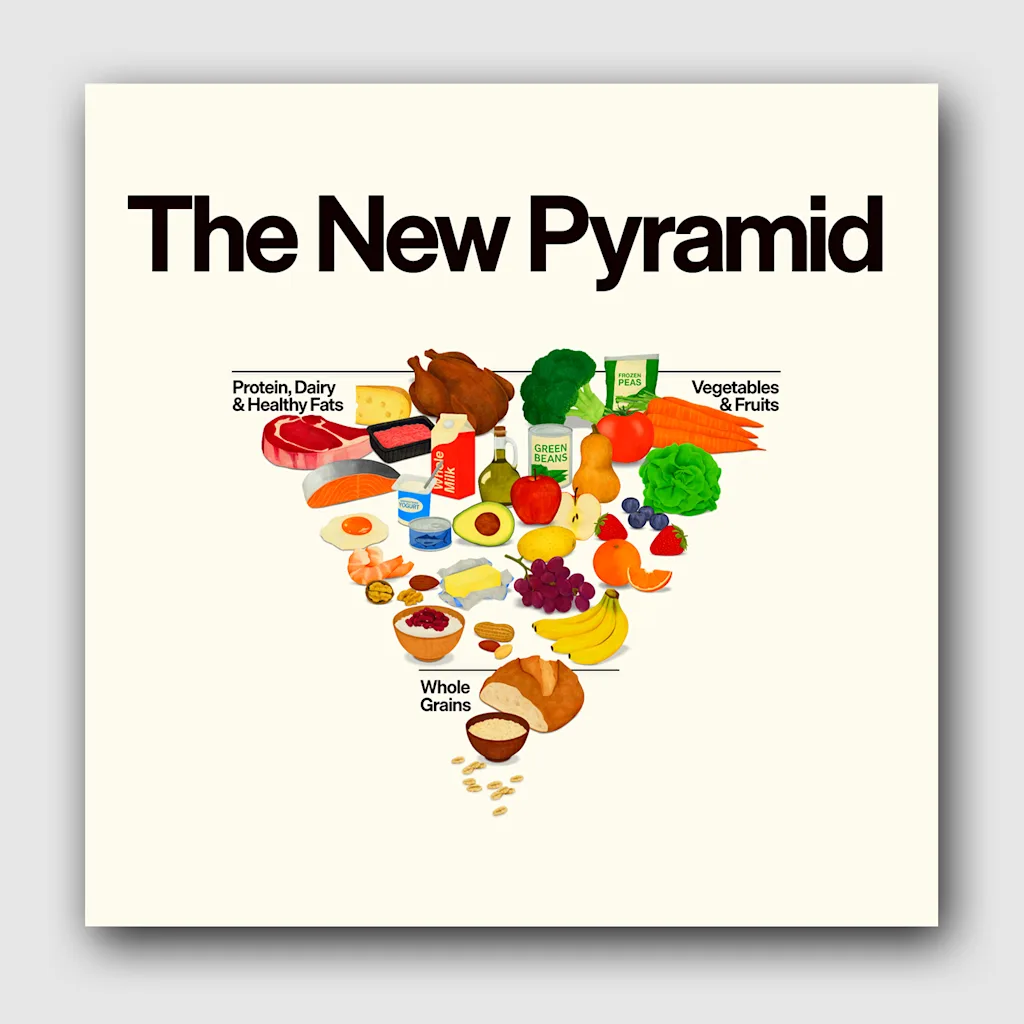
    [Image: USDA]

    The graphic is colorful, with eye-catching, painterly illustrations of example foods that might appear in a 1970s health food magazine. But the infographic is less successful as a piece of communication design. It’s not clear how literally the placement of foods within the graphic is meant to be. And although supporting documents about the new pyramid offer specific guidelines, like suggesting saturated fat consumption shouldn’t exceed 10% of total daily calories, the new pyramid doesn’t communicate specifics itself.

    Users can hover over each section of the pyramid for additional information, but it doesn’t provide much. The pyramid doesn’t indicate how many servings of dairy or healthy fats you should have. And to determine your protein target, realfood.gov asks Americans to take on the additional step of first calculating their weight in kilograms. (Quite frankly, we don’t know what that is.)

    The federal government’s new guidance, which gets updated every five years, also removes specific recommendations about daily alcohol consumption and only suggests to drink less. It also calls for more protein and full-fat dairy.

    Government designers have worked to improve upon the food pyramid before. In 2005, an updated graphic made the food segments slice upwards instead of dividing the shape horizontally. In 2011, it ditched the pyramid altogether for MyPlate, a skeuomorphic representation of dietary guidelines that used a circular graphic to represent portions as they’d appear on a plate.

    The new 2026 pyramid represents the Trump administration’s “Make America Healthy Again” priorities under Kennedy’s Health Department and comes two days after the agency cut its number of recommended vaccines for children, worrying medical groups.

    The new recommendations are not meant to be a strict diet, according to its website, but “a flexible framework meant to guide better choices.” It’s minimalist, for sure, but whether Americans find it a useful guide to healthy living remains to be seen.


    Source link

    Share. Facebook Twitter Pinterest LinkedIn Tumblr Email

    Related Posts

    Indiana Hoosiers’ college football championship by the numbers

    January 21, 2026

    How anti-doomscrolling influencers are combating social media addiction

    January 21, 2026

    Millionaires are sounding the alarm about democracy — and blaming people like themselves

    January 21, 2026
    Top News

    Boris Johnson Urges Ukraine To Continue War

    By Staff WriterNovember 25, 2025

    Trump’s proposal for peace in Ukraine has been met with an overwhelming condemnation from the…

    Marjorie Taylor Greene is resigning from Congress after falling out with Trump: See video announcement

    November 22, 2025

    People “Are Tired of Backroom Decisions”: A Conversation With Minneapolis’s Omar Fateh

    September 5, 2025

    US in talks over 10% Intel stake, White House confirms

    August 20, 2025
    Top Trending

    Indiana Hoosiers’ college football championship by the numbers

    By Staff WriterJanuary 21, 2026

    The state of Indiana is no stranger to underdog stories. Hoosiers and Rudy,…

    How anti-doomscrolling influencers are combating social media addiction

    By Staff WriterJanuary 21, 2026

    It’s simple to accidentally become entranced by an endless loop of videos…

    Millionaires are sounding the alarm about democracy — and blaming people like themselves

    By Staff WriterJanuary 21, 2026

    As wealth inequality widens and billionaires become increasingly enmeshed with politics, the…

    Categories
    • Business
    • Economy
    • Headline News
    • Top News
    • US Politics
    • World Politics
    About us

    The Populist Bulletin serves as a beacon for the populist movement, which champions the interests of ordinary citizens over the agendas of the powerful and entrenched elitists. Rooted in the belief that the voices of everyday workers, families, and communities are often drowned out by powerful people and institutions, it delivers straightforward, unfiltered, compelling, relatable stories that resonate with the values of the American public.

    The Populist Bulletin was founded with a fervent commitment to inform, inspire, empower and spark meaningful conversations about the economy, business, politics, inequality, government accountability and overreach, globalization, and the preservation of American cultural heritage.

    The site offers a dynamic mix of investigative journalism, opinion editorials, and viral content that amplify populist sentiments and deliver stories that echo the concerns of everyday Americans while boldly challenging mainstream narratives that serve the privileged few.

    Top Picks

    Indiana Hoosiers’ college football championship by the numbers

    January 21, 2026

    How anti-doomscrolling influencers are combating social media addiction

    January 21, 2026

    Millionaires are sounding the alarm about democracy — and blaming people like themselves

    January 21, 2026
    Categories
    • Business
    • Economy
    • Headline News
    • Top News
    • US Politics
    • World Politics
    Copyright © 2025 Populist Bulletin. All Rights Reserved.

    Type above and press Enter to search. Press Esc to cancel.