
You’ve probably encountered the term uncanny valley somewhere or other. The concept refers to the feeling of discomfort one has when coming across some android representation—a robot, perhaps, or an AI-generated face—that looks remarkably human, but not quite. A robot can be cute, but if it looks similar to us, and we’re almost hoodwinked, it actually strikes us as off-putting. Consider your eerily sentient discussions with ChatGPT, or Tom Hanks’s CGI avatar in The Polar Express.
I would like to offer the world a less important but related phenomenon: the uncomfortable valley. The uncomfortable valley is the effect one experiences when presented with some kind of image, and there’s an uncomfortable gap between normal-looking and absolutely insane. Normal-looking is fine, like the classic typed emoji face (i.e., :), for the elderly and otherwise uninitiated). Insane-looking, like the Pixar Minions, is also fine, because the face is so weird you’ve accepted there’s something purposely ironic, strange, or otherworldly being presented to you.
What’s not fine is something that is super close to, but hasn’t passed the threshold of, being totally wacky, leaving you stuck wondering whether what you’ve sent is actually weird or if you’re just overthinking it.
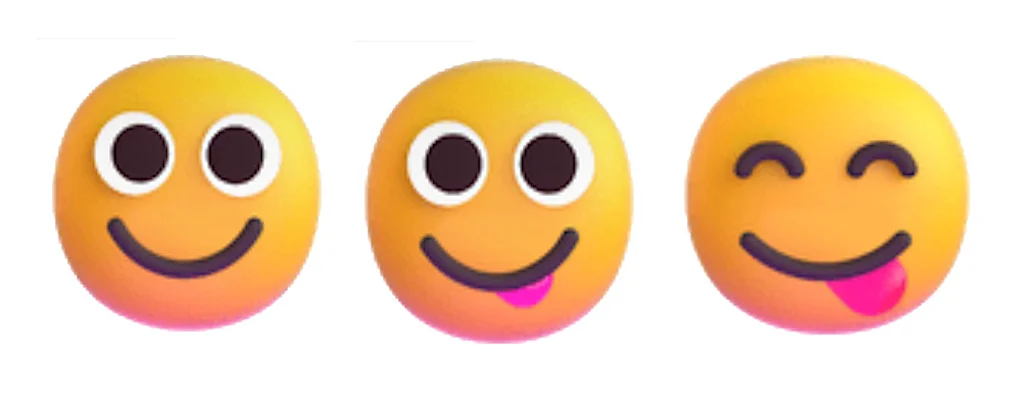
I now humbly nominate the emoji reactions available on Microsoft Teams as the nadir of this uncomfortable valley. Let me explain with a case study: the tongue-out emoji. The tongue-out emoji is used to convey playfulness. When I type a sarcastic message to my boss, I am okay with :P. There are no extra frills; it merely suggests a trite “haha” or “joking” tenor to whatever message I’m sending (as an example: “I am definitely going to submit this assignment on time :P”). I am fine with what Slack, a competitor to Microsoft Teams, produces when I type this.
But Teams produces animation that transitions among the following expressions, grinning stupidly and then appearing to maybe lick its lips, before completing its sequence with a final tongue out:
Now, I ask, why in the world would I ever want to send something like this to my boss? More than once, I’ve typed :P, watched this animated face render and lick its lips, and then deleted the message entirely, suddenly unsure whether this is really the tone I want to send.
Which raises a larger question: What is an emoji for, anyway? With friends, it can mean anything. Irony! Earnestness! Jokes! On dating apps, emoji are for stating (obvious) subtext. At the workplace, however, the status of emoji is fraught. Faces, of course, are meant to express emotion, but it’s well-established that you should not be bringing your full self—or the full range of your emotions—to work.
In the professional context, it seems like emoji reactions should exist to add at least a little texture to the flatness of late capitalist keyboard communication. A smiley face makes a request for help sound a little less blunt, a tongue-out emoji reminds your manager that you’re emotionally well-adjusted, if perhaps a little quirky. It’s a critical component of the 21st-century social contract: Yes, we’re all here, stuck typing away at our desks, completing labor somewhere deep in some corner of the cloud, but we are still human.
The problem with Microsoft Teams emoji is that they do not accomplish this at all. The Teams “smiling” face is childlike, innocent, and too smug about it. Also, it’s blinking, which is an unnecessary action overloading my already too-busy Teams chat interface.
The “angry” face, which actually shakes in fury, cannot be taken seriously, but it has no irony, either. The sad face actually tears, which is a lot. The “thinking” face seems overly skeptical, and the “upside down” face seems to be having fun, when the whole point of this face is to express irony.
The “relieved” face is sweating so much it—he?—actually appears nervous. The “rolling on the floor” laughing face evokes maniacal. The “surprised” face seems too overwhelmed, and, in its brief animation, shudders in startlement. (Traditional punctuation for expressing surprise is better here. Just use a long line of exclamation and question marks: “!!!!??????!!??!!!?”).
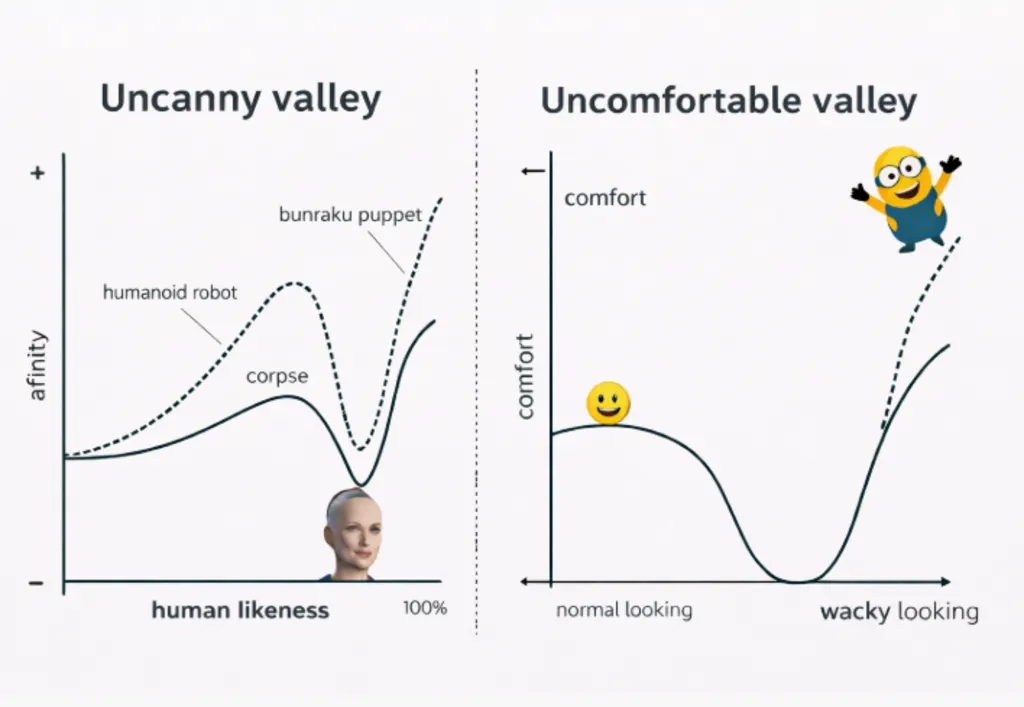
Another way of looking at the problem is that these cherubic visages are not simple enough to be an emoticon, which correlates to one emotion—like how 🙁 equals “sad,” and 🙂 equals “happy.” They are also not like Minions, which are fully developed characters, or Memoji, which represent the most important protagonists of all (ourselves). Rather, Microsoft Teams emoji are partially animated, half-alive things. Ids without egos. In Severance terminology, innies with no outies. In mine, a discarded draft of metaverse avatars.
I should say here that this is an opinion piece, and that my editor, who approved this story and agreed to publish it, actually likes the Teams emoji a lot. “I’d argue their zaniness brings a perfect amount of chaos to an otherwise staid corporate communication platform,” he tells Fast Company (in other words, me). I concede I am taking this way too seriously, but consider, for a moment, that there have been actual court cases, and at least one murder conviction, that have partially hinged on what an emoji might actually connote.
The stakes are high: Millions of people who use Teams could be misinterpreting messages because Microsoft did not consider affect theory.