
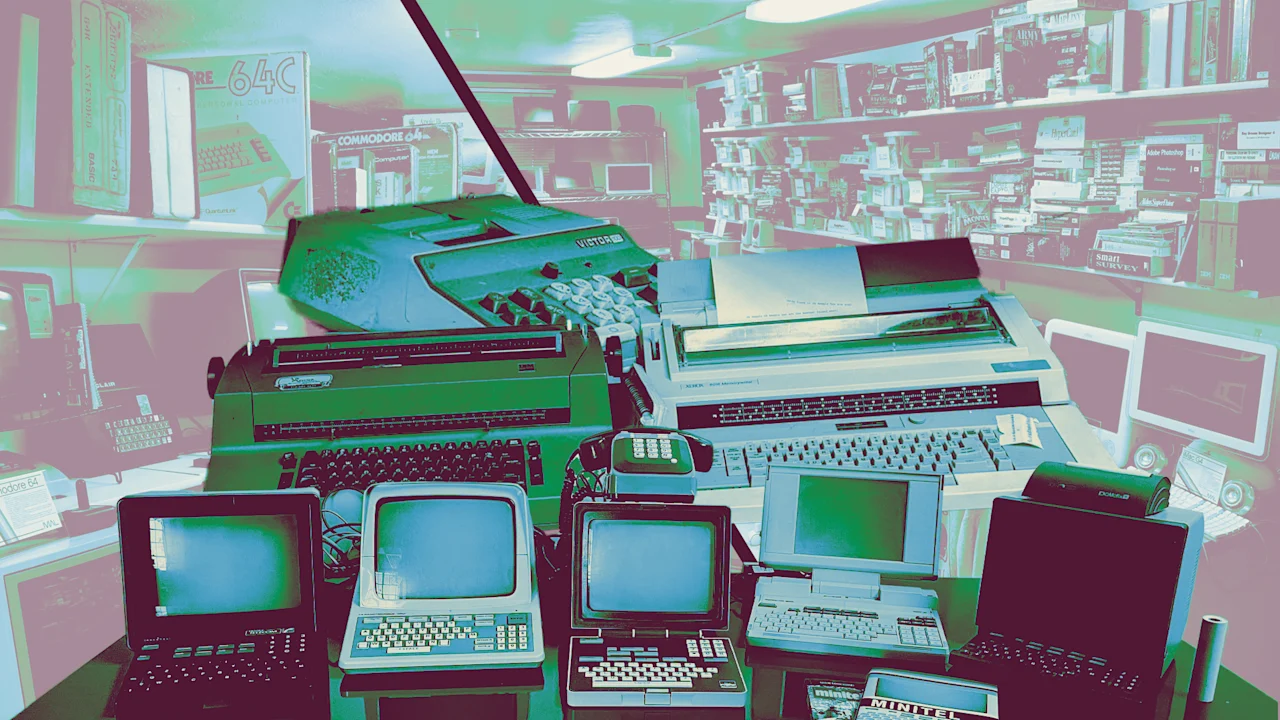
In 2021, University of Wisconsin-Milwaukee history professor Thomas Haigh began teaching a course on the history of computers.
Haigh, the coauthor of a book on the subject published around that same timenoticed that many classic histories of computing from the 1990s assumed that readers would have firsthand knowledge of technology from around that era—desktop PCs and Macs, early game consoles, and the once-ubiquitous floppy disk. But for many of his students, that equipment was obsolete before they were born. While it might make millennials grimace, Windows 95 and Nintendo 64’s GoldenEye 007 are now firmly in the purview of the history department.
“With today’s undergraduates, they’re just as distanced from the days of the Apple II, or the IBM PC, or the first Mac as people [then] were from ENIAC and the very earliest computers,” Haigh says.
Haigh can’t practically show his students how to use the ENIAC or the other room-sized machines from the mid-20th century. But he realized he could stock a lab with equipment from the 1980s, 1990s, and 2000s, letting students experience and understand what it was like to load a spreadsheet from floppy disk on an Apple IIe, boot up Windows on a Gateway PC, or play a game on a vintage Atari or Nintendo 64.
“The idea isn’t to collect one of everything, and it’s also not really to collect rare and exotic things,” Haigh says. “We’re more interested in recapturing what the typical experience was of using computer systems in different eras.”
Haigh believes the Retrocomputing Lab, or simply Retrolab, may be the only such lab run out of a U.S. history department. It’s one of a handful of university labs around the country that provide students and researchers with access to machines and software from before the age of ubiquitous internet and cloud computing. It’s stocked with a mix of eBay purchases, university surplus, and faculty hand-me-downs (meaning students are sometimes greeted with the names of users from decades gone by when they load vintage operating systems or floppy disks). Lab organizers say the labs help students and researchers understand how computing and communication technology has evolved, both for better and for worse—and help them use ideas from the past to understand and shape what the future of tech might be.
“What I’ve noticed, especially in the last year, is that young people are just fascinated and utterly compelled by typewriters, by technology that they can see into, that they can understand how it works, that they sometimes can open up,” says Lori Emerson, founder of the Media Archaeology Lab (MAL) at the University of Colorado Boulder. “And especially the pieces of tech that we have in the lab that’s not connected to the internet, that’s not surveilling them, tracking them, collecting data. “
It’s something that emulation, which can make it possible to use vintage software and games on modern equipment, doesn’t fully capture. Emerson founded the lab in 2009 while working as a professor in the English department and teaching students about a digital poetry project called First Screening, released on floppy disk in the 1980s by the celebrated Canadian poet bpNichol. Emerson wanted to show students how the poems would have been seen on the computers of their day. The lab she set up for that purpose continued to expand, ultimately growing into a sprawling collection that’s now available for use by students, visiting researchers, and curious members of the public.
“I think that was pretty much the beginning of the end for me as an English professor,” says Emerson, now a professor in the media studies department. “And then I just couldn’t stop collecting old pieces of technology, and I couldn’t stop convincing people to give me their things.”
Even with commercial software, the tactile experience of using particular keyboards, mice, and disks, and the entire concept of unpacking disks and manuals from a store-bought box, just can’t be simulated.
“One of the things that surprises students is that software used to come in a box full of manuals and stuff,” Haigh says. “They just think of software as this purely immaterial thing that downloads.”
Emma Culver, a Ph.D. student in UW-Milwaukee’s media, cinema, and digital studies program, says she discovered installing and playing The 7th Guest—a 1993 DOS horror adventure that helped pioneer the use of the CD-ROM for full-motion video and inspired a generation of game designers—was far from smooth, experiencing firsthand the trial-and-error frustrations of PC gaming in that era.
“And it’s much more satisfying once you actually sit down to play it after you’ve been through all that effort to set it up,” she says.
But though today’s students will likely play a role in the next steps in technology’s evolution, it’s not clear whether they’ll be able to show future generations the technology they currently use. That’s because over the past decade or so, software has become dependent on connections to cloud servers, AI models, or online gaming infrastructure can’t easily be archived in fully operational form.
“In the future, once systems aren’t there to activate copies and download patches and so on, none of this stuff is still going to be accessible unless enthusiasts do a huge amount of work to replicate parts of that system,” Haigh says.
But for now, universities are working to share and preserve what they can of the digital past. At Georgia Tech, a similar retroTECH program run out of the university library similarly helps archive and share with students vintage technology from the slide rule to millennial favorites like The Oregon Trail and early Mario Kart offerings. Games for historic consoles are a big focus, especially since they were released as static products rather than updated and patched over time like PC games, says digital accessioning archivist Dillon Henry. Students are sometimes “intrigued by” how quickly cartridge-based games could load compared to today’s releases, and the games are often accompanied by print gaming media of the day, so students can see how they were advertised and promoted in outlets like Nintendo Power.
The library has hosted informal gaming nights, but it’s also seen plenty of use by students in classes looking at everything from interactive narrative storytelling to game design. Engineering students also learn to fix the vintage machines.
“It’s a win-win, because you can’t go to an Apple Store today and ask them to fix your Apple II,” Henry says.
They’re also inspiring students to make their own creations. One student brought classmates from a game design class to the lab to study elements of Final Fantasy IX9 (released for the original PlayStation in 2000), Henry recalls, and visitors are also often intrigued by the evolution of video game interfaces and forgotten elements of the industry’s history. The collection includes technology like the Virtual Boy, a famously odd Nintendo VR system from the mid-1990s, and the Fairchild Channel F, which introduced the concept of removable cartridges and featured a unique, joystick-like controller.
“Now controllers are getting more or less standardized,” Henry says. “It was kind of a Wild West there at the beginning of the gaming world, when people were just trying stuff that hadn’t been done.”
The retroTECH program’s vintage material isn’t all computer-based. The library has an Edison wax cylinder phonograph from 1902 and a set of blank cylinders, and Henry hopes in the future to work on recording projects based around the medium, perhaps in conjunction with the university’s celebrated music technology program.
Historic technology is also a creative medium at CU Boulder. The Media Archaeology Lab has hosted a residency series that’s attracted artists creating work with the equipment, and seen musicians perform using vintage music software and computerized keyboards on site. The lab has also recently begun acquiring typewriters and other historic printing and copying equipment, and Emerson and lab managing director Libi Rose Striegl plan to offer zine-making workshops in the near future. Students weary of AI and cloud computing have generally been showing an interest in technology from before the age of the always-on internet, Emerson says.
“A theme that’s been coming up recently is that they say, ‘I feel like my mental health would be a lot better if I used these machines,’” she says. “And we laugh, but we’re also like, ‘yeah, it probably would be.’”