
We’ve been expecting the tsunami of AI-generated videos ever since we first got a taste of AI’s image-making abilities several years ago. The results until recently were underwhelming. But now our social feeds are awash in increasingly realistic AI-created video. OpenAI, Meta, and Google have entered the game.
At the end of September, Meta introduced Vibes, an AI-only video feed, in the newest version of its Meta AI app. It allows users to share videos created by the company’s generative tools in the Meta app, as well as on Facebook and Instagram. Five days later, OpenAI unveiled its Sora app, which, beyond creating videos from a prompt, is focused on allowing users to insert themselves, their friends, and even public figures who allow it into hyperrealistic scenarios.
More than any other challenger—even Google’s Veo3, which the tech giant launched over the summer and quickly integrated into YouTube shorts—Sora is positioning itself as the TikTok of AI, leaning heavily into the ability for users to have a fully synthetic version of themselves to appear in their content. The app quickly shot to the top of Apple’s App Store, logging 164,000 downloads within 48 hours of launch.
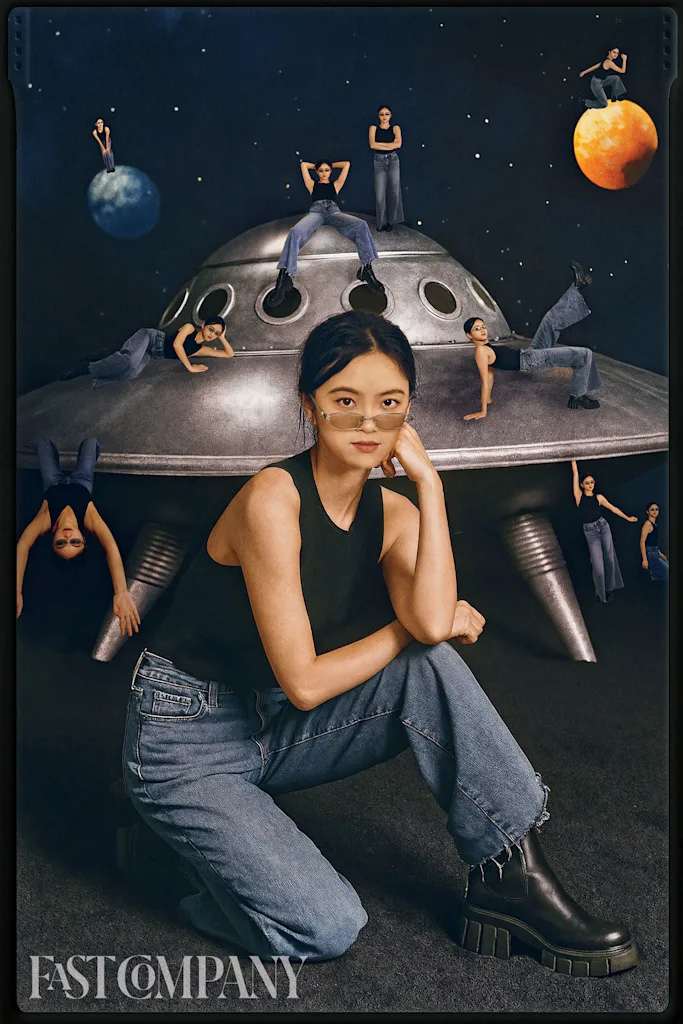
Sora’s playbook might be new to the tech world, but it’s familiar to Demi Guo, the 26-year-old founder of the AI video company Pika, whose vision for the trajectory of social AI video predicted the current moment.
Launched in November 2023, Pika is known for its Pikaffects app, which offers users a library of viral AI video effects. They include the straightforwardly named “Squish It,” which turns the subject of a video or photo into a squishy toy manipulated by a pair of AI-generated hands, and “Cake-ify It,” which slices up a subject and gives it the innards of cake. The company is so committed to its vision of letting users insert themselves into shareable scenarios that it launched its own social video creation app, Pika: AI Video & Trend Maker, at the end of the summer.
“We really believe AI will be the next way for people to express themselves and will define the next social platform,” Guo said the day after Sora launched. “That’s the reason we launched our app two months ago.”
With a $470 million valuation, Pika is a smaller, but prophetic player in AI video. Guo’s next move could offer another glimpse at the future of the fast-moving industry.
Matan Cohen-Grumi remembers the first time he experienced “the squish.”
The founding creative director of the generative AI video platform Pika was playing around with a new suite of effects the company had just come up with. One tool took an image and made it look like two sets of fingers were literally squishing the subject—be it a cat, a cup, or a person’s head—in a delightfully (and terrifyingly) realistic way, complete with scrunching sound effects.
“There was something very surprising about it,” says Cohen-Grumi, a former TV and commercial director who first discovered the magic of generative AI in 2023, when he used Midjourney to make a short film for his (now defunct) rock band. “I remember saying to everyone, ‘I’ve been playing with AI for so long. I’ve never laughed so hard. I hope this will translate.’”
It did. When Pika released its Pikaffects tools in October 2024, the internet was flooded with metamorphosing bicycles, pets, and body parts. Tattoo artist Christopher Miranda’s video of what appeared to be a knife cutting into a man’s tattooed head, revealing a yellow layer cake inside, received 1.9 million views on Instagram. Even brands got in on the fun: Fashion house Balenciaga posted a video squishing one of its 6XL sneakers, racking up nearly 20,000 likes on Instagram. Pika says the virality of the new tools translated into an 800% increase in users.
The success of Pikaffects was an “aha” moment for the company. Cofounded in April 2023 by Guo and Chenlin Meng, who dropped out of Stanford’s artificial intelligence PhD program to start Pika, the company was originally focused on being a tool for professional-quality video. But now it saw an opportunity to become the go-to AI platform for the TikTok crowd focused on social-media-friendly templates for easily shareable short videos.
This approach allowed Pika to distinguish itself from the longer-form tools, aimed at more professional creators, from companies like Midjourney, Runway, and Luma. With its ready-made library of special effects and videos that average only about 7 seconds, Pika would go after Gen Z social media users looking to create—or at least join—the latest viral trend.
Pika was early to chart a path for its video-generating tools on social media. But it’s no longer alone—and its rivals are substantially better resourced. Beyond billion-dollar coffers, companies like Google also have access to their own social media platforms that they can use to mainstream their AI tools.
Google did just that when it began integrating Veo 3 into YouTube Shorts in July, reaching the platform’s 2 billion monthly users. Vibes users can share across Meta apps, and while Sora videos can be downloaded to share elsewhere, OpenAI is positioning the app as a platform that can stand alone.
How long Pika will be able to stand alone in an increasingly crowded corner of the AI industry is an open question. (There were rumors over the summer of a possible Facebook acquisition—which Vibes seems to have put to rest.) Pika’s nearly half-billion-dollar valuation is not on the scale of Runway, which is valued at $3 billion and is expected to generate $300 million in 2025, let alone OpenAI.
With monthly subscriptions that start at $8 and go up to $76, Guo will say only that revenue is in the “eight figures.” But the company has a respectable 16.4 million registered users, and average monthly active users across the web and mobile apps totaled 1.4 million in the first half of 2025. However, the company says fewer than a quarter million of them are paying subscribers. As it looks to grow, Pika’s challenge will be continuing to spawn irresistible social-friendly effects that users can’t find elsewhere.
Following the success of Pikaffects, the company has doubled down on creating templates geared to making short, meme-friendly videos that can be quickly shared on TikTok and Instagram without requiring any AI skills. Over the summer, Pika gave users a new thrill by offering the ability to Labubu-fy an image into the adorable furry-eared beast that has been all the rage with Gen Alpha.
Ben Woods, a creator-economy analyst with MIDiA Research, says Pika’s approach is a smart response to the “tyranny of creative possibilities” that AI tools impose on users. Most AI video generators “give us that blank box and say ‘Create whatever you want.’ But some consumers come to that and don’t know what to create,” he says. “There’s too much possibility.” Pika’s templates help winnow those possibilities.
Pika’s social-first messaging isn’t subtle. Last May it released a provocative brand film dubbed Pikapocalypse. It featured a young woman using the app to inflate her cat, turn a potted flower into a balloon, and transform a pile of clothes into butterflies—oblivious to an apocalyptic wasteland outside her window. Guo says the point of the video was to underscore how, with AI platforms, “people create their own reality.” It generated buzz in part for toying with the idea that this alternate reality can itself be a mindless, self-insulated hole.
The company garnered more attention in June, when Adobe integrated Pika’s tools into its generative AI app Firefly—targeted at video professionals and social creators—along with other video models, including Veo 3, OpenAI’s Sora, and Luma. Alexandru Costin, vice president of generative AI at Adobe, sees Pika as a dynamic means of creating social content. “Pika offers a unique type of model with a unique personality,” he says.
One issue that Pika will have to wrestle with is cost. The company’s free version of Pikaffects has been criticized for being laggy—and because it allows users to make only a limited number of videos, users often find themselves needing to upgrade to a paid version, which starts at $10 per month. Meanwhile, Pika’s new Sora-like social app has a standard paid tier for $95.90 per year and an “artist” tier for $389 annually.
For younger kids and teens to be interested in Pika, “it would almost have to be completely free to use because you’re not going to see kids and teens paying those prices for videos,” said Kai Turner, a former Netflix and Sony executive who focuses on generative AI video. Cost is, at least for now, not a factor with Sora and Vibes. Both are currently free, though ChatGPT Pro users have access to an experimental Sora 2 Pro model that isn’t in wide release.
Guo acknowledges this challenge, saying that Pika is “brainstorming different monetization models,” including offering certain premium features for a cost while greatly lowering the price for basic users. At the same time, the social video creation app shows that Guo is pushing ahead with a wider vision for Pika than just viral tools. That puts her in more direct competition with Sora and others—which might be a harder space in which to carve out a niche.
MIDiA’s Woods says Pika’s strength remains its ability to cull the endless possibilities of AI video into easy-to-use, viral-ready features. “OpenAI now is positioning itself to compete with TikTok and Youtube, as opposed to being an AI creator tool app, which is still what I see Pika as,” Woods says.
Guo notes that Sora’s launch brought a spike in downloads of Pika’s app, though she doesn’t specify how many. And despite her having predicted this moment for AI video, she still seems to be figuring out her next moves. (In a conversation the day after Sora’s launch, Guo noted that the company’s user base skews female—something she seems ready to lean into, though she didn’t detail how.)
One thing Guo is clear about: She doesn’t want her app associated with the “AI slop” that’s invading social platforms and blurring the lines between fact and fiction. “Our app is not just about random videos, slop videos—it’s really about yourself, your identity,” she says, noting that Pika focuses on letting users center themselves in their own creations. It’s an idea that also animates the new Sora app and its cameo-based videos.
“I think there’s a chance that Open AI was potentially inspired by this idea to bring a user’s identity inside their app as well,” Guo says. “It’s very validating that a big company like OpenAI also realizes that. We’re really proud to be an underdog in the space—and the first to inspire everyone.”
A version of this article appears in the Fall 2025 print edition of Fast Company.