

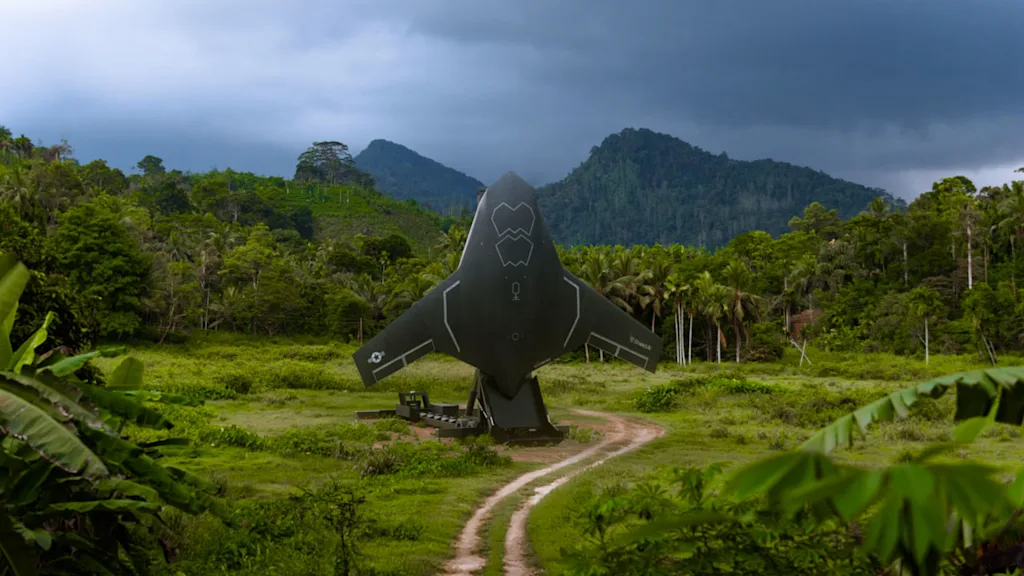
San Diego-based Shield AI is developing a first of its kind fighter jet: a 2,000-mile-range pilotless plane that takes off and lands vertically and uses artificial intelligence to fly itself, even when adversaries jam navigation and communication systems.
Like the company’s smaller, combat-tested autonomous drone, the V-BAT, the X-BAT doesn’t need a runway, allowing it to launch from remote islands or the decks of aircraft carriers or drone ships. But with its larger blended wing body design, the X-BAT can carry missiles and electronic weapons. Instead of propellers, it’s powered by an afterburning jet engine.
“Airpower without runways is the holy grail of deterrence,” said Brandon Tseng, Shield’s cofounder and president.
The aircraft could join a new class of AI-piloted fighter jets being developed for the Pentagon and other defense agencies, where the aim is to deploy robotic wingmen alongside human pilots or as part of separate drone squadrons. Taking their cue from the fierce drone war in Ukraine, military officials around the globe are eyeing layers of cheaper, more disposable AI-powered drones on air, land, and sea, with a single soldier responsible for an entire swarm. A separate race is on to field counter-drone systems.
Investors have followed suit, pouring cash into a range of defense-tech firms, including Shield rivals like Anduril, Helsing, and publicly traded AeroVironment, or AV. Globally, venture capital investment in defense companies surged to $31 billion last year, a 33% increase over the previous year, according to McKinsey. Anduril, founded in 2017, is the largest of the so-called “neo prime” contractors, with a valuation at around $30 billion. Shield, founded in 2015 and valued at $5.3 billion, is the next biggest defense startup. (Fast Company named it a Most Innovative Company in 2020.)
With the X-BAT, Shield joins a number of startups and legacy contractors developing AI aircraft that can match the capabilities of an F-16 but in a smaller form factor. Last month, Shield was picked by the Air Force to provide the AI software for the YFQ-44, Anduril’s entrant in the service’s Collaborative Combat Aircraft (CCA) competition.
Defense giant RTX was selected to build the software for the other drone prototype being considered by the Air Force, the YFQ-42, built by General Atomics. Both drones are roughly the same size as the 26-foot-long X-BAT, which is about a third as large as a conventional fighter jet.
The service has said it plans to choose a design for production by fiscal year 2026, and has indicated it may select multiple companies. Last month, Breaking Defense reported that the Navy had selected another set of drone designs by Anduril, Northrop Grumman, Boeing, and General Atomics for its own collaborative combat aircraft competition. The Army and the Marine Corps are also making plans for their own “loyal wingmen.”
Tseng declined to comment on Shield’s role in the current CCA program, or on the potential of X-BAT to enter a future competition.
Still, he said the aircraft’s price, at around $27 million, is “in the same range as the Collaborative Combat Aircraft programs, with variations based on mission systems and configurations.” That translates to about a tenth of the “cost per effect” compared to legacy fifth-generation aircraft, Tseng said.
X-BAT also represents “a major development” for Shield AI’s business,” the company said in a press release.
“We believe the greatest victory requires no war,” said Tseng. “To make that belief real, we’re executing a simple but ambitious master plan: Prove the value of autonomy, scale it across domains, and reimagine airpower. X-BAT represents the next part of that plan.”
Up and down
Shield AI’s plans have taken several turns in recent years. Founded in 2015 by brothers Brandon and Ryan Tseng and Andrew Reiter, the 1000-person company has sold hundreds of its V-BAT drones. But after it landed a $240 million funding round in March, Brandon told Bloomberg that the company would place more of an emphasis on its AI software, which had been a larger focus before it bought longtime V-BAT maker Martin UAV in 2021.
The company has generated billions of dollars in revenue, and had planned to reach profitability by 2025. But as Forbes reported in May, those projections were scrapped after a service member had his fingers partially severed during a V-BAT landing in 2023. Shortly before Forbes published its story, Ryan Tseng stepped down as CEO, and Gary Steele, a Cisco executive, took the helm. (Ryan became chief strategic officer and remains on the board of directors.)

Company officials have said they have taken a number of steps to address safety concerns, including adding unassisted launch and land capabilities to the V-BAT. The service member has since fully recovered.
“Today, V-BAT retains a perfect record of no injuries when following trained procedures,” Tseng told Forbes. While the accident “delayed” the decisions of prospective customers, “we are back on track now,” he said.
A human still in the loop
In recent months, Shield’s software division has entered partnerships with legacy defense contractors including RTX, Airbus and shipbuilder HII to incoporate AI into their vehicles and weapons systems. Shield’s Hivemind software—which grew out of Chief Technology Officer Nathan Michael’s research at Carnegie Mellon University, as well as AI startup Heron Systems, which Shield acquired in 2021—can help pilot vehicles ranging from attack drones to F-16s, helicopters and boats, operating individually or in swarms.
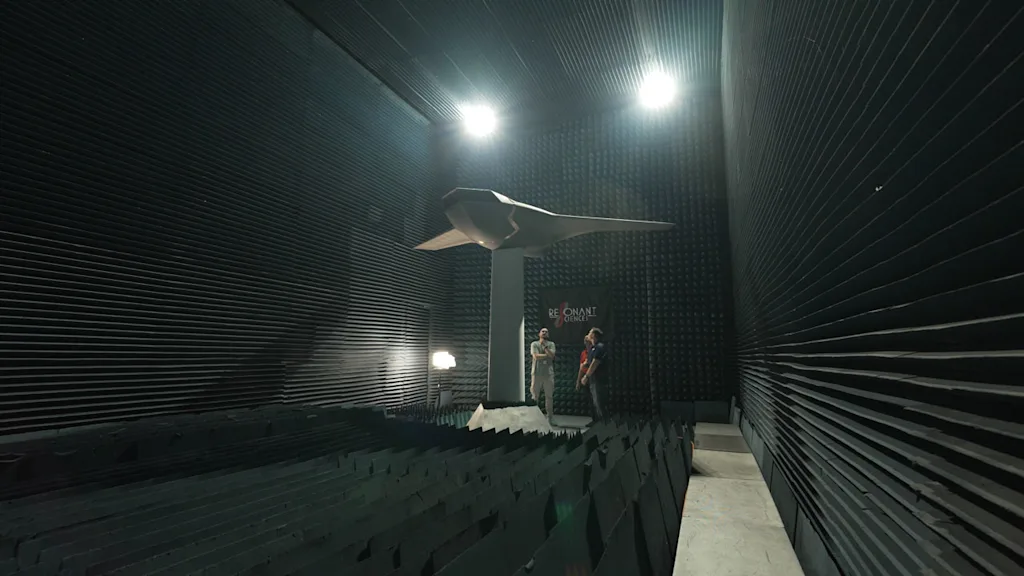
Last year, Air Force Secretary Frank Kendall flew in a test fighter piloted by Shield AI’s algorithms, taking on a manned F-16 in a simulated dogfight over the California desert.
“Shield AI aspires to service the autonomous needs for the defense sector, like Palantir services its intelligence needs,” Brandon Tseng told Bloomberg in March. (Shield also announced a partnership with Palantir last year, under which the firms would use each other’s software.)
Shield AI also continues to develop the V-BAT. The 9-foot-long drone, which can fly more than 80 miles and stay aloft for more than 13 hours, carrying a payload of about 40 pounds, has been used by Ukraine, Israel, and other countries to carry out reconnaissance and targeting operations. U.S. special forces have deployed the V-BAT, and the Coast Guard, which has a five-year contract with Shield AI worth $200 million, has used the drone with “joint forces” to “interdict billions of dollars’ worth of narcotics,” Tseng said.
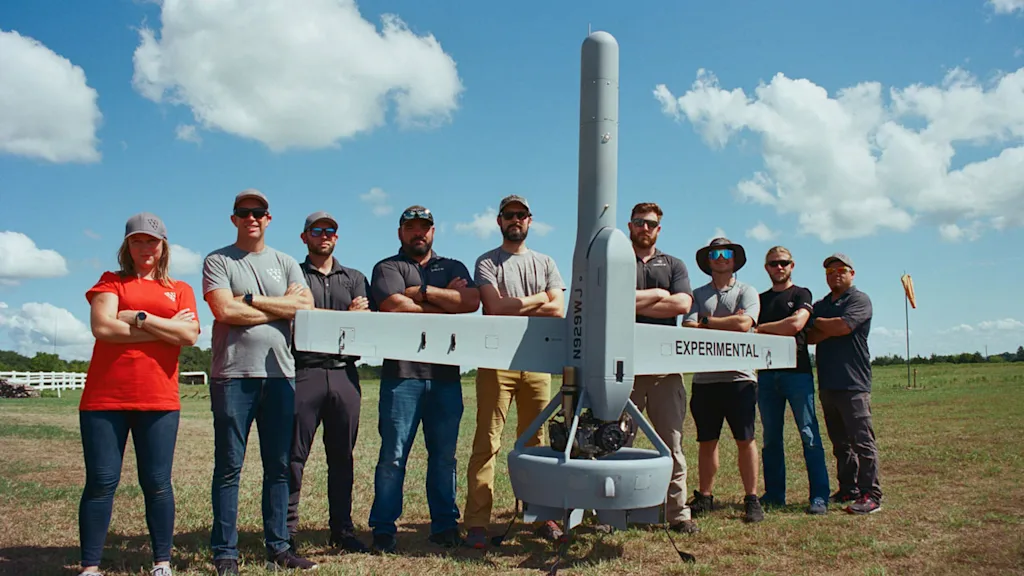
Through over 150 V-BAT deployments in Ukraine, the AI software has also been put through its paces in places where GPS and other communications aren’t available.
“You’re telling the aircraft, ‘hey, this is your zone of operations, we want you to do X-Y-Z in this area,’” Armor Harris, Shield’s senior vice president of aircraft, told The War Zone. And “given its last set of instructions and the rules of engagement for what it’s allowed to do, what it’s not allowed to do, it’ll go and it’ll continue its mission autonomously when those comms links are not there.” That capability is “where the system is more advanced than anything else in the world to date.”
Still, not everything is autonomous—yet. “Fundamentally [at] Shield AI, we believe that a human should be on-the-loop for an offensive kill decision,” Harris said.
All-out drone push
The Collaborative Combat Aircraft programs are part of an all-out push at the Pentagon (and in Silicon Valley) for AI and drones. In June 2025, President Donald Trump issued an executive order called Unleashing American Drone Dominance that aims to accelerate commercialization of drone technologies, and the administration’s budget request has allocated billions of dollars to unmanned systems and AI.
That includes an effort to onshore the supply chain for drones and the electronics and minerals they require, which is currently dominated by China. Shield AI has some experience here: In March, the Chinese Ministry of Commerce placed 15 U.S. entities, including Shield AI, on its export control list, barring them from the export of dual-use commodities.
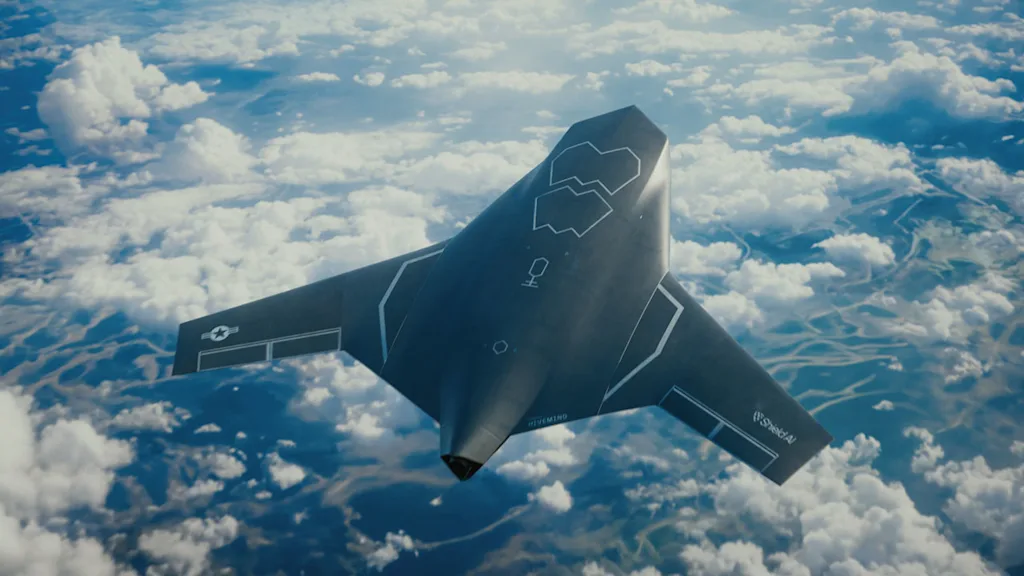
Shield is working with Pratt & Whitney and GE to develop the X-BAT’s jet engine. Company officials declined to share further details on the engine, or how it handles takeoff and landing. But Tseng pointed to subsystems built with “proven U.S. partners” to “ensure performance, reliability, and resilient American supply chains.”
Tseng said the company expects to conduct initial vertical takeoff and landing demonstrations for X-BAT as early as fall 2026, followed by all-up flight testing and operational validation in 2028.
As for possible X-BAT manufacturing sites, Tseng said, “we are in discussions with several states and their leadership.” And if some defense agency eventually places an order, he added, “the selected location will create thousands of jobs and generate billions in economic value.”