

For most of his career, Mike Kelland worked on software. But after selling his last startup in 2016, he decided to focus on climate change instead.
He zeroed in on one key part of the problem: Cutting emissions is no longer enough to address climate change on its own. He’d read an Intergovernmental Panel on Climate Change (IPCC) report that explained that we’ll also need to remove hundreds of billions of tons of CO2 from the atmosphere. “We’re 30 years beyond the point where decarbonization alone was enough,” Kelland says.
He spent nearly a year meeting with scientists to learn about potential new carbon removal technology, and eventually met a researcher working on ocean alkalinity enhancement—the process of adding alkaline minerals to the ocean to help it store more CO2. The method can also help reduce ocean acidification. But the tech was stuck in the lab.
“I said, this is the moment to take this and turn it into something,” Kelland says. In 2019, he cofounded Planetary, a startup focused on commercializing the idea. Now, at a site in Nova Scotia, the company is actively adding its “antacid” to the ocean.
Earlier this year, it sold independently verified carbon credits to British Airways, Stripe, and Shopify for CO2 that it had already removed. And in a recent deal, Frontier—a coalition of tech companies and others that are trying to help the nascent carbon removal industry grow— committed $31 million to buy more than 100,000 tons of carbon removal from the startup over the next four years. It hasn’t yet been tested at a large scale. But the goal is to scale up to remove gigatons of CO2—and do that at a very low cost.
How Planetary’s ocean antacid works
The method works by adding small amounts of minerals like lime (calcium oxide) or magnesium oxide into the ocean near the coast. Making the water more alkaline accelerates a natural process so the ocean can absorb more CO2 from the air. The CO2 reacts with the minerals to form bicarbonates that are dissolved in the water and can lock up carbon for thousands of years.
The company works with power plants and other industrial facilities that already discharge water into the ocean, and then adds its minerals via those existing pipes. “Our philosophy is really the more that we can reuse existing infrastructure, the cheaper and more scalable this is going to be,” says Kelland.
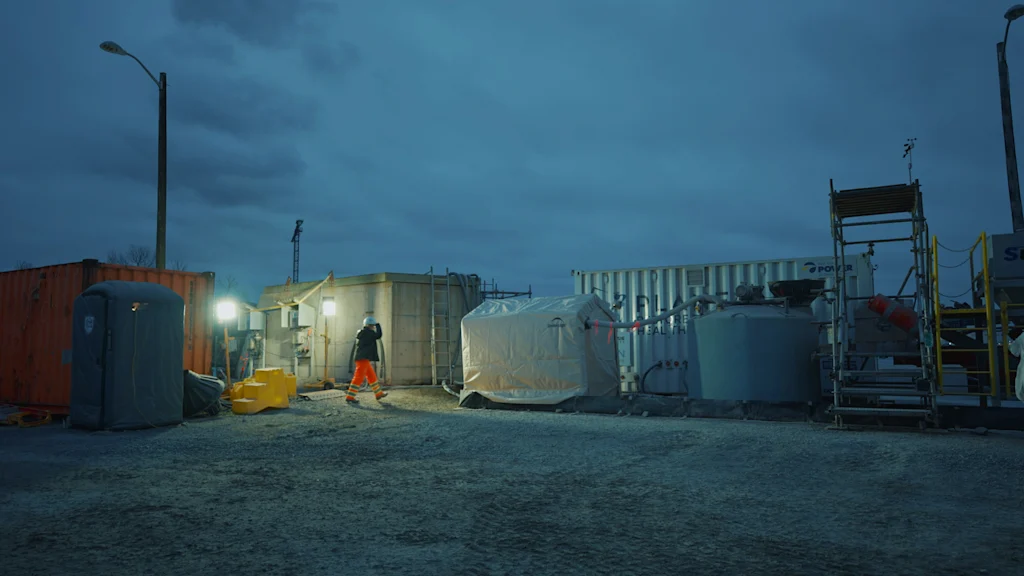
In Nova Scotia, the startup works with a power plant that circulates ocean water through its systems for cooling. On a tiny corner of the power plant’s property, the startup produces the minerals for the process, and then adds them to the power plant’s pipes before the water goes back in the ocean. The size of its operation is roughly 8% of a direct air capture plant, but can capture more carbon, Kelland says.
The minerals aren’t unique. “This is literally Tums,” Kelland says. But because the standard way to make the product has a relatively large carbon footprint, the company couldn’t buy it off the shelf. Instead, the company uses alkaline byproducts of existing industrial production and mining that would otherwise end up in landfills. Then it purifies them so no harmful heavy metals or other pollutants are added to the ocean.
The impact on marine life
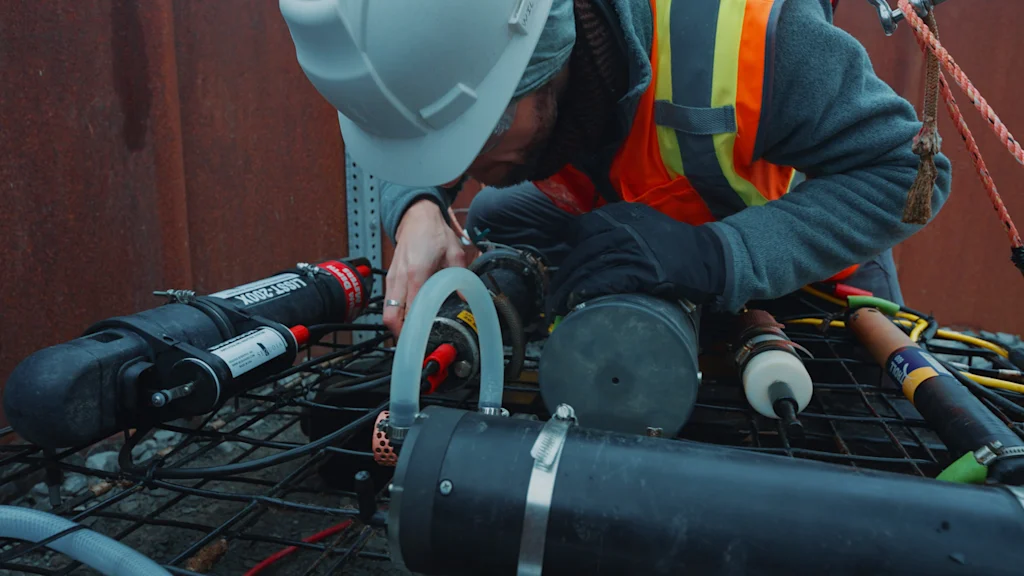
One benefit for marine life is clear: Locally, in the parts of the ocean where the minerals are added, the process can help reduce acidification. Extra CO2 in the ocean creates acid that makes it hard for species like oysters to form shells. (The bicarbonate formed by Planetary’s process, by contrast, helps form shells and coral.) Since the industrial revolution, the ocean has become around 30% more acidic.
“That has really nasty effects on ecosystems, from the base of the food web—the tiny little plankton that form shells—all the way up to shellfish that we eat,” says Kelland. Fisheries are already being impacted by ocean acidification. Because of the ocean’s enormous scale, Planetary’s process can’t bring its pH back to pre-industrial levels. But if it’s done at scale in coastal zones, it can help counterbalance the pressure from human emissions.
Like any form of geoengineering, this type of work also has risks. “Unintended consequences from ocean alkalinity enhancement (OAE) are still an active area of research, and the risks depend largely on the mineral used and how much alkalinity is added,” says Melissa Meléndez, an oceanographic researcher at the University of Hawaii at Mānoa. “Some minerals could introduce trace metals that might be harmful to marine ecosystems, and certain organisms are more sensitive to abrupt chemical changes than others.” Because there’s still uncertainty, she says, field testing and monitoring are critical.
Kelland argues that the risks can be controlled. There’s a risk to marine life if the water becomes too alkaline, but that’s already been well studied for the billions of tons of water that industry discharges into the ocean each day, which has to meet certain pH requirements. The levels can be monitored, and the system can stop immediately if needed. It’s also possible to carefully measure the amount of undissolved particles that go into the water and control that. The company can meet existing regulatory limits.
Since Planetary is doing something new, though, it’s also continuing to work with scientists to do in-depth research on potential impacts. One large ecotoxicology study, for example, looked at the potential impact of the antacid on lobster larvae, and found no effect.
Kelland argues that the science is already well enough understood for the company to scale up to larger projects, though more research will be needed before the gigaton-scale would be possible.
Even if there’s some environmental risk, the risk to marine life from climate change and ocean acidification is larger. With ocean acidification, for example, “we know that it poses very significant risks to any creatures that form shells in the ocean, which are a substantial portion of the food base,” says Brad Ack, CEO of Ocean Visions, a conservation organization that works on climate challenges to the ocean and studies approaches like ocean alkalinity enhancement. “So we’re already running a very signifiant risk just by letting this happen. You have to weigh the risk of doing things against the risk of not doing things.” (Ocean Visions has no relationship with Planetary or financial interest.)
Scaling up
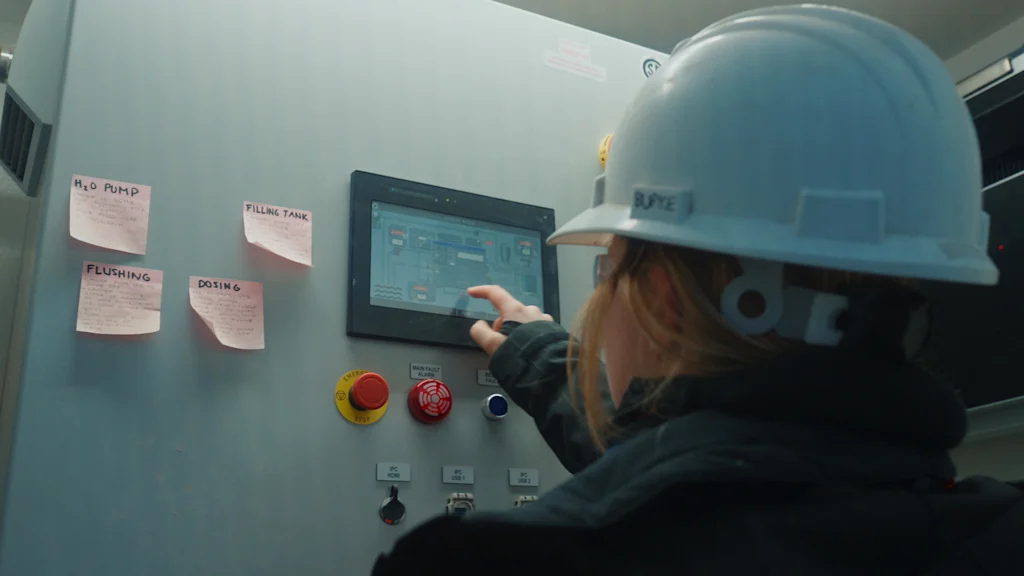
Ocean alkanity enhancement has the potential to scale quickly, says Hannah Bebbington, head of deployment at Frontier. “We think you can get to gigatons of scale,” she says. “It has a minimal physical footprint. It requires very little energy and it piggybacks on some existing coastal infrastructure. So from a pathway perspective, we are really excited about this category.”
In the carbon removal industry, companies are aiming for a cost of $100 or less per ton of captured CO2. But Planetary has calculated that it could get as low as $17 per ton. The low cost depends on sourcing its byproduct very close to its coastal operations. (In a pilot that it had planned earlier in the U.K., the startup ended up canceling the project because the cost of delivering materials was too high; now, material supply is one of its key criteria.) In an analysis of locations where it could access the right supply chains, it calculated that it could eventually scale up to around 2.9 billion tons of CO2 removal per year. Right now, society’s total global emissions are around 40 billion tons a year.
Community opposition could be a challenge. In the U.K. pilot that the company scrapped for supply chain reasons, protestors fought the project, saying that they were concerned about marine life. Right now, the company operates under existing regulations for discharge from industrial plants, but it’s possible to imagine that some communities might pass new legislation banning the new practice.
Still, the company managed to get widespread support for the project in Nova Scotia, including from indigenous communities like the Mi’kmaq. In some cases, Bebbington says, communities may actively want the company to set up operations. “We’ve actually seen that a lot of fisheries have been interested and engaged in this sort of ocean alkalinity enhancement,” she says. The technique can help support populations of oysters and other important food species.
Business support is necessary to help the work grow, since carbon removal companies need to sell that service. While environmentalists often argue that supporting carbon removal is a distraction from the work of cutting emissions, Bebbington says that both are necessary.
Frontier is working with Stripe, Google, Shopify, McKinsey Sustainability, Autodesk, H&M Group, and Workday to purchase carbon removal from the startup. (Other companies, from Canva to Zendesk, are participating through a partnership that Watershed, a corporate decarbonization program, has with Frontier.)
“We make these commitments to proactively ensure that there will be carbon dioxide removal solutions in place to meet our net-zero target at the end of the next decade,” says a spokesperson from H&M. “As the first fashion retailer joining Frontier as a member, we want to inspire others in our industry to follow our example and become early buyers of carbon removal.”
“When you look at what the IPCC report says, in order to limit global warming to either 1.5 or two degrees, we are going to need to both radically reduce the emissions we emit—that’s sort of 80% of the challenge ahead of us—and then also proactively remove carbon dioxide permanently,” Bebbington says.
Scientists estimate that we’ll need to remove between 5 billion tons and 10 billion tons of CO2 a year by 2050 (and even more if we miss targets for cutting emissions.) So far, we’ve only removed a paltry 100,000 tons.
Getting to the goal “requires deploying technology, refining technology, scaling technology, bringing technology down the cost curve, which takes time, takes capital, takes talent,” says Bebbington. “The mandate today that we encourage corporates and countries alike to adopt is a dual mandate: You both need to radically reduce your emissions and starting today, work on proactively scaling carbon removal. Because if we wait until 2050, you can’t just flip a light switch and expect that we’ll have gigaton scale carbon removal that is safe, responsible, cheap, effective. That market, that technology, takes time to develop.”