
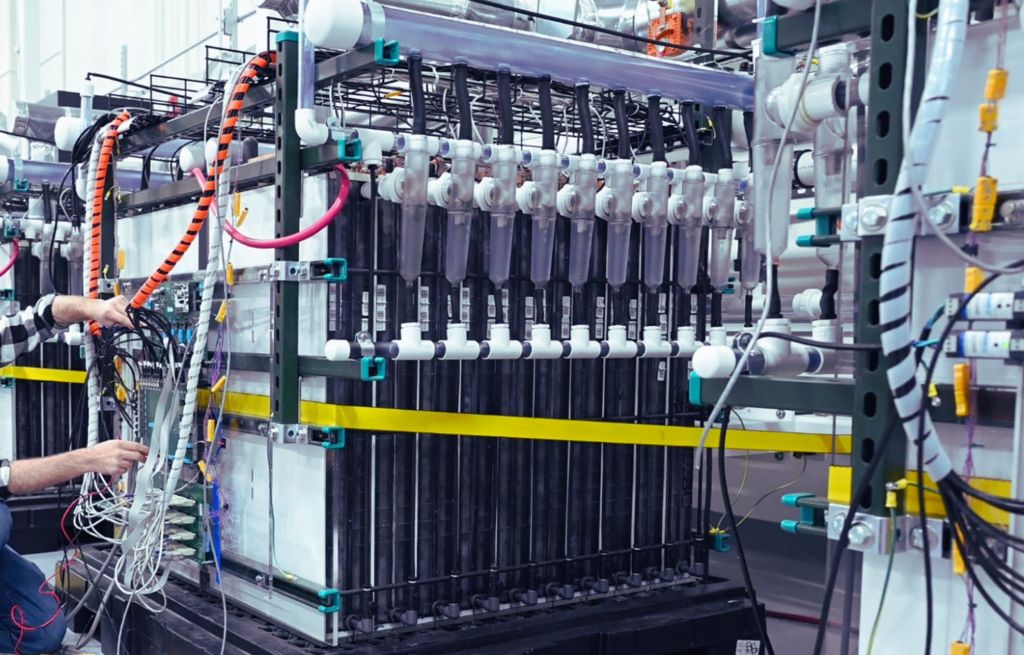
In science class, you probably learned that rust forms when iron reacts with water and air. Now a tech startup is turning that same reaction into a battery. Form Energy calls the clean-energy process “reversible rusting.” The battery takes in oxygen and turns iron into rust to discharge power, then reverses the process to recharge. The company just raised $750 million, pushing its total funding past $2 billion, according to the Wall Street Journal.
The batteries last longer than the Energizer Bunny. While standard lithium-ion batteries run for a few hours at a time, Form’s can keep going for 100 hours straight, long enough to get a utility through a multi-day grid emergency like a winter storm.
The money is going toward ramping up manufacturing at Form Energy’s Weirton, West Virginia plant and its first wave of commercial projects, including a 300-megawatt installation with utility Xcel Energy tied to a Google data center in Minnesota. Form’s list of projects lined up to build has quadrupled this year, from 20 to 80 gigawatt-hours, driven largely by the AI data center boom straining the power grid.
In science class, you probably learned that rust forms when iron reacts with water and air. Now a tech startup is turning that same reaction into a battery. Form Energy calls the clean-energy process “reversible rusting.” The battery takes in oxygen and turns iron into rust to discharge power, then reverses the process to recharge. The company just raised $750 million, pushing its total funding past $2 billion, according to the Wall Street Journal.
The batteries last longer than the Energizer Bunny. While standard lithium-ion batteries run for a few hours at a time, Form’s can keep going for 100 hours straight, long enough to get a utility through a multi-day grid emergency like a winter storm.
The money is going toward ramping up manufacturing at Form Energy’s Weirton, West Virginia plant and its first wave of commercial projects, including a 300-megawatt installation with utility Xcel Energy tied to a Google data center in Minnesota. Form’s list of projects lined up to build has quadrupled this year, from 20 to 80 gigawatt-hours, driven largely by the AI data center boom straining the power grid.