Close Menu
    Facebook X (Twitter) Instagram
    TRENDING :
    • Europe’s Wealthiest Households Are Drowning In Debt
    • Why My Times Square Billboard Didn’t Drive Sales
    • Can India Become The Next Factory Of The World?
    • Silence in a Meeting Isn’t Alignment. It’s Fear. Here’s How to Build a Team That Tells You the Truth
    • For Two Years, I Was Using AI Wrong. Fixing It Is Why My Clients Are Winning While Other Brands Fall Behind.
    • Your Cold Outreach Keeps Getting Deleted for These 5 Reasons
    • What Separates Entrepreneurs Who Endure From Those Who Quit
    • Your Team Doesn’t Need Certainty. It Needs Direction.
    Compatriot Chronicle
    • Home
    • US Politics
    • World Politics
    • Economy
    • Business
    • Headline News
    Compatriot Chronicle
    Home»Business»This ultrathin wearable lets you ‘feel’ textures on a screen
    Business

    This ultrathin wearable lets you ‘feel’ textures on a screen

    November 20, 20253 Mins Read
    Share Facebook Twitter Pinterest LinkedIn Tumblr Telegram Email Copy Link
    Follow Us
    Google News Flipboard
    Share
    Facebook Twitter LinkedIn Pinterest Email


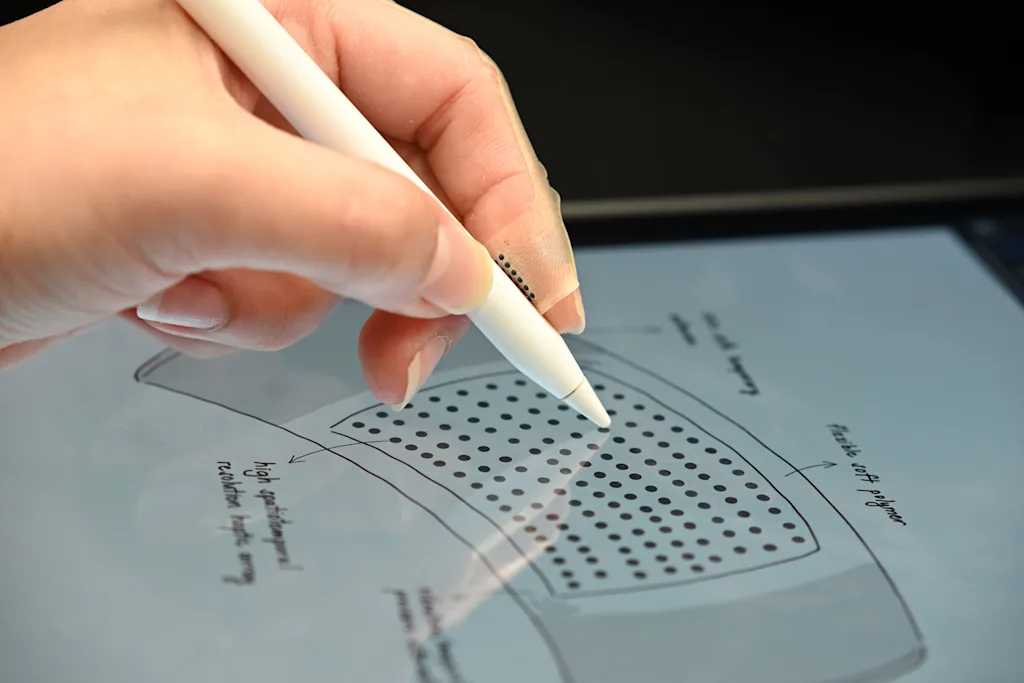
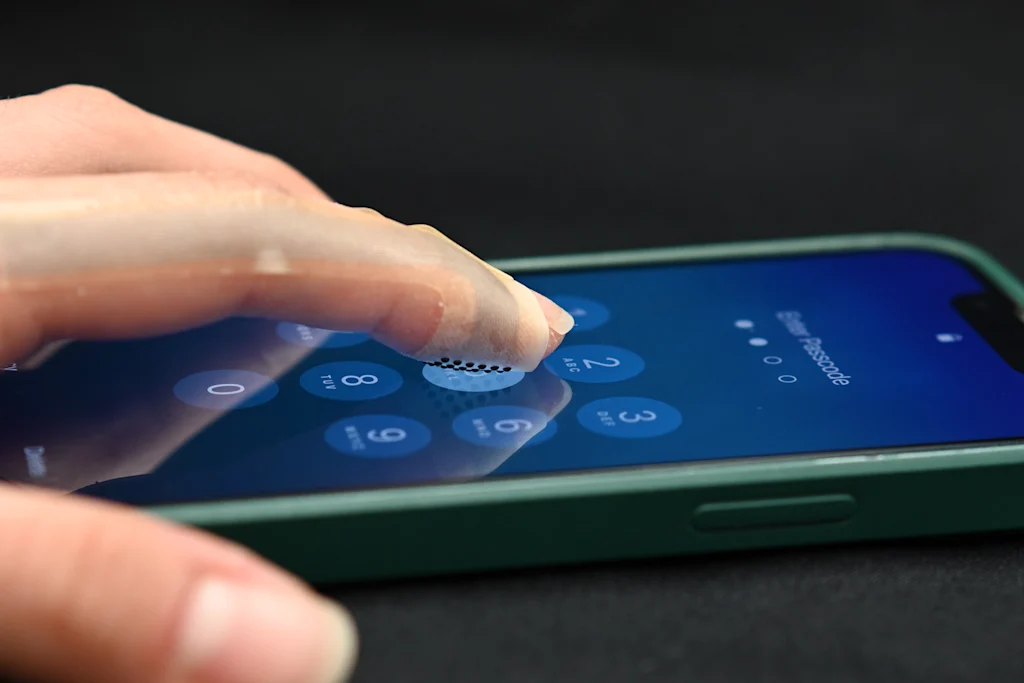
    If you slip a tiny wearable device on your fingertip and slide it over a smooth surface like a touchscreen, you can feel digital textures like denim or mesh.

    The device, designed by researchers at Northwestern University, is the first of its kind to achieve “human resolution,” meaning that it can more accurately match the complex way a human fingertip senses the world.

    In previous attempts at haptic devices like this, “once you compare them to real textures, you realize there’s something still missing,” says Sylvia Tan, a PhD student at Northwestern and one of the authors of a new study in Science Advances about the research. “It’s close, but not quite there. Our work is trying to just get that one step closer.”

    [Photo: Northwestern University]

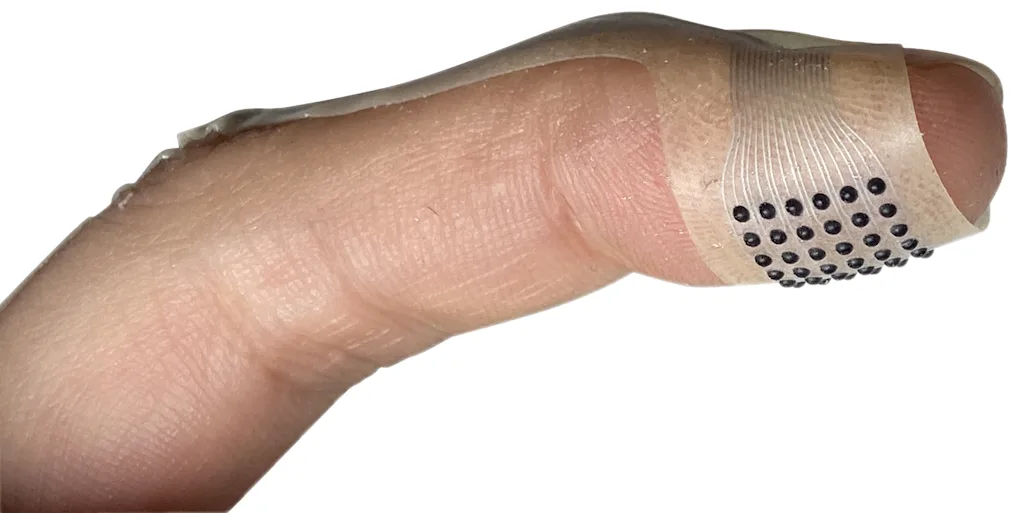
    The wearable, made from flexible, paper-thin latex, is embedded with tiny nodes that push into the skin in a precise way and can move up to 800 times per second. Past devices had low resolution—the touch equivalent of a pixelated image or an early movie from the 1890s with so few frames that the movement looks jerky. Using nodes and arranging them in a particular density improves that resolution.
    [Photo: Northwestern University]

    Earlier devices were also bulky. The ultrathin new technology, which weighs less than a gram, is designed to be comfortable to wear. “A big goal was to make it very lightweight so you aren’t distracted by it,” Tan says. “And [to make] something that we call ‘haptically transparent’—that means that even when you’re wearing it, you can still perceive the real world, so you can perform everyday tasks.”
    [Photo: Northwestern University]

    In the study, users could identify fabrics like corduroy or leather with 81% accuracy. The technology is still in development, but in the future, it could make it possible to feel products as you shop online. It could also have more immediate uses for people who are visually impaired, like making it possible to feel a tactile map or translating text on a screen to braille without a large, expensive device. On devices like microwaves, where physical buttons have often been replaced by flat touchscreens, the wearable could help a visually impaired person know where to push.

    It could also help improve human-robot interfaces. “In the medical field, the Da Vinci robot has very good kinesthetic force feedback,” Tan says. “But getting a surgeon to feel exactly what’s happening at your fingertip as you move the angle of your finger is not quite there. And that’s very important for high-skill workers.”


    Source link

    Share. Facebook Twitter Pinterest LinkedIn Tumblr Email

    Related Posts

    Why My Times Square Billboard Didn’t Drive Sales

    July 30, 2026

    Silence in a Meeting Isn’t Alignment. It’s Fear. Here’s How to Build a Team That Tells You the Truth

    July 30, 2026

    For Two Years, I Was Using AI Wrong. Fixing It Is Why My Clients Are Winning While Other Brands Fall Behind.

    July 30, 2026
    Top News

    Jet fuel prices just jumped 80%. Will airline tickets get more expensive next?

    By Staff WriterMarch 6, 2026

    Get ready to pay more to fly. The war in Iran has sent fuel prices…

    YouTube TV and NBCUniversal head toward blackout standoff

    September 27, 2025

    Layoffs are actually on the decline in 2026—but not in the tech industry

    May 7, 2026

    Gen Z is deep in ‘financial nihilism’: Why young people are betting big on stocks and crypto

    September 24, 2025
    Top Trending

    Europe’s Wealthiest Households Are Drowning In Debt

    By Staff WriterJuly 30, 2026

    Europe has spent decades portraying the southern nations as irresponsible debtors while…

    Why My Times Square Billboard Didn’t Drive Sales

    By Staff WriterJuly 30, 2026

    Opinions expressed by Entrepreneur contributors are their own. Key Takeaways Putting my…

    Can India Become The Next Factory Of The World?

    By Staff WriterJuly 30, 2026

    For more than a decade, Prime Minister Narendra Modi has been pursuing…

    Categories
    • Business
    • Economy
    • Headline News
    • Top News
    • US Politics
    • World Politics
    About us

    The Populist Bulletin serves as a beacon for the populist movement, which champions the interests of ordinary citizens over the agendas of the powerful and entrenched elitists. Rooted in the belief that the voices of everyday workers, families, and communities are often drowned out by powerful people and institutions, it delivers straightforward, unfiltered, compelling, relatable stories that resonate with the values of the American public.

    The Populist Bulletin was founded with a fervent commitment to inform, inspire, empower and spark meaningful conversations about the economy, business, politics, inequality, government accountability and overreach, globalization, and the preservation of American cultural heritage.

    The site offers a dynamic mix of investigative journalism, opinion editorials, and viral content that amplify populist sentiments and deliver stories that echo the concerns of everyday Americans while boldly challenging mainstream narratives that serve the privileged few.

    Top Picks

    Europe’s Wealthiest Households Are Drowning In Debt

    July 30, 2026

    Why My Times Square Billboard Didn’t Drive Sales

    July 30, 2026

    Can India Become The Next Factory Of The World?

    July 30, 2026
    Categories
    • Business
    • Economy
    • Headline News
    • Top News
    • US Politics
    • World Politics
    Copyright © 2025 Populist Bulletin. All Rights Reserved.

    Type above and press Enter to search. Press Esc to cancel.