

Last week, the Financial Times reported that Apple CEO Tim Cook may step down next year. This news seemed to have little impact on Apple’s stock price, but it certainly sparked conversations among Apple fans and armchair tech pundits. Some people have long criticized Cook as a bean counter and “ops guy,” believing he was not the right person to helm the 21st century’s leading consumer technology company, especially one previously guided by a product visionary like Steve Jobs.
Many of these same people are now hoping that Apple’s next CEO will be Apple’s current senior vice president of hardware engineering, John Ternus. They see Ternus as a “product guy” like Jobs. Or, probably more accurately, they see Ternus as a “product guy” unlike Cook. But I think that this does Cook a disservice. And for the good of the company, I hope whoever ends up taking the reins is as much like Cook as they are like Jobs. Because while Steve Jobs may have been a visionary, Tim Cook pulled off the impossible.
Tim Cook, the product guy
Let me first address the false idea that Cook isn’t a product guy. Just look at the groundbreaking new products—hardware, software, and services—Apple has released under Cook’s leadership since 2011.
In 2014, Apple released Apple Pay, which brought contactless mobile payments to the masses for the first time. A year later, in 2015, the company redefined the smartwatch with the Apple Watch. Also in 2015, Apple officially became a streaming services company, with the launch of Apple Music, giving the world its first competent alternative to Spotify.
The launch of the AirPods in 2016 upended the headphone industry and changed the way we listen to audio. In 2017, the iPhone X eliminated the iPhone’s dated Home button in favor of an all-screen design and Face ID—a consumer biometric authentication system that is still unmatched to this day.
From 2019 to 2020, Apple expanded its services footprint with the launch of Apple Card, Apple TV, Apple Arcade, Apple Fitness+, and Apple News+. That same year, Apple took its biggest risk in decades by switching its Macs from Intel chips to Apple Silicon—a move that has reinvigorated Mac sales and enabled stunning new Mac designs.
And most recently, in 2024, Cook swung for the fences with the Apple Vision Pro, a product that was personally important to him. So far, that product hasn’t performed well commercially, but it has more innovation packed inside it than the iPod or iPhone did when Jobs shepherded those devices to the masses. It also exemplifies that Cook, like Jobs, is not afraid of trying new things.
Sure, Cook isn’t an engineer, and he didn’t personally invent these products. But Jobs didn’t hunch over a workbench with a soldering iron to assemble the first prototype of an MP3 player with a clickwheel, or a phone with a touchscreen. Instead, both men oversaw the organization—and, more importantly, trusted its visionary engineers and designers—in order to bring these gadgets, which so many of us couldn’t imagine living without today, to market.
At the time of Jobs’ passing, Apple had only four main products: the Mac, the iPod, the iPad, and the iPhone. Under Cook’s leadership, Apple has added the AirPods, Apple Watch, iPad Pro, and Apple Vision Pro to that lineup, while constantly improving the iPhone and Mac experience in significant ways. I’m not sure how a CEO who shepherded all that can’t be considered a “product guy.”
Cook had the hardest act in business history
But shepherding so many beloved products during his time as CEO isn’t why I say Tim Cook has done the impossible. I say this precisely because he had to undertake the hardest act in business history: following in the footsteps of Steve Jobs.
And Cook succeeded wildly. It would have been easy to fumble the reins at Apple after Jobs’ passing, especially considering that for many people, including Apple’s employees, Jobs was Apple. It’s not difficult to imagine that morale was at an all-time low and uncertainty at an all-time high within the company after Jobs’ untimely death. There are plenty of leaders who would have been unable to pull together an organization of Apple’s size and successfully steer it down the path of not just continuing, but outpacing Jobs’ legacy.
It’s easy to imagine that if Jobs could strap the latest Apple Watch to his wrist, put the latest AirPods in his ears, and look through the display of the Apple Vision Pro, he would say “Wow!” and be proud that the company he built is still creating industry-defining products.
Of course, if you need more proof of Cook’s success in steering Apple, just look at the company’s financials. In 2010, Apple had an annual revenue of around $65 billion. By the end of fiscal 2025, the figure exceeded $416 billion. And Apple’s stock price has reflected the company’s growth under Cook. Apple recently reached a valuation of $4 trillion. It was valued at just around $350 billion when Jobs passed.
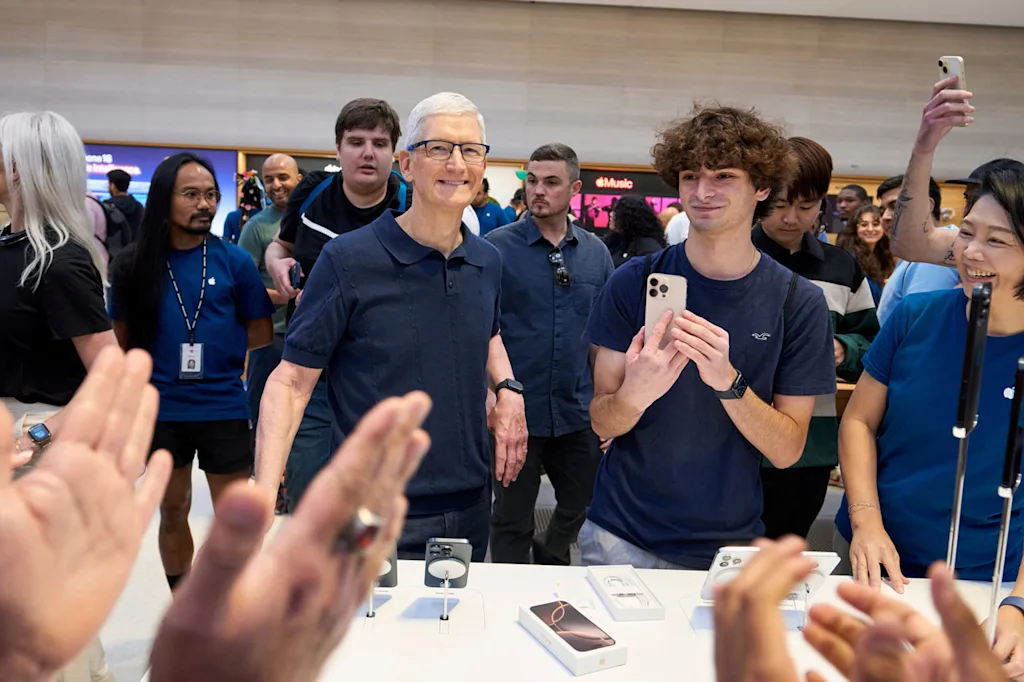
This success is all the more astonishing considering that Cook has faced challenges Jobs likely never even would have conceived. Technology’s role in society, government, and politics has changed significantly over the past decade, and today’s tech giant CEOs need to be not only chiefs of their companies but also quasi-diplomats as they interact more regularly with governments and their leaders.
The geopolitical changes of the last decade have necessitated this, and it’s not something everyone could pull off—perhaps including Jobs, who was known for his anger and arrogance. But over the last decade, Cook has carefully threaded the needle in dealing with increasingly challenging individuals and landscapes.
As Tesla’s recent $1 trillion pay package for Elon Musk shows, many people believe that there are companies with futures inextricably linked to their CEOs’ continued involvement. Many people thought that about Apple in the early 2000s, too. Unfortunately, Apple didn’t get the choice to keep Jobs around. It needed to find a replacement. Fortunately for the company, that replacement was Tim Cook.
Now comes the second hardest act in business history
As successful as Cook’s reign at Apple has been, he won’t be leading the company forever. And, if the FT’s report is correct, Cook could step down in 2026.
I’ve cautioned before that it’s dangerous to deify tech CEOs—and that goes for Cook, as well. Like Jobs, Cook has made choices that haven’t always panned out well for Apple.
But Cook has proved he can steer the company through its most tumultuous times—and take Apple farther than it’s ever gone before. Those are big shoes to fill. Whether or not John Ternus will indeed be the one stepping into them is uncertain. The company has other leadership options available.
Yet one thing is certain: whoever ultimately becomes Apple’s new CEO will have to pull off the second hardest act in business history: following in Tim Cook’s footsteps.