
The tiny Fiat Topolino—about the length of a cargo bike and half as long as an American SUV or pickup—is the kind of car tourists stop to photograph as a cute curiosity in Rome or Milan. The electric car only travels 28 miles an hour, and it’s designed for dense European cities. But it also only costs around $10,000, and Fiat is now betting that Americans are ready for something this tiny.
The company recently announced plans to bring the car to the U.S., shortly after Trump said that he wanted to help bring similarly tiny kei cars to the U.S. from Japan. There’s a strong argument that smaller cars are better for society: They’re more affordable, more efficient, take up less space, and they’re safer for pedestrians and other vehicles in a crash. (Uncharacteristically, Trump noted that “really cute” kei cars can be electric and are fuel efficient, shortly after his administration started the process to roll back fuel efficiency requirements.) But for the smallest microcars to be more than a niche category, a lot would have to change.
Growing interest in smaller rides
For years, the conventional wisdom has been that Americans love giant vehicles. Ford F-Series trucks have long been the bestselling vehicles; SUVs are more popular than cars. But size preferences are slowly starting to shrink. Compact SUVs now outsell larger SUVs. Sales of midsized trucks are growing faster than full-sized trucks. Compact car sales are also growing.
Automakers push bigger vehicles because they make more money on them, partly because of loophole in fuel efficiency regulations. But as consumer cost concerns grow, buyers are moving in the other direction. “I think that it’s certainly not baked into our DNA to like big cars,” says Ben Crowther, policy director at America Walks, an organization that advocates for smaller vehicles to make streets safer for pedestrians and others on the road. “It’s the result of several decades’ worth of marketing. But where I think I see the tipping point being is that small cars are more affordable. Right now, the average cost for new cars is around $50,000. That’s easily someone’s salary. That cost is inflated because vehicles are oversized.”
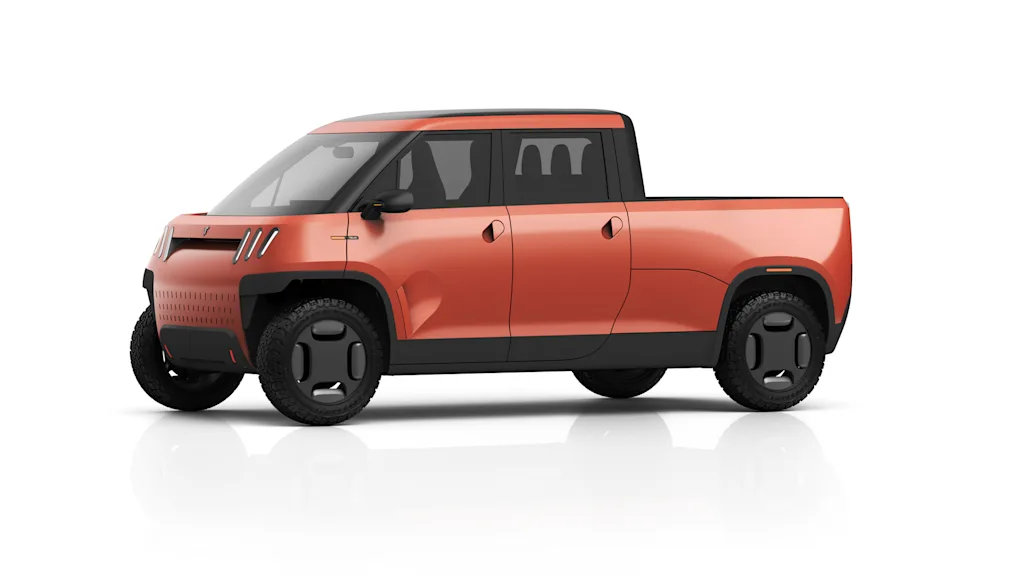
Telo, a startup making a small electric pickup that’s roughly as long as a Mini Cooper and cheaper than a typical gas truck, says that it’s seen strong interest in its first model, which will hit the market next year.
Jason Marks, Telo’s CEO, says that it’s also noteworthy how much demand there is for kei cars and trucks. Right now, the U.S. only allows the Japanese vehicles to be imported when they’re at least 25 years old, under regulations aimed at classic cars. But despite the restrictions, kei trucks are the largest class of vehicles being individually imported to the U.S., with around 7,500 arriving last year. “These are vehicles the size of golf carts, with well over 100,000 miles on them, that can’t go 60 miles an hour, and only about 17 states legally allow you to drive them on the highway,” says Marks. “And they’re still this desirable.”
Telo’s offering is very different than a kei truck—the Telo MT1 can haul as much as a regular passenger truck, it can be driven anywhere, and it’s designed with modern safety features including sensors, unlike 25-year-old kei cars, which typically don’t even have airbags. Still, the interest in kei cars illustrates the appetite for smaller cars in general. And though kei cars and microcars like the Topolino face challenges in adoption, there’s also room for them to become more widespread with more support.
Kei cars versus microcars
In Japan, kei cars—short for keijidosha, meaning “light automobile”—originated in 1949 as part of Japanese industrial policies to rebuild the country’s auto industry when most people couldn’t afford larger vehicles. The cars have to stay under 11 feet long and have small engines. They’re allowed on Japanese highways, but have reduced safety features.

They’re still very popular in Japan, and also popular in countries like India, where Suzuki’s tiny cars have dominated the auto market for decades. But even current models likely wouldn’t meet safety requirements in the U.S., and adding those features would jack up costs. Take the example of the Honda N-Box, a bestselling car that costs around $12,000 to $15,000 and has a fuel efficiency of around 50 miles per gallon.
“The Honda N-Box does not have airbags, it does not have ABS, and it does not have some of the features that you would typically require under the current regulations in the United States,” says Aditya Ramji, an economist at UC Davis who focuses on energy, transportation, and electric mobility. “That means that the moment I add those requirements and made this vehicle compliant, the price of the $12,000 N-Box now will become $22,000 straight away.” That’s similar to the cost of the Toyota Corolla—making it unlikely that an N-Box could compete under current regulations.

In theory, the DOT could create new standards and certification requirements benchmarked to those that have been in place in Japan for decades, and make it more feasible to import new kei cars. That process would take time. (Trump’s post on Truth Social saying “I have just approved TINY CARS to be built in America” did not actually constitute approval.)
Microcars like the Fiat Topolino fit into a different category under U.S. regulations—something the DOT calls a “neighborhood electric vehicle” or NEV. The cars are restricted to speeds of 25 miles an hour. In most states, they’re only allowed on roads with speed limits up to 35 miles an hour. Some states require extra safety equipment, like windshield wipers. But airbags aren’t required. Because of the limitations, it’s a niche market.
Some experts are skeptical that demand of either kei cars or neighborhood electric vehicles could significantly grow. “Generally speaking, it is difficult to imagine a scenario that could significantly shift the personal vehicle market in a direction that would result in widespread adoption of very small cars in the United States,” says David Bunch, a management professor emeritus at UC Davis who has studied consumer choice in vehicles. The main exception, he says, could be highly urbanized areas like New York or San Francisco.

The safety challenge
Both kei cars and neighborhood electric vehicles struggle with consumer concerns about safety. Still, Ramji argues that tiny vehicles could be relatively safe in urban commutes even without the current suite of required safety features, as they travel at relatively low speeds.
The growing suite of safety features on other modern cars, including sensors and automatic braking, also helps. “I think the trend that we’ll be seeing as the fleet turns over and more of these vehicles have safety features, it means that you don’t need the full armor of an SUV or a pickup truck because your car, and everyone else’s car on the road is actively working beyond just the driver to avoid that collision,” says Crowther.
If more of the tiny cars were in use, it would also mean fewer pedestrian deaths: If a person is hit by a small vehicle, they’re much more likely to survive. That’s both because there’s less force in a collision and because low cars hit the body lower than a large truck or SUV that can fatally strike someone in the head or chest. And small cars are also less likely to damage other vehicles in a crash. The paradox, of course, is that people are more likely to choose cars that protect themselves, not others on the road.
“The notion of ‘safety benefits’ of smaller cars has long been problematic, because they must share the road with larger vehicles, and in a ‘contest’ the larger vehicles win,” says Bunch. “That is, smaller cars are by definition less safe in an environment with mixed vehicle sizes.”
Can microcars grow?
Even with the challenges that exist, there could be room for more tiny cars in the U.S., especially in dense cities. Demand isn’t guaranteed—the tiny Smart Fortwo was taken off the American market in 2019 due to low sales. But some policy changes could support growth. For example, a city could offer cheaper parking permits based on vehicle size, since tiny cars don’t take up as much valuable curb space. States could choose to allow neighborhood electric vehicles on more roads—or, to boost safety, could lower speed limits on more routes.
Better urban design would also help. “To have neighborhood electric vehicles, you really do need to have a better mix of land uses, which we don’t see in most suburban settings,” says Kara Kockelman, a professor of transportation engineering at the University of Texas at Austin. “In these planned developments, a grocery store is off of a much higher speed street.” If it was possible to drive at a low speed to run errands or commute to work or school, tiny cars could become a more viable option for more people. (Of course, it would also be easier to bike in that scenario.)

Both microcars and kei cars could be useful as a second car for short commutes, says Ramji, and that could potentially help unlock a new urban market for EVs. It’s not likely that the current administration will intentionally do anything to promote electric cars. But creating new regulations that allow kei cars could also theoretically boost EV sales. One popular current kei car, the Nissan Sakura EV, has around 110 miles of range and costs $16,000 or $17,000—far less than most EVs on the U.S. market.
“Maybe this is an opportunity in the U.S. to think about how the small car segment can fundamentally serve the electrification narrative and really come in strategically leapfrogging that ecosystem and looking at urban EVs as opposed to gas cars in the mini car segment,” Ramji says.