
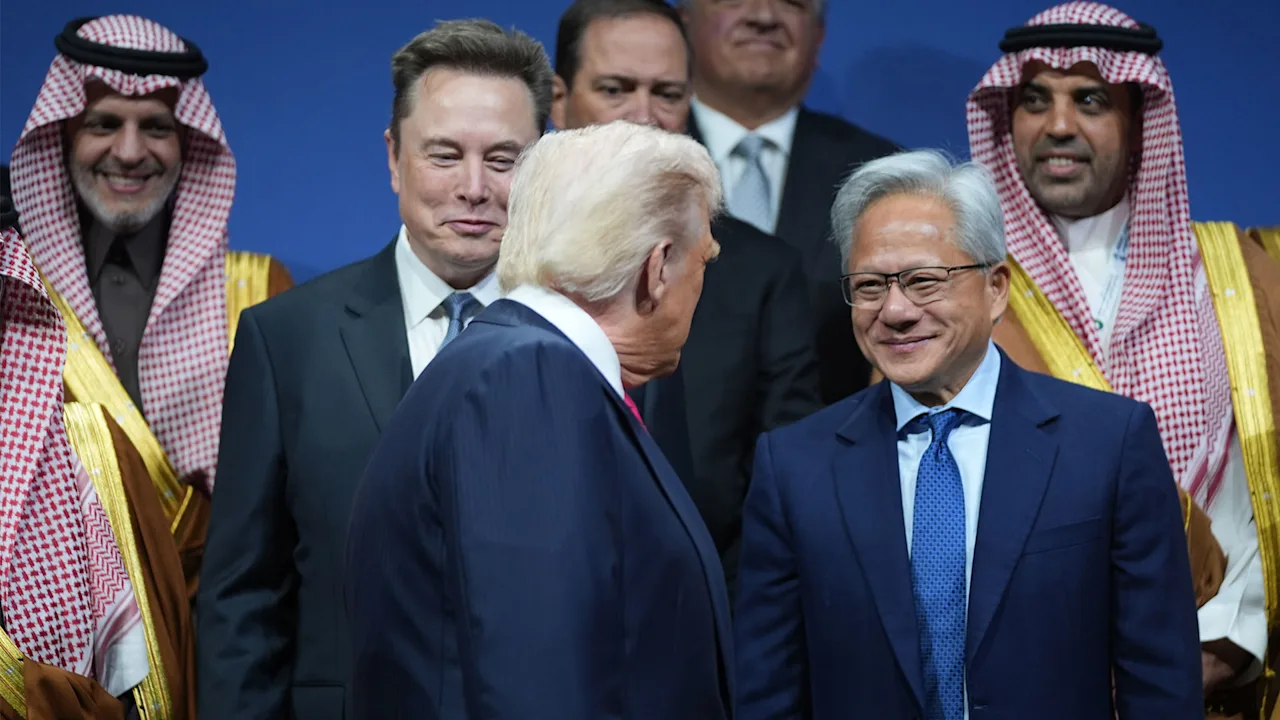
President Donald Trump plans to use a key address Wednesday to try to convince Americans he can make housing more affordable, but he’s picked a strange backdrop for the speech: a Swiss mountain town where ski chalets for vacations cost a cool $4.4 million.
On the anniversary of his inauguration, Trump is flying to the World Economic Forum in Davos — an annual gathering of the global elite — where he may see many of the billionaires he has surrounded himself with during his first year back in the White House.
Trump had campaigned on lowering the cost of living, painting himself as a populist while serving fries at a McDonald’s drive-thru. But in office, his public schedules suggest he’s traded the Golden Arches for a gilded age, devoting more time to cavorting with the wealthy than talking directly to his working-class base.
“At the end of the day, it’s the investors and billionaires at Davos who have his attention, not the families struggling to afford their bills,” said Alex Jacquez, chief of policy and advocacy at Groundwork Collaborative, a liberal think tank.
Trump’s attention in his first year back has been less on pocketbook issues and more fixed on foreign policy with conflicts in Gaza, Ukraine and Venezuela. He is now bent on acquiring Greenland to the chagrin of European allies — a headline likely to dominate his time in Davos, overshadowing his housing ideas.
Trump noted the Europeans’ resistance, telling reporters Monday night, “Let’s put it this way: It’s going to be a very interesting Davos.”
The White House has tried to shift Trump’s focus to affordability issues, a response to warning signs in the polls in a year where control of Congress is at stake in midterm elections.
About six in 10 U.S. adults now say that Trump has hurt the cost of living, according to the latest survey by the Associated Press-NORC Center for Public Affairs Research. It’s an issue even among Republicans, who have said Trump’s work on the economy hasn’t lived up to their expectations. Only 16% say Trump has helped “a lot” on making things more affordable, down from 49% in April 2024, when an AP-NORC poll asked Americans the same question about his first term.
The president is banking on investment commitments from billionaires and foreign nations to create a jobs boom, even as his broad tariffs have crimped the labor market and spurred inflation. Trump supporters who attend his rallies — which the president resumed last month — are left to trust that Trump’s business ties can eventually help them.
This strategy carries political risks. Voters are more interested in the economy they’re experiencing in their own lives than in Trump’s relationships with billionaires, said Frank Luntz, the Republican-affiliated pollster and strategist.
“If you’re asking me, ‘Are billionaires popular?’ The answer is no — and they’ve haven’t been for some time,” said Luntz, who last year identified “affordability” as a defining issue for voters.
Wooing billionaires instead of the working class
Since Trump’s first term in 2017, the wealthiest 0.1% of Americans have seen their wealth increase by $11.98 trillion to $23.46 trillion, according to the Federal Reserve.
The magnitude of those gains dwarfs what the bottom 50% of households — the majority of the country — received during the same period. Their net worth rose by $2.94 trillion, roughly one-fourth what the top 0.1% got.
One of the biggest concerns for voters is the cost of housing. In recent weeks, Trump has floated proposals like reducing interest rates on home loans by buying $200 billion in mortgage debt and banning large financial companies from buying homes. Yet those efforts would do little to address the core problem in the housing market: a multi-year shortfall in home construction and home prices that have generally risen faster than wages.
Trump regularly points to the investments made by the wealthy and powerful as signs of economic growth to come. To encourage billionaires to deliver, Trump in his first year pursued policies on artificial intelligence and financial regulation that can benefit the wealthy, along with tax cuts, reduced IRS enforcement and fewer regulatory burdens for large-scale investments.
“Most billionaires don’t share the interests of the working class,” said Darrell West, a senior fellow at the Brookings Institution who has written about the “wealthification” of U.S. politics. “The ultrawealthy love tax cuts and deregulation, and those preferences make it difficult for government to provide the help that working class people want.”
Trump has been trying to sell tax breaks on tips and overtime pay from what is known as the ” One Big Beautiful Bill ” as benefiting workers. But a Congressional Budget Office analysis indicated that middle-class families may only see savings of $800 to $1,200 a year, on average, while the top 10% of earners would receive $13,600. A separate analysis by the Tax Policy Center, a think tank, said those earning above $1 million would save on average $66,510 this year.
The company Trump keeps
Trump regularly holds public events with the wealthy and powerful at the White House and beyond. He jetted to the Middle East and Asia with billionaires in tow as he had foreign countries announce investment commitments, promising that the money would flow down into factory jobs for the middle class.
At a September dinner with tech billionaires, Trump said it was an honor to be surrounded by the likes of Bill Gates, Tim Cook, Sergey Brin and Mark Zuckerberg.
“There’s never been anything like it,” Trump said. “The most brilliant people are gathered around this table. This is definitely a high-IQ group and I’m very proud of them.”
The White House said the previous Biden administration had alienated the business community to the detriment of the economy. “President Trump’s pro-growth policies and friendly relationships with industry titans, on the other hand, are securing trillions in investments that are creating jobs and opportunities for everyday Americans,” White House spokesman Kush Desai said.
Last month, Trump celebrated a charitable contribution of $6.25 billion to the “Trump” investment accounts for children by Michael Dell. It was a chance to talk about economic inequality — but also another opportunity for Trump to showcase his relationship with billionaires.
Trump takes phone calls from billionaires and CEOs to chat about business, politics and interests such as his planned White House ballroom. He regularly peppers his speeches with shoutouts to Nvidia founder Jensen Huang, whose net worth was estimated by Forbes at roughly $162 billion as of Sunday.
He’s installed billionaires in his inner circle such as Commerce Secretary Howard Lutnick (net worth: $3.3 billion) and Special Envoy Steve Witkoff (net worth: $2 billion). He put Elon Musk (net worth: $780 billion) in charge of slashing government payrolls before a dramatic falling-out and, later, a public reconciliation.
White House press secretary Karoline Leavitt at a briefing last month portrayed Trump’s own status as a billionaire as a positive for him with voters.
“I think it’s one of the many reasons they reelected him back to this office, because he’s a businessman who understands the economy and knows how to fix it,” she said.
—Josh Boak, Associated Press