
The launch of a digital art department at upscale auction house Christie’s was precisely as well-publicized as its eventual shuttering was devoid of fanfare.
On March 11, 2021, Christie’s made history as the first major auction house to sell art in the form of a non-fungible token (NFT). Digital artist Beeple managed to offload his massive mosaic, Everydays: The First 5000 Days, for a whopping $69 million, generating hundreds of astonished headlines and getting those three letters, NFT, in front of untold scads of early-adopter eyeballs. It was the sale heard ’round the world, a starter pistol kicking off the NFT gold rush.
Cut to last month, when Christie’s quietly closed its digital art department. It was as if the moment when NFTs briefly became the molten core of culture, tech, and commerce had never happened at all—as if the vague memory of surly apes with unconscionable price tags had just been a fever dream. There may be a lesson, however, in examining how quickly the hype cooled on NFTs—especially considering what the market has evolved into in the years since.
Here comes the boom
For those who may have forgotten—or never bothered to learn—NFTs are unique digital certificates stored on a blockchain, proving ownership or authenticity for an array of items, including art. Unlike the typical crypto asset, where each Bitcoin or Ethereum is identical and equal, these tokens are not interchangeable. Hence, they are—say it with me—non-fungible.
Though the first-ever NFT—a short, looping generative animation called Quantum—was created in 2014, the technology only started making waves a few years later, with the arrival of CryptoKitties. Minted on the Ethereum blockchain, CryptoKitties were playfully animated feline NFTs, designed not only to collect and trade, but also to breed new kitties with inherited traits, lending them a gamified aspect that proved to be a game-changer.
“We saw all the craziness going on at that time with ICOs [initial coin offerings] and we said, ‘Hey, look, not everything has to be a coin,’” recalls Roham Gharegozlou, CEO and cofounder of Dapper Labs, the pioneering NFT company behind CryptoKitties and other digital collectibles. “CryptoKitties was the first time we showed that crypto could be a lot more than just currency, and it attracted the attention of a lot of people who saw the potential of digital ownership as applied to these massive, billion-fan communities like the NBA, the NFL or Disney.”
By the time the notorious Beeple auction took place, Dapper had collaborations in the works with all three companies, and had already launched NBA Top Shot, turning video clips from NBA games into NFTs. One such moment, a gnarly LeBron James dunk from February 2021, went for $208,000, a headline-worthy sum that preceded the art world’s own NFT coming-out party by about three weeks. It was official: NFTs were the Next Big Thing. Soon enough, fashion houses, entertainment companies, and more major brands wanted in. As did the speculative set.
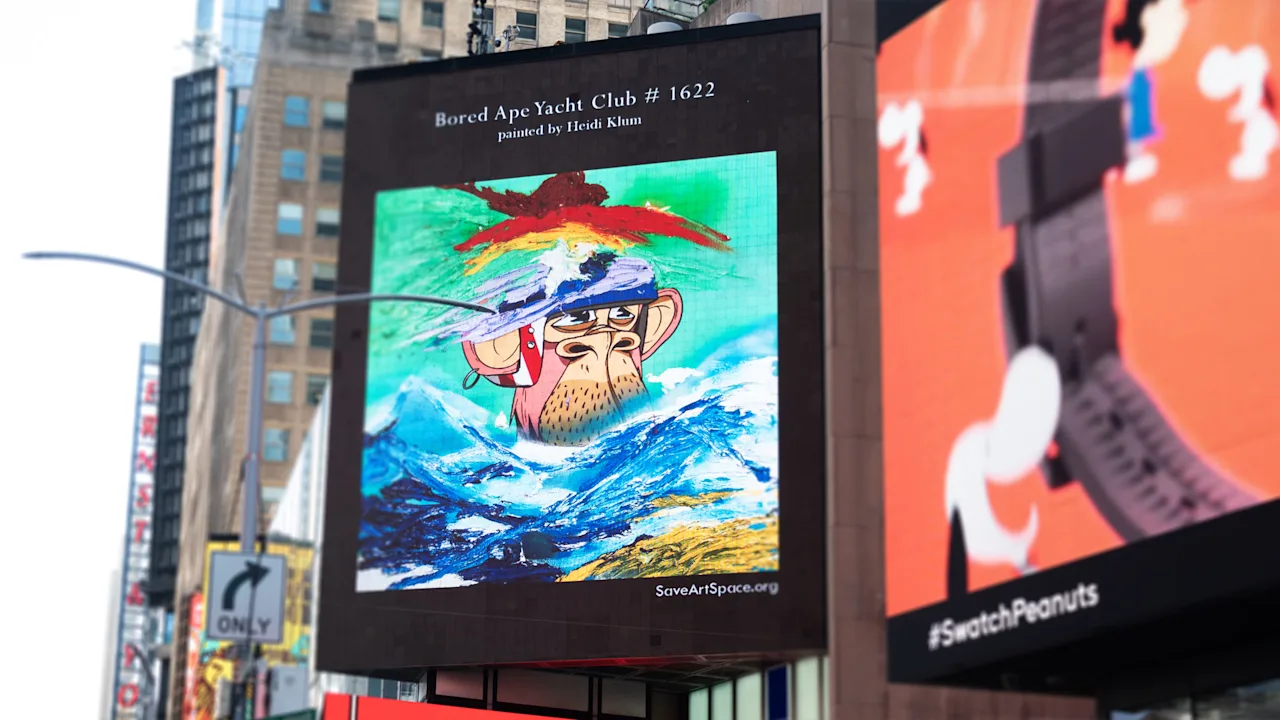
Among the names most associated with NFTs is Bored Ape Yacht Club (BAYC). Launched in April 2021 by the four pseudonymous founders of Yuga Labs, the project consisted of 10,000 singular cartoon apes, stylized to evoke esoteric personality types. On the surface, the apes were similar to CryptoKitties, but unlike that venture, Yuga marketed BYAC as an exclusive club. Those willing to pay prices that started art $190 in the early days received promises of perks like merch drops and a private Discord, along with access to special events. They also got to feel like they shared space on an ever-unfurling red carpet with celebrities like Justin Bieber and Serena Williams, who started touting their newfound Apes as status symbols.
As consumer interest in NFTs soared, so did the value of Ethereum and the tokens on its blockchain. The prices of some Bored Apes skyrocketed from hundreds of dollars to hundreds of thousands in a matter of months. Green-eyed investors started tracking their value like stocks. By the end of 2021, the trading volume of NFTs altogether reportedly surpassed $13 billion.
“I’d been looking into these kinds of things for years, and then suddenly my barista was asking about NFTs,” says Merav Ozair, an expert on responsible innovation and the founder of Emerging Technologies Mastery, a Web3 consultancy shop. “Everyone wanted to know about it and how they could benefit from it. People from every industry suddenly came to me with questions, and then I understood this had become much more than it was supposed to be.”
Omar Kholief, a curator, professor, and author of the book Internet_Art: From the Birth of the Web to the Rise of NFTs, had a similar experience during the NFT feeding frenzy of 2021.
“It was not surprising that [the Beeple sale] would make news. What shook me, however, was the vast speculation around this sale, and the number of start-ups professing to be specialists in NFTs all of a sudden, who wanted to enlist my knowledge, labor and support,” Kholief says. “I was being offered jobs by company after company—and today, well, none of them exist.”
Things fall apart
At their mainstream peak, NFTs were everywhere and could seemingly be anything. Rock band Kings of Leon released an NFT album. Reese Witherspoon’s production company Hello Sunshine made a deal to adapt NFTs into movies and TV shows. (To date, no Hello Sunshine NFT adaptations have seen the light of day.) Author Neil Strauss released a book as an NFT, and an NFT of New York Times writer Kevin Roose’s column about NFTs sold for $560,000.
The cumulative effect of so much all-in hype from high places was that anyone tuned into pop culture at the time might have started to feel like a schmuck for not diving in, wallet first. Of course, many holdouts eventually saw their hesitancy validated, once it turned out these digital assets were not as sturdy an investment at the time as the loudest hype-peddlers portrayed them.
“Everyone jumped on the bandwagon, causing market saturation supremely quickly, as well as confusion and boredom,” Kholief says. “Because the mouthpieces at the front of the companies had not a clue what an NFT actually was.”
When the Federal Reserve started hiking interest rates in March 2022 to fight pandemic inflation, it lowered investor confidence in crypto. Prices of tokens fell sharply as more hikes followed, alongside geopolitical chaos including a then-new war between Russia and Ukraine. A major downturn in the crypto market had begun, one that would peak with the November 2022 crash of FTX. By that point, NFT trading volume for the year had collapsed by 97%.
And where were the celebrities who’d proudly and quite publicly shown off their Bored Apes? By December 2022, when most BYAC tokens were worth a fraction of what their owners paid for them, several bold-face names were listed in a class action lawsuit against Yuga Labs. Snoop Dogg, Madonna, Post Malone, and many others were alleged to have participated in a scheme to “artificially increase the interest in and price of” Bored Ape NFTs without disclosing “the nature, source, and amount of any compensation paid, directly or indirectly, in exchange for the endorsement.”
Even before the lawsuit, which was dismissed on October 1, though, celebrities had pumped the brakes on their NFT enthusiasm. As quickly as the decibel-shattering hype had begun, it was over.
“It had already started to wind down, but after FTX, people decided they weren’t touching this space anymore,” says Ozair. “They figured, ‘Maybe all these NFTs are just a scam.’”
In it for the long term
The NFT market collapsed for many reasons, but chief among them were excessive hype and rapid expansion.
“It was definitely too much too soon,” Dapper Labs’ Gharegozlou says of peak NFT hype. “Because crypto is this odd industry where, even though the technology was immature for many years, there was opportunity to make money, so that brought a rush of people in, whereas with most new technologies, people leave them alone until they’re a lot more mature.”
What had started as a new frontier in digital ownership quickly got conflated with a faddish money-printing machine. As the dust settled in 2023, it became clear that just because an image was digital and unique didn’t make it inherently valuable—and also that maybe Starbucks didn’t need an NFT program, something the company finally conceded in early 2024.
So, what might the NFT market look like in maturity? Over time, a smaller, more pragmatic set of use cases has emerged among collectors and various fandoms. Gaming companies are figuring out how to better integrate NFTs in their open worlds, and fashion brands like Louis Vuitton are tying (wildly expensive) physical garments to their NFTs. Meanwhile, regulatory changes like this year’s GENIUS Act are helping to firm up crypto’s infrastructure, making the waters safer for consumers. NFTs now trade in smaller volumes, to more niche audiences, with the speculative crowd mostly having moved on to things like meme coins.
Dapper Labs had found success with NBA Top Shot and NFL All Day prior to peak NFT hype, but the company only unveiled its Disney collaboration, Disney Pinnacle, in November 2023—a year after the bottom fell out of the market, when people were reassessing NFTs. The turn in public opinion apparently had an impact on the company’s efforts to launch a new venture.
“It sort of reset expectations,” Gharegozlou says. “We had to approach things from a very cautious standpoint, because we wanted our customers as well as our partners—in the case of Disney—to know that we’re in this for the long term.”
The team at Dapper Labs moved thoughtfully and slowly as it created a line of collectible digital pins for various Disney IP, free from the speculative craze that enveloped previous projects. Disney Pinnacle seems focused on serving fans reasonably priced collectibles, while inspiring deep-pocked collectors to bid tens of thousands on limited drops. (NBA Top Shot also still produces NFTs that occasionally fetch six figures on the market.) As the Disney fandom embraces Pinnacle, Disney+ has harnessed these digital pins as a perk for subscribers. It’s a hint of how a more grounded, practical market for NFTs might play out in the future.
What can the NFT boom tell us about AI?
As NFTs settle into their niche within the greater crypto ecosystem, it’s important to remember what happened when they were previously in the global spotlight. Silicon Valley, after all, appears to be making similar mistakes with artificial intelligence. While many have compared the AI craze to the dot-com bubble, it also closely resembles the NFT boom.
At their 2021 height, NFTs thrived on novelty over utility. They were a shiny new concept that could not maintain mass interest when the hype died down. A similar phenomenon now plagues AI. Nearly three years after Chat GPT’s arrival, the incorporation of AI in any product or service is still meant to signal value—even if, in practice, most shoehorned-in AI components tend to just make consumers want to opt out. The market is now willing to bet billions on, say, an energy real estate investment trust, seemingly because AI is involved at all, rather than because it’s involved in a particularly useful or innovative way.
Beyond prizing novelty over utility, the executives touting AI the loudest have been over-promising what the technology can deliver. Instead of emphasizing the practical use cases of today, they are claiming AI will cure cancer tomorrow, for starters.
“There is a lot of overpromising,” Ozair says.“When Sam Altman says GPT-5 is like having PhDs in your pocket for every discipline, that is false advertising. It doesn’t have that capability. The fact that it got a gold medal for mathematics and physics [at the Olympiad] doesn’t say anything about what it can actually do.”
For all the mistakes the NFT movement made that AI can learn from, though, the fact that the industry is still standing after it took such a reputational drubbing should be inspirational for those who see AI as a bubble on the brink of bursting. After falling back to Earth in 2022, the supposed end of NFTs in the mainstream might eventually just be seen as a blip.
“I think everything’s working out the right way,” Gharegozlou says. “There were speculative excesses within the industry, but I think that also was a stress test for everything to come.”
If the AI industry is to survive its own current phase of rapid experimentation and expansion, it would do well to heed the lessons of the last Next Big Thing.