
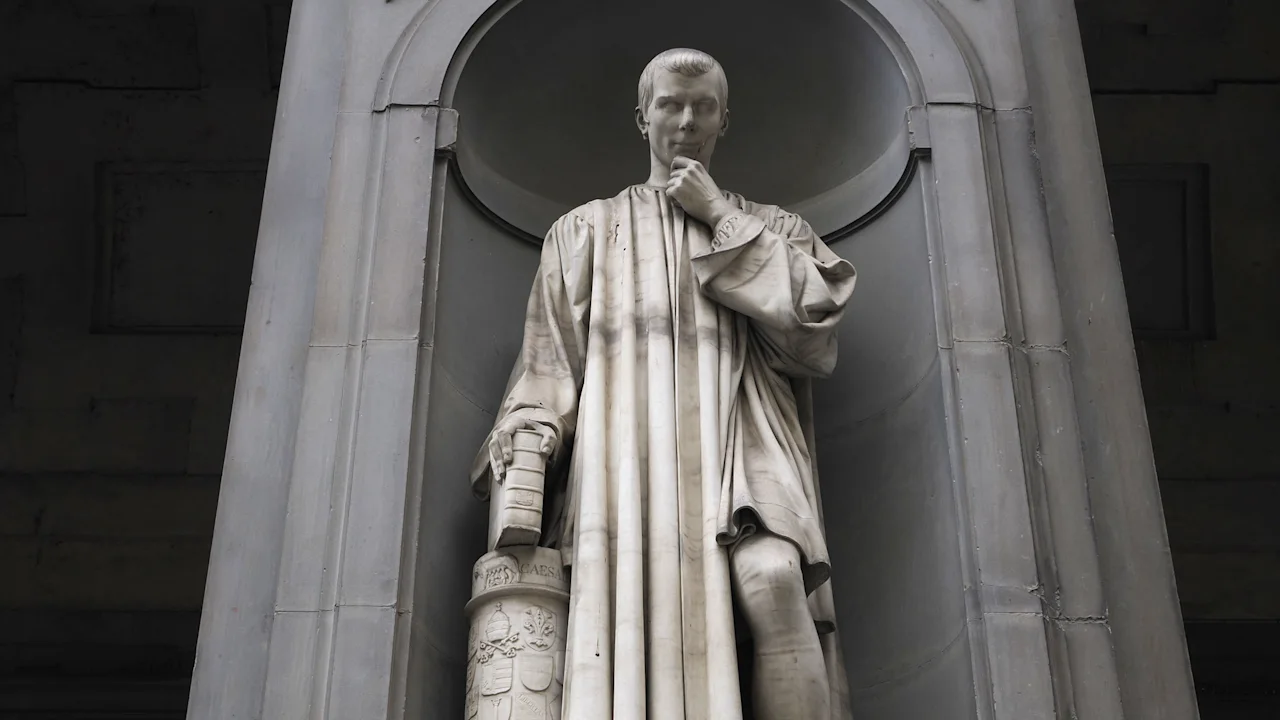
Niccolò Machiavelli, the infamous author of The Prince, wrote in the 1500s that the ideal leader makes and breaks solemn agreements. He creates alliances with weak allies to defeat a powerful enemy and then eliminates them one by one. He blames his next-in-charge for his own mistakes, and he executes opponents in public.
St. Francis of Assisi was the antithesis of a Machiavellian leader. Born in 1181, the future saint renounced his father’s wealth, then spent the remainder of his life wandering around northern Italy as a beggar and preacher. Francis gained a reputation for extreme humility—but certainly he was not weak. He dealt with popes, nobles and even an Egyptian sultan. He founded a religious order, the Franciscans, that survives today.
In modern times, Machiavellian leaders abound in the corporate world. Perhaps more surprisingly, many other business leaders resemble Francis: humble and self-effacing, but by no means weak. In our research, we argue that two types of motivation help to explain these vast and enduring differences in leadership.
‘Two faces of power’
Psychologists have long been fascinated by people’s nonconscious motives—and how to measure them. One influential assessment, developed in the 1930s, is the Thematic Apperception Test, or TAT. People write short stories about ambiguous pictures, and researchers then analyze the stories to see which themes emerge: what the writer cares or worries about, and how they see the world.
In 1970, psychologist David McClelland coined the phrase “the two faces of power” to describe two different types of power that motivate people, based on his TAT analyses: personal power and socialized power. Personal power is the motivation to dominate others. McClelland noted that people with a desire for personal power tend to use imagery that evokes “the ‘law of the jungle’ in which the strongest survive by destroying their adversaries.” Socialized power, on the other hand, aims to benefit others.
McClelland noted that personal power was associated with behavior like heavy drinking, gambling, aggressive impulses and collecting “prestige supplies,” like convertibles. People concerned with the more socialized aspect of power, meanwhile, join more organizations and are more apt to become officers in them, including sports teams.
A few years later, McClelland and consultant David Burnham published an article titled “Power is the Great Motivator,” elaborating on this basic link between power motivation and leader effectiveness. Through a series of biographical vignettes and an analysis of a large company, they showed that managers exhibiting a high degree of socialized power were more effective than managers motivated by personal power.
Measuring motivation
It seemed to us that personal power, the “law of the jungle,” motivates the kinds of behavior approvingly described by Machiavelli. Likewise, socialized power seemed to underlie the forceful but altruistic behavior of St. Francis and modern so-called humble leaders.
But we faced a problem: how to measure motivation. Powerful people such as world-class CEOs have little inclination to take TATs or answer questionnaires for admittedly humble scholars.
In the 1990s, psychologist David Winter showed that speeches, interviews and diplomatic texts reveal nonconscious motivation in the same way as the Thematic Apperception Test—demonstrating a way to study leaders’ views of power. For example, someone driven by a desire for personal power often tries to control or regulate people around them; attempts to persuade and convince; and is concerned with fame, status and reputation.
However, Winters’ procedures for analyzing texts are manual and complex; it is difficult to process a large number of documents. Also, he focused on personal power; socialized power was not included in his coding procedures.
Words and action
In order to overcome these limitations, we used computer-aided text analysis to analyze the language of CEOs in interviews and conference calls.
In a series of 2019 studies, which were peer-reviewed and summarized in the Academy of Management Proceedings, our team identified 40 Machiavellian and 40 humble CEOs. First, we took a close look at the types of words and phrases that distinguished the two groups, shedding light on the kind of power that motivates each one.
Using these patterns, we created two “dictionaries” of words and phrases that expressed personal power and socialized power. Language about strong, forceful actions, control, managing impressions, punishment and fear of failure, to name a few themes, constituted the personal power dictionary. “Defeat,” “overrun” and “strafe,” for example, appeared among the words on the personal power list. Themes such as rewards, mentoring and positive relationships characterized the socialized power dictionary.
Then, we used a computer program to scan hundreds of interviews and quarterly conference calls. The computer program calculated personal and socialized power scores for each of the CEOs.
Our team also developed indexes of Machiavellian and humble leader behavior—such as smearing competitors and backing out of agreements, or making significant donations to charity, respectively—and measured all 80 CEOs.
We found very high correlations between power motivation and CEO behavior. CEOs with high personal power scores, based on our analysis of their interviews and conference calls, also tended to show Machiavellian behavior. CEO humble behavior was positively related to socialized power.
People and profits
Do these abstract statistical results really mean anything? Evidently.
Numerous CEOs from our list of humble executives have founded or managed exceptionally successful and people-oriented companies, including Warren Buffet of Berkshire Hathaway, Danny Wegman of Wegmans, and James Goodnight of the SAS Institute. Several of the “humble” CEOs have appeared multiple times on Fortune’s annual Best Companies to Work For list.
The Machiavellian CEO list included Kenneth Lay of Enron fame and John Rigas, one of the founders of Adelphia Communications Corporation, who was convicted of fraud. Mark Hurd, one-time CEO of Hewlett Packard, appeared on Complex’s list of the worst chief executive officers in tech history. In general, criticisms of “profits over people,” poor treatment of employees, scandals, lavish spending, lawsuits and accusations or convictions of fraud characterize many of our Machiavellian CEOs.
McClelland and Burnham were right. Power really is the “great motivator,” but it’s the type of power that makes the difference.
William D. Spangler is an associate professor emeritus of management at Binghamton University, State University of New York.
Aleksey Tikhomirov is a lecturer of public administration and policy at Binghamton University, State University of New York.
This article is republished from The Conversation under a Creative Commons license. Read the original article.