
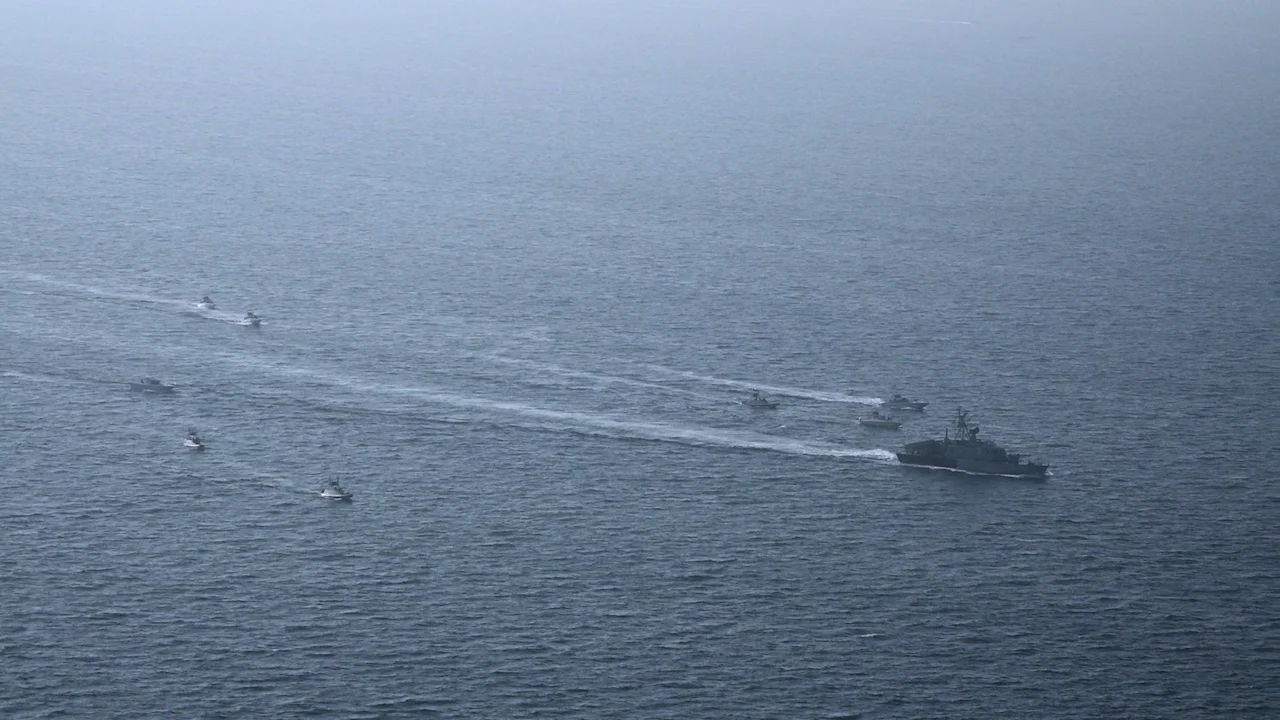
The Strait of Hormuz is a small strip of water connecting the Persian Gulf to the world’s oceans, and it has become a big problem for the global economy.
On a typical day, ships carrying about a fifth of the world’s oil sail out of the Gulf through the narrow passageway. But the war with Iran means it’s effectively closed, hemming in more than 90% of that crude and refined products, according to the International Energy Agency. The Islamic Republic has vowed to block the region’s oil exports, saying it would not allow “even a single liter” to be shipped to its enemies.
The snarls have sent oil prices above $100 per barrel and threatened a surge of painful inflation for the global economy if the blockage lasts a long time.
“The scale of what is at stake cannot be overstated,” said Hakan Kaya, senior portfolio manager at investment management firm Neuberger Berman.
Some energy analysts believe oil prices could jump to $150 per barrel if the strait remains closed for weeks and conditions worsen. That would mean even higher gasoline prices for drivers worldwide, undercutting household budgets already pressured by high inflation. It would also raise costs for businesses, which could in turn raise prices for customers.
“One way or the other, we will soon get the Hormuz Strait OPEN, SAFE, and FREE!” President Donald Trump said in a posting on his social media network Saturday.
Here’s what to know about the strait and the widening Iran war.
A key waterway for global shipping
The Strait of Hormuz is a bending waterway, about 33 kilometers (21 miles) wide at its narrowest point. It connects the Persian Gulf to the Gulf of Oman. From there, ships can then travel to the rest of the world. While Iran and Oman have their territorial waters in the strait, it’s viewed as an international waterway all ships can ply. The UAE, home to the skyscraper-studded city of Dubai, also sits near the waterway.
The strait long has been important for trade
The Strait of Hormuz through history has been important for trade, with ceramics, ivory, silk and textiles moving from China through the region. In the modern era, it is the route for supertankers carrying oil and gas from Saudi Arabia, Kuwait, Iraq, Qatar, Bahrain, the UAE and Iran. The vast majority of it goes to markets in Asia, including Iran’s top oil customer, China.
While there are pipelines in Saudi Arabia and the UAE that can avoid the passage, the U.S. Energy Information Administration says “most volumes that transit the strait have no alternative means of exiting the region.”
Threats to the route have caused global energy prices to spike before, like in June during the Israel-Iran war.
Mounting attacks
The United Kingdom Maritime Trade Operations center, run by the British military, says it has received 21 reports of incidents affecting vessels in and around the Persian Gulf, Strait of Hormuz and Gulf of Oman as of Tuesday. It lists 16 attacks and five others as “suspicious activity,” involving tankers, tugs, cargo and other vessels.
The waterway is effectively shut
The strait is effectively closed as Iran targets energy infrastructure and traffic through the strait.
Previously, Iran temporarily shut down parts of the strait in mid-February for what it said was a military drill. In past times of tension and conflict, Iran has at times harassed shipping though the narrows, and during the 1980s Iran-Iraq war, both sides attacked tankers and other vessels, using naval mines to completely shut down traffic at points. But Iran up until now not carried out repeated threats to close the waterway altogether since then, even during last year’s 12-day war when Israel and the U.S. bombarded Iran’s key nuclear and military sites.
The U.S. is rolling out ship reinsurance in the region through the U.S. International Development Finance Corp., a government agency that partners with the private sector to back global investment projects, in an effort to get ships moving through the strait again.
Political risk insurance is a type of coverage intended to protect firms against financial losses caused by unstable political conditions, government actions, or violence. Marine insurers had been canceling or raising rates for insurance in the region.
The U.S. reinsurance facility will insure losses up to approximately $20 billion on a rolling basis, according to the International Development Finance Corp., focusing on insuring cargo and physical damage to a ship’s structure and operating machinery to start.
Trump said that, if necessary, the U.S. Navy would escort oil tankers through the strait, though that has yet to happen.
On Wednesday, Trump’s Energy Secretary Chris Wright briefly posted on social media that the U.S. Navy had escorted a tanker through the strait, but he later deleted the false claim. The initial posting and walk back helped send oil prices and stock markets swinging sharply, showing how the singular focus of markets is on getting ships through the strait again.
Some traffic is getting through. A vessel-tracker said Tuesday that 15 ships moved through the Strait of Hormuz in the past three days.
MarineTraffic, which tracks positions of ships globally, said they included eight bulk vessels, five tankers and two Liquified Petroleum Gas carriers.
Rejection from NATO
Trump said NATO and most other allies have rejected his calls to help secure the Strait of Hormuz as Iran war rages on.
Trump fumed in a post on social media that the U.S. is not getting support “despite the fact that almost every Country strongly agreed with what we are doing, and that Iran cannot” be allowed to secure a nuclear weapon.
“I am not surprised by their action, however, because I always considered NATO, where we spend Hundreds of Billions of Dollars per year protecting these same Countries, to be a one way street,” Trump added. “We will protect them, but they will do nothing for us, in particular, in a time of need.”
Global shippers suspend operations
Global shippers have issued service alerts saying they have suspended operations in the area.
“Those ships that got stuck in the Gulf are not going anywhere,” said Tom Goldsby, logistics chairman in the Supply Chain Management Department at the University of Tennessee. “There’s also a whole host of ships that were heading into the Gulf to replace them, and of course they’re anchored or going elsewhere now.”
The effort to free up oil
As the Strait of Hormuz remains at a standstill, a group representing many of the world’s wealthiest countries said it will release the largest volume of emergency oil reserves in its history. The International Energy Agency said it will make 400 million barrels of oil available from its members’ emergency reserves, which is more than double the 182.7 million barrels that the IEA’s 32 member countries released in 2022 in response to Russia’s full-scale invasion of Ukraine.
But while such moves can replenish some of the oil supplies blocked in the Persian Gulf, they do so only for the short term. For a longer-term fix, analysts say the Strait of Hormuz needs to clear.
The White House is also looking into waiving Jones Act requirements. The 1920s law is often blamed for making gas more expensive. It requires goods shipped between U.S. ports to be moved on U.S.-flagged vessels, and is designed to protect the American shipbuilding sector.
—Jon Gambrell and Mae Anderson, Associated Press
Associated Press writers Cara Anna, Stan Choe, Collin Binkley, and Aamer Madhani contributed to this report.