
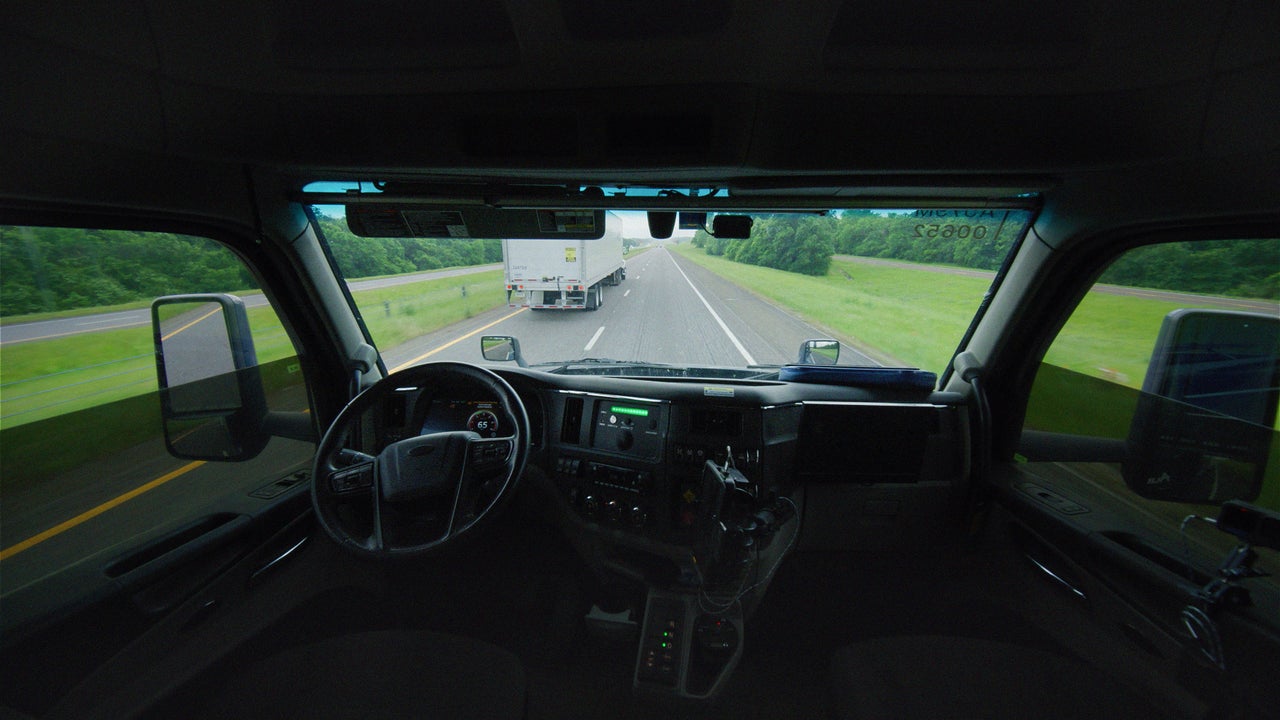
Driverless trucks with artificial intelligence on board could dramatically change the landscape of freight shipping. A few companies have begun testing early models on some limited routes in Texas and California. Simulations of automated fleets show the potential benefits of the technology: The vehicles could improve safety, enhance fuel economy, and lessen transit times.
Truck makers and operators still have to solve some major issues, however, including how automated trucks will operate in variable weather and road conditions, and whether drivers should still be inside big rigs.
I am an engineer who studies human factors and transportation safety, and in my view, it is likely that automated trucks and human drivers will be working together for quite some time.
Benefits of automation
Fully automated trucks, which can drive on an interstate highway in good weather without human intervention, use a combination of AI, machine learning, computer vision, pattern recognition, and adaptive decision-making. Torc, one company developing these vehicles, uses AI to combine data from multiple sensors and generate models that predict truck performance.
Data taken from modern big rigs that are equipped with certain technology such as automatic emergency braking and lane-keeping assistance systems indicate that fully automated, driverless trucks could reduce the number and severity of crashes. They could also save fuel and therefore cost by optimizing acceleration and braking, and by running multiple vehicles in a close-knit convoy or platoon. Driverless trucks could reduce parking needs as well as emissions from idling because they could run almost 24 hours a day and would not need to idle when they do park, which is common for regular rigs at truck stops.
Finally, automated trucks could help ease the ongoing driver shortage. Ironically, automation could make driving less stressful and less physically demanding, improving job satisfaction among drivers.
Weather and work zones are hard to navigate
The main reason automated trucks are not common today is that they have difficulty operating in variable weather, under changing roadway conditions, and alongside unpredictable drivers.
Automated trucks require sensors, radars, and cameras that gather information about the environment around them to make decisions. However, snow and rain remain a problem for all automated vehicles, including cars, because they prevent the technology from “seeing” the roadway. Driverless taxi company Waymo, for example, operates driverless cars only in areas that get no snow.
Furthermore, any stretch of road where there may not be a predictable, clear surface and prevalent lines is difficult to handle. Imagine a construction zone with orange cones, narrow lanes, and missing lane lines. Driverless car companies still try to avoid these areas. And, oddly, some research shows that automobile drivers tend to crash into driverless cars at a higher rate than they do cars piloted by people.
Given those challenges, companies are testing automated trucks on roads that lack complications.
For example, autonomous truck maker Aurora is operating large freight trucks on I-45, a relatively flat and straight highway between Dallas and Houston. Rival Kodiak’s robotrucks are delivering sand to industrial sites in Texas over roads few people use. Few if any automated trucks are being tested in chaotic urban environments, given the pedestrians, bicyclists, traffic lights, and elements of city traffic.
Driverless trucks are operating on some roads in Texas.
Some companies that were developing automated trucks have scaled back ambitions, changed direction, or exited the market.
In 2023, Embark, TuSimple, and Locomotion closed down. Waymo began to focus solely on cars. Other companies narrowed their focus to trucks that would operate only along a few dedicated routes between two large cities or manufacturing sites.
Drivers and trucks that work together
In my view, for years to come, automated trucks with AI-based controls will still require a driver.
The best technology will support a symbiosis between human and machine, where the person and the truck each do what they do best. A human would likely drive the truck across the “first mile”—the uncertain and crowded warehouse grounds and local streets to a highway. The driver would then stop using the steering wheel, gas pedal, and brake and let automation take over. The human would take back control during the “last mile” to the truck’s final destination.
Research my colleagues and I conducted shows that human-machine interfaces that communicate between drivers and autonomous vehicles will be key. For example, a screen or head-up display inside the cab would tell the driver how the technology is doing. Verbal messages or a vibrating seat could signal that the automation cannot handle a developing situation, and the driver would take over.
Developers will have to be aware of possible biases. So-called automation bias could lead to a driver who trusts and relies on the truck’s decision-making so much that they defer to it. Algorithmic bias could cause truck sensors to recognize certain groups of people on the road more than others, such as only detecting pedestrians of a certain size or shape.
The long-term vision is to have no driver, in part to lower costs. But driverless trucks do not seem to me to be practical on a large scale in the near future. It is more realistic to envision the driver and the automated truck as a team. Vehicle manufacturers, technology developers, regulators, and drivers will need to work together to realize the benefits.
Shannon Roberts is an associate professor of industrial engineering at UMass Amherst
This article is republished from The Conversation under a Creative Commons license. Read the original article.