
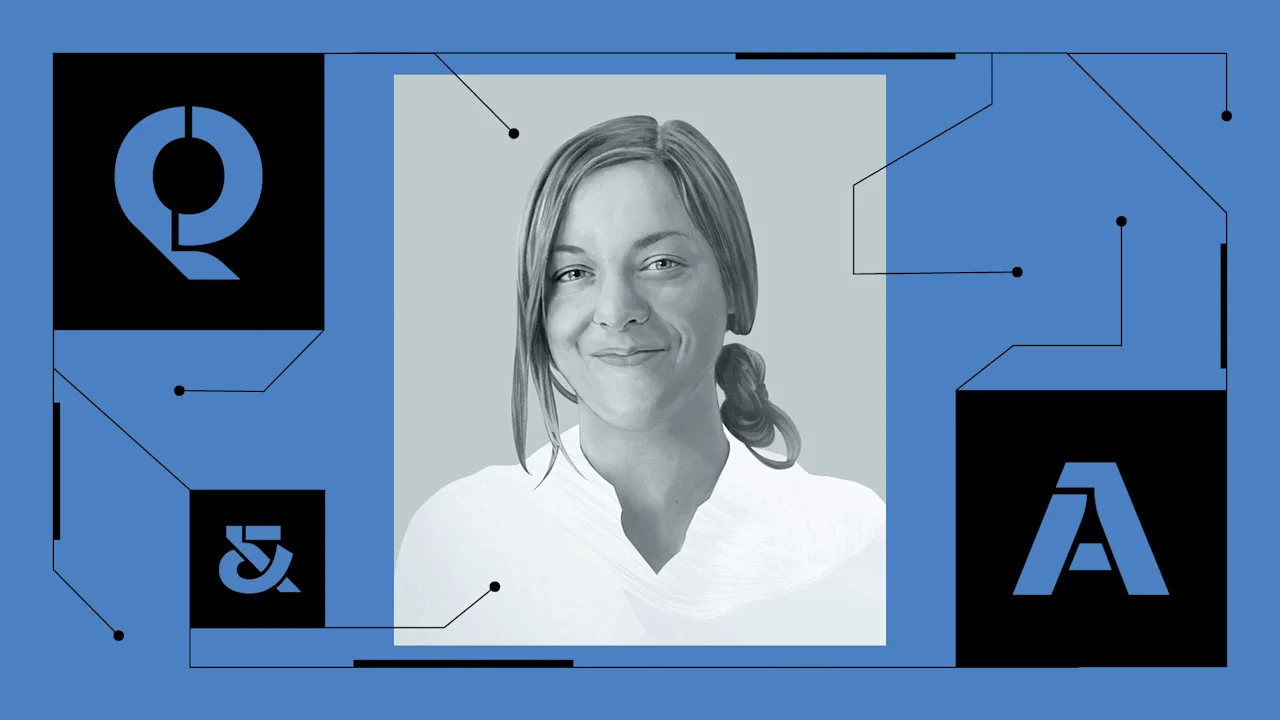
A few years ago, Tara Feener’s career took an unexpected pivot. She’s spent nearly two decades working on creative tools for companies like Adobe, FiftyThree, WeTransfer, and Vimeo, and was content to keep working in that domain.
But then the Browser Company came along, and Feener saw an opportunity to build something even more ambitious. Feener—one of Fast Company’s AI 20 honorees for 2025—is now the company’s head of engineering, overseeing its AI-focused Dia browser and its earlier Arc browser.
The browser is suddenly an area of intense interest for AI companies, and Feener understands why: It’s the first stop for looking up information, and it’s already connected to the apps and services you use every day. OpenAI and Perplexity both offer their own browsers now, borrowing some Dia features like the ability to summarize across multiple tabs and interrogate your browser history. The Browser Company itself was acquired in September by Atlassian for $610 million, proclaiming that it would “transform how work gets done in the AI era.”
Feener says her team has never felt more creative. “We’ve never seen more prototypes flying around, and I think I’m doing my job successfully as a leader here if that motion is happening,” she says.
This Q&A is part of Fast Company’s AI 20 for 2025, our roundup spotlighting 20 of AI’s most innovative technologists, entrepreneurs, corporate leaders, and creative thinkers. It has been edited for length and clarity.
How’d you end up at the Browser Company?
[The Browser Company CEO] Josh Miller started texting me. We were both in that 2013 early New York tech bubble, we had a couple conversations, and he pitched me on the Browser Company.
At first I couldn’t connect it to the arc of my career in creativity, but then it just became this infectious idea. I was like, “Wait a minute, I think the browser is actually the largest creative canvas of my entire career. It’s where you live your life and where you create within.”
Why does it feel like AI browsers are having a moment right now?
I really do believe that the browser is the most compelling, accessible AI layer. It’s the number-one text box you use. And what we do is, as you’re typing, we can distinguish a Google search from an assistant or a chat question. In the future, you can imagine other things like taking action or tapping into other search engines. It basically becomes an air traffic control center as you type, and that’s going to help introduce folks to AI just so much faster because you don’t have to go to ChatGPT to ask a question.
That’s part one. Part two is just context. We have all of your stuff. We have all of your tabs. We have your cookies. With other AI tools, the barrier to connecting to your other web apps or tools is still high. We get around that with cookies within the browser, so we’re able to just do things like draft your email, or create your calendar event, or tap into your Salesforce workflow.
How do you think about which AI features are worth doing?
I just see it as another bucket of Play-Doh. I never wanted to do AI for the sake of AI but for leveraging AI in the right moment to do things that would have been really hard for us to do before.
A great example is being able to tidy your tabs for you in Arc. There’s a little broom you can click, and it starts sweeping, and it auto-renames, organizes, and tidies up your tabs. We always had ambitions and prototypes, but with large language models, we were able to just throw your tabs at it and say, “Tidy for me.”
With Arc, it was a lot about tab management. With Dia, we have context, we have memory, we have your cookies, so it’s like we actually own the entire layer. We leverage that as a tool for things like helping you compare your tabs, or rewriting this tab in the voice of this other tab, which is something I do almost every day. Being able to do that all within the browser has just been a huge unlock.
Can you elaborate on how Dia taps into users’ browser histories?
Browser history has always been that long laundry list of all the places you’ve been, but actually that long list is context, and nothing is more important in AI than context. Just like TikTok gets better with every swipe, every time you open something in Dia we learn something about you. It’s not in a creepy way, but it helps you tap into your browser history.
Just like you can @ mention a tab in Dia and ask a question, like “give me my unread emails,” with your history you can do things like, “Break down my focus time over the past week,” or “analyze my week and tell me something about myself given my history.” We have a bunch of use cases like that in our skills gallery that you can check out, and those are pretty wild. In ChatGPT and other chat tools, it feels like you have to give a lot to build up that context body. We’re able to tap into that as a tool in a very direct way.
Some AI browsers offer “agent” features that can navigate through web pages on your behalf. Will Dia ever browse the web for you?
We’ve done a bunch of prototypes and for us, the experience of just literally going off and browsing for you and clicking through web pages hasn’t felt yet fast enough or seamless enough. We’re all over it in terms of making sure we’re harnessing it at the right moment and the right way when we think it’s ready.
We don’t want to hide the web or replace the web. Something I like to say about Dia is that we want to be one arm around you and one arm around the internet. And it’s like, how can we make tapping into your context in your browser feel the same way it would feel to write a document, or even just to create something with plain, natural language? I think that’s like the most powerful thing.
It’s like the same feeling I had when I was young and tapped into Flash, and that people had with HTML. With AI, literally my mom can write a sentence like, “turn this New York Times recipe into a salad,” and in some way she’s created an app that does some kind of transformation. And that just gets me really excited.