

When the iPhone first introduced apps in 2008, a feverish gold rush followed. New APIs and design standards made it easier to make software—even by non-coders.
The question became: Could you create a small experience, perhaps something as simple as a fart button app, that could make you a million dollars in a weekend? (And while some people definitely cashed in, a majority of us did not.)
Nearly two decades later, the rest of us have another opportunity to rethink mobile software. We’ve entered the era of vibe coding—in which complex software can be generated with nothing but plain language prompts. Now, rather than offer developers the tools to make the next hit app, it seems phone manufacturers may urge everyone to vibe-code their next widget.
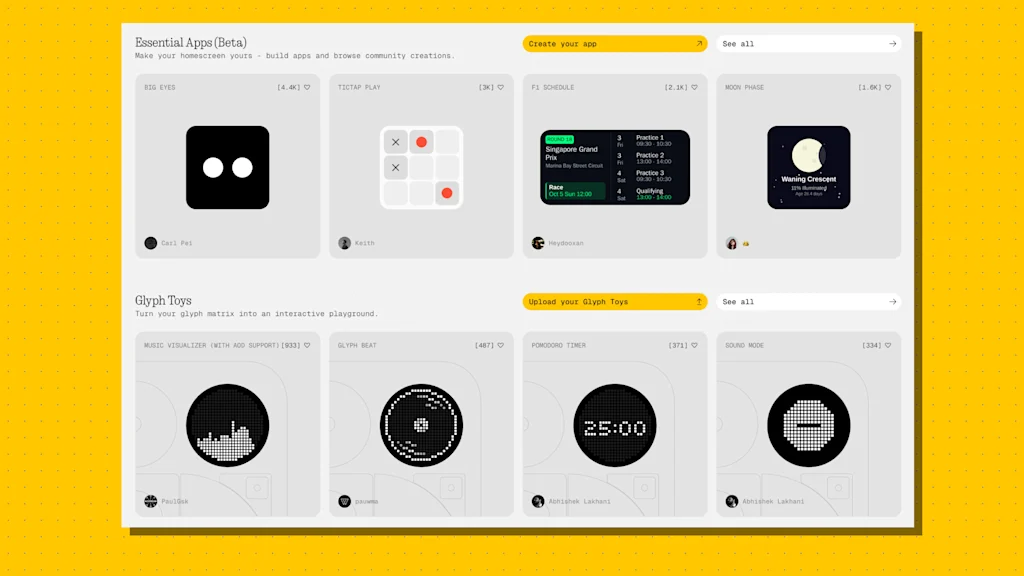
The hypebeasty smartphone company Nothing Technology has launched what it’s calling Essential Apps in beta on its website. What that really means is that, for the first time, you can simply describe the widget you’d like to have (maybe the latest scores from your favorite team, or a slideshow of beautiful public domain imagery), and it will become a widget that you can download right to your phone, or even share with the public.
Nothing’s mantra? “One billion apps for one billion people.” I still prefer the term “widgets” for what Nothing is sharing, but I’ll admit that it’s a good line.
Because it seems quite feasible that, for many of us, our first experience with vibe coding will actually be a widget.
The rise of widgets
Full-blown apps have been the main modality of smartphones since the early days of the App Store. But the industry has embraced widgets for nearly as long—as lighter-weight, glanceable apps that are always open on your screen.
Desktop computers had used widgets for years before Google introduced them to Android in 2009. Apple held out until 2014. While they’ve always represented a strange mortar of our digital lives, widgets have remained an established part of our app lexicon as bite-size vessels for information that can live wherever you want on your phone.
Vibe coding is amazing, but it’s still involved in building something as complex as a modern app. Widgets, on the other hand, have such a limited scope that they seem perfect for an inexperienced vibe coder. The information you want is the interface, and there’s not a lot more to it.
Nothing isn’t technically the first company to come up with the idea of vibe-coding widgets on a mobile platform. You may have forgotten that this was also the biggest promise from Rabbit, the early AI hardware company that captured the tech world’s imagination in 2024—before turning out to be less capable than promised. (Meanwhile, its founder, Jesse Lyu, is building a new piece of hardware completely dedicated to vibe coding that’s called the Cyberdeck.)
Nothing has sold over 7 million devices to a loyal crowd that appreciates its quirkier, more expressive approach to design. Its phones have touches like its Glyph Button on the back, which can contain cute micrographics that evoke the Atari era.
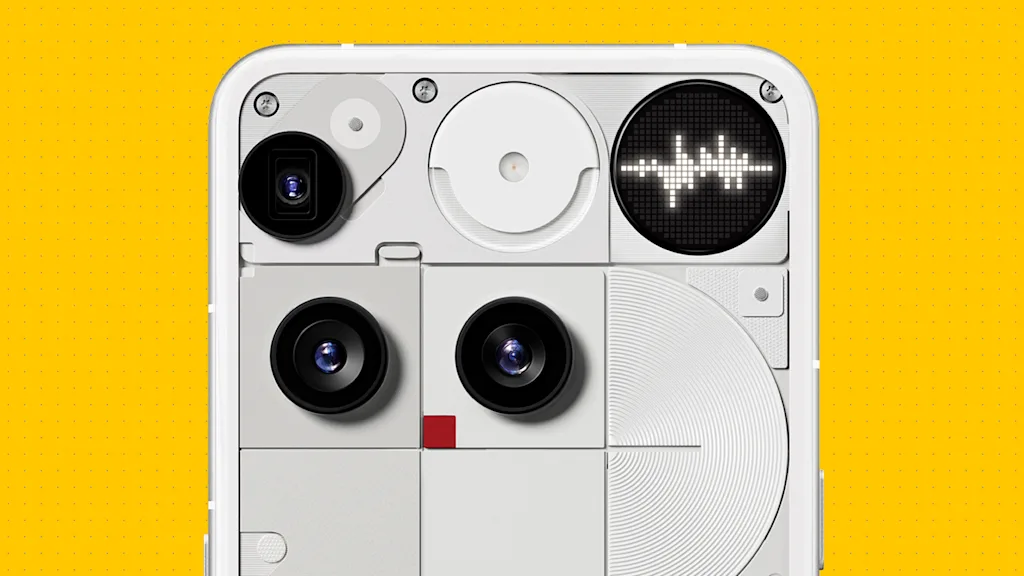
As it turns out, Nothing’s vibe coding supports new animations for this button—and people have already generated music visualizers and timers. Other early works you can find from Nothing vibe coders—which, for now, seem to be Nothing’s own employees—include tic-tac-toe and phases of the moon. They’re also letting people generate and share custom music equalizers and photo slideshows.
Two different early hands-ons both suggest Nothing’s vibe coding isn’t as perfectly automated as we may imagine, but the modality seems promising all the same. While I don’t believe every human on earth is capable of developing the next Uber by vibe coding, it’s easy to imagine myriad people having a tiny, very specific problem related to their commutes, or a transportation challenge that they’d love to solve. And vibe-coded widgets offer a reasonable container for those solutions.
This is only the beginning
This is all to say that while Nothing was first(ish) out of the gate, I suspect vibe-coded widgets are going to be an extraordinarily popular modality sold by phone manufacturers. And not even necessarily because people need or want them, but because their limited scope seems just right for welcoming the masses into a cutting-edge behavior.
Samsung, for instance, is already trying to distinguish its platform with AI integration of all types. Google, a global leader in all things AI at this moment, is almost certainly working on tools like this. On our December By Design podcast, former Fast Company design editor—and current Google senior staff designer working on Android AI—Cliff Kuang suggested vibe coding would be the biggest paradigm for “the next decade or even century.”
Even Apple, a company I would naturally assume would never touch vibe coding, may come to surprise us. Consider that it’s already embraced generative AI in Messages and other apps, and it just signed a deal to source its next AI model from Google. I could certainly imagine Apple, working with its collection of internally designed components, creating a widget customizer for its users.
And of course, we cannot count out Chinese companies, which produce around 50% of smartphones globally. Huawei, in particular, already offers a variety of Service Cards—an evolution of the widget that can turn an app into a little card, complete with the app’s core functions, right on the home screen. Why couldn’t AI make the perfect intermediary here, for a user to customize exactly what they want to surface from an app?
I’m not saying that vibe-coded widgets will become the predominant way we interact with our smartphones. As few as 15% of Apple users report actively using them today. But I do believe that a combination of feasible scope and FOMO-driven strategy could drive the entire smartphone industry in this direction over the next year or two.
In other words: If you haven’t delved into vibe coding yet, don’t be surprised if your first project is a widget.