
Want more housing market stories from Lance Lambert’s ResiClub in your inbox? Subscribe to the ResiClub newsletter.
Zillow economists just published their updated 12-month forecast, projecting that U.S. home prices—as measured by the Zillow Home Value Index—will shift down 0.1% from April 2026 to April 2027.
That’s a tiny downward revision from its 12-month national forecast published in April (+0.1%) and its 12-month national forecast published in March (+0.5%).
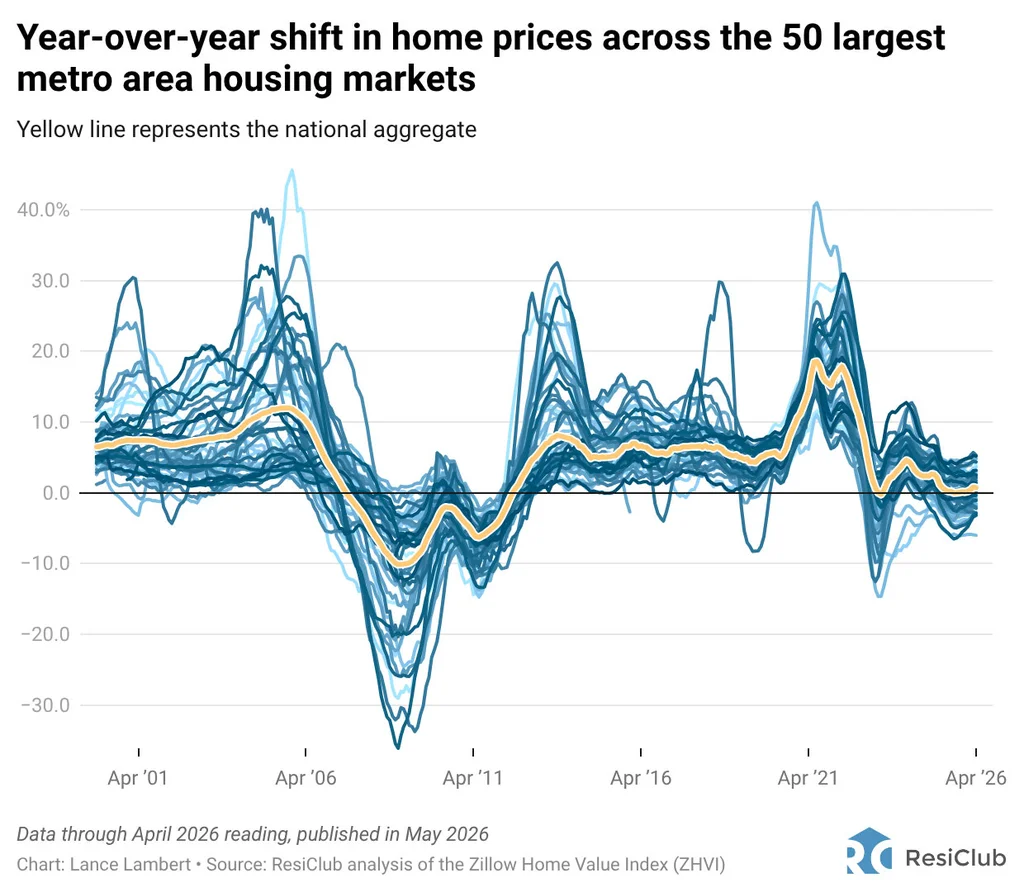
U.S. home prices, as measured by the Zillow Home Value Index, are currently up 0.7% year over year. Zillow’s latest 12-month outlook (-0.1%) expects national home prices to remain near that subdued pace. As long as national home price growth remains below U.S. wage growth (currently up 3.6%), underlying fundamentals should continue to improve. If that trend continues—and mortgage rates don’t spike—national housing affordability should also continue to gradually improve.
While Zillow’s national home price forecast isn’t negative—it isn’t exactly bullish either. It’s calling for a soft national housing market in 2026, one where national housing affordability may improve slightly as U.S. income growth outpaces U.S. home price growth.
What type of regional variation does Zillow anticipate over the next 12 months?
(function(){function e(){window.addEventListener(`message`,function(e){if(e.data[`datawrapper-height`]!==void 0){var t=document.querySelectorAll(`iframe`);for(var n in e.data[`datawrapper-height`])for(var r=0,i;i=t[r];r++)if(i.contentWindow===e.source){var a=e.data[`datawrapper-height`][n]+`px`;i.style.height=a}}})}e()})();
Among the 300 largest U.S. metro-area housing markets, Zillow forecast the biggest home price increase from April 2026 to April 2027 to occur in these 15 metros:
- Syracuse, New York → 4.8%
- Rockford, Illinois → 4.5%
- Atlantic City, New Jersey → 4.1%
- Utica, New York → 4.0%
- Rochester, New York → 3.9%
- Binghamton, New York → 3.6%
- Pottsville, Pennsylvania → 3.3%
- Knoxville, Tennessee→ 3.2%
- Norwich, Connecticut → 3.2%
- Erie, Pennsylvania → 3.1
- Morristown, Tennessee → 3.1%
- Janesville, Wisconsin → 3.0%
- Buffalo → 2.9%
- Youngstown, Ohio → 2.9%
- Kingston, New York → 2.9%
Among the 300 largest U.S. metro-area housing markets, Zillow forecast the biggest home price decline from April 2026 to April 2027 to occur in these 15 metros:
- Houma, Louisiana → -6.7%
- Lake Charles, Louisiana → -5.8%
- Austin → -5.4%
- New Orleans → -4.4%
- Alexandria, Louisiana → -4.1%
- Chico, California → -3.5%
- Vallejo, California → -3.4%
- Beaumont, Texas → -3.4%
- Lafayette, Louisiana → -3.3%
- Punta Gorda, Florida → -3.2%
- San Francisco → -3.1%
- Santa Rosa, California → -3.0%
- Denver → -2.8%
- San Antonio → -2.8%
- Shreveport, Louisiana → -2.8%
My quick take: Based on my own analysis, I believe Zillow is too bearish on the New Orleans metro-area housing market—which is showing signs of mild tightening after passing through a correction—and also too bearish on pockets of the Bay Area, especially San Francisco proper, which has benefited from AI boom spillover (although pockets of Oakland remain weak).
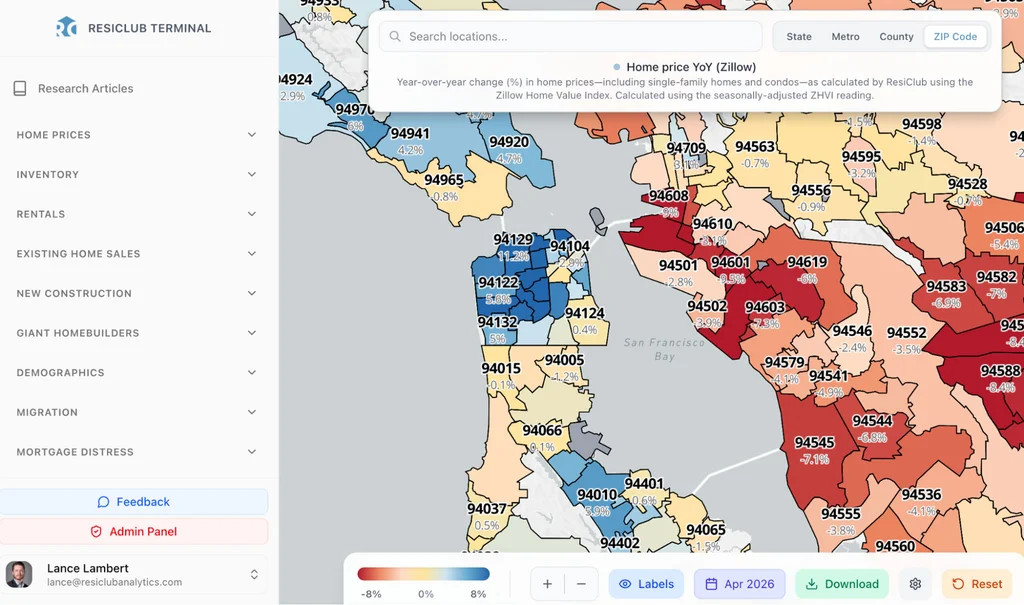
Below is what the current year-over-year rate of home price change looks like for single-family and condo home prices. The Sunbelt, in particular Southwest Florida, is currently the epicenter of housing market softness over the past year.
(function(){function e(){window.addEventListener(`message`,function(e){if(e.data[`datawrapper-height`]!==void 0){var t=document.querySelectorAll(`iframe`);for(var n in e.data[`datawrapper-height`])for(var r=0,i;i=t[r];r++)if(i.contentWindow===e.source){var a=e.data[`datawrapper-height`][n]+`px`;i.style.height=a}}})}e()})();