
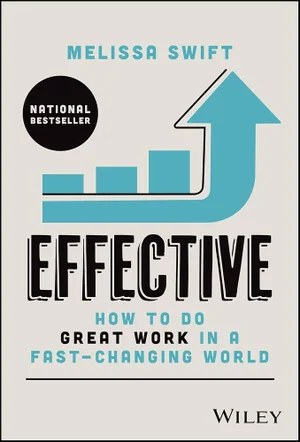
Below, Melissa Swift shares five key insights from her new book, Effective: How to Do Great Work in a Fast-Changing World.
Melissa is the founder and CEO of the consulting firm Anthrome Insight. She has held consulting leadership roles at Capgemini, Mercer, Korn Ferry, and Deloitte. Her quarterly columns in MIT Sloan Management Review often rank among their most-read articles, and her writing has also been featured in the New York Times, The Washington Post, and Newsweek.
What’s the big idea?
Many of the problems we blame on ourselves at work are actually rooted in how our jobs, tools, and organizations are designed. When we get clearer about what our work really is—and stop assuming more collaboration, multitasking, or effort is always better—we can work more effectively and with a lot less frustration.
Listen to the audio version of this Book Bite—read by Melissa herself—in the Next Big Idea App, or buy the book.
1. Most of us are not on a first-name basis with our own jobs.
When you started your current job role, did you sit there and assiduously pore over the job description for hours? Don’t worry—me neither. Most job descriptions are rough approximations of the work you will actually be doing. Who cares about the job on paper when the job in practice is what you get paid for?
But there is a wrinkle. If you asked many of the people around you—your boss, your coworkers, your customers—what they think you should be doing all day, you might get a very different answer from what it is you actually do all day. That dissonance trips up both our performance and our happiness.
We spend hours analyzing our behavior and don’t look closely enough at the other critical half of the equation: what is the work we’re asked to do? Sitting down and discussing the nature of your actual job with the people around you can be an incredibly productive conversation.
Bonus: Unlike talking about how you do your job, discussing what’s in the job itself is emotionally neutral. Dollars to donuts, you’ll discover some points of confusion and friction that, if remedied, could change your day-to-day work life for the better.
2. Think about technology like a crow.
Crows, research shows, get actual pleasure from using technology. A crow performing a task using a stick (which is cutting-edge tech in the crow world) derives more pleasure from the effort than a crow performing the same task with their teeny, little beak.
In our private lives, this is often true. It’s fun to use everything from funny face filters on your phone to a good saucepan on the stove. Technology can be delightful! It generally isn’t at work, though. And while some of this phenomenon comes from, as the old adage puts it, Flintstones at work, Jetsons at home (old, crummy technology at work, new shiny tech at home), some of the feeling of frustration and annoyance with technology comes from the fact that we’ve been taught to use work tech in a joyless fashion. We’re pushed to train up quickly, get what we need from a piece of tech, and move on.
“Crows, research shows, get actual pleasure from using technology.”
If you think about tech you use successfully in your home life, you probably toyed around with it a bit first, right? There was a sense of childlike play. And you played with whatever the technology was until you got a bit good at it, too—whereas at work we often get to the point of being barely competent and then we plateau.
So, carve out some bandwidth to truly play with new technologies and pick one or two pieces of tech that you’re going to get great at. As your enjoyment goes up, your annoyance goes down, and everything proceeds more smoothly as a consequence.
3. Humans are built to collaborate, but not too much.
The white sclera of humans’ eyes exist for a reason. When prehistoric people were hunting, having white parts of their eyes allowed them to silently communicate with the folks they were hunting with. They could gesture toward, let’s say, a woolly mammoth without having to yell and scare the woolly mammoth away. Collaboration: we are literally designed for it.
Fabulous, right? Well, yes, but it’s possible to over-collaborate, and that’s happening a lot right now. The European Working Conditions Survey identified excess interdependence—having to interact with too many people to get any task done—as a driver of work intensification, which causes soul-sucking burnout and productivity losses. In research my company conducted last year, we found that people who reported needing to involve a large number of people to get their work done were 49 percent more likely to always or often feel overwhelmed than their peers. Conversely, people who felt they were highly effective were 16 percent more likely to report being able to work largely independently.
Now, I’m not going full Jean-Paul Sartre “hell is other people” here, but rather I’m arguing for “figure 8” style collaboration. Work together, go away and work alone, then come back together. The endless email chains and back-to-back meetings are doing no one any favors. We don’t need to work together all the time—just when it matters.
4. If knowledge workers worked like lives were on the line, we’d do our jobs differently.
I spoke to a firefighter, an air traffic controller, and an emergency room physician, and the contrast between how they do their jobs and how I have done mine could not be sharper.
For example, it’s common in the corporate world to multitask—to do two things at the same time—or even to double hat—to do two jobs at the same time. Guess who doesn’t do that? Firefighters. Definitely, when things are not metaphorically on fire, you can’t do two things at once. As NYC firefighter Ro Rodriguez described, you cannot be the person holding the rope and the person rappelling down the building. You need to pick a lane and do it well.
“You cannot be the person holding the rope and the person rappelling down the building.”
To take another example, in the corporate world, we often don’t say exactly what we mean. Euphemisms and jargon abound! Emergency room doctors don’t have that option. ER physician Dr. Rebecca Parker explained to me that when someone’s loved one has died, you must tell their family members that fact in clear terms, making sure to use the word “died.” It’s not clever in her world to be vague and dance around the matter—it would be inhuman and unkind to do so. This is a level of clarity in communications that would serve us all well in corporate life.
5. You can’t always be effective.
When you look at what your job really is, it may have a fatal flaw. Most often, this fatal flaw is that you are asked to accomplish something without the resources or organizational power to do it: Leading through influence! Being a change agent! Vibes! This does not work. If your job is broken down in such a way, your chances of succeeding are very low.
On a similar front, you may have taken a job the organization doesn’t want. You’re probably asking, how can the organization not want my job? They hired me to do it! The reality is that some jobs are created because the organization inherently struggles to do that work—meaning you’ll struggle too. A great example is when organizations build innovation teams from the outside because they haven’t created the conditions for anyone to be successful at innovation.
Plenty of other things may be showstoppers for effectiveness, too: anything from your boss doing your job for you to the organization tolerating so much mediocrity that you have no chance of being great. Effectiveness isn’t universally available.
This article originally appeared in Next Big Idea Club magazine and is reprinted with permission.
Enjoy our full library of Book Bites—read by the authors!—in the Next Big Idea app.