
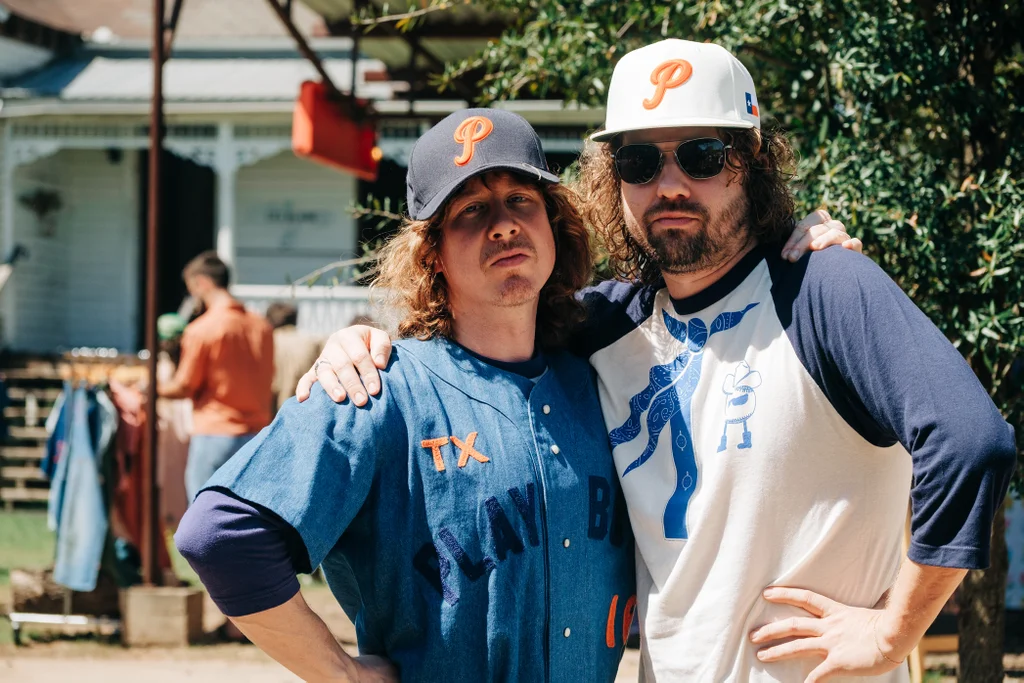
Kevin Morby arrived in Austin in mid-March to participate in a music showcase as part of South by Southwest, the city’s annual cacophony of industry obligations and branded “activations.” The Kansas City-based indie musician was due to perform a six-song solo set promoting his forthcoming album, Little Wide Open. Shortly after South by Southwest, Morby would embark on a months-long international tour in support of the record. He had every reason to make the Austin trip a quick one.
But Morby lingered for one more day, heading about a half hour southeast of the city, past ranchland and new housing developments to a spot where an enormous neon-lit baseball crossed with two bats rose like a pirate flag above the treeline. There, on an unseasonably hot afternoon, he and a loose crew of friends and fellow creatives took the field before an audience of more than 1,000 people.
The built-from-scratch venue, called The Long Time, is equal parts concert hall, art compound, and social outpost. As Morby, an avid athlete in a former life, took the mound, spectators sprawled across lawn chairs and blankets or ambled between the bar, gift shop, and pop-up flea market. Parents chased after scampering kids. A woman sold enchiladas from a cart.
Morby has made a habit of stopping by The Long Time whenever he’s in town. He seems, like so many others, captivated by the place’s strange alchemy: live music, throwback jerseys, families, and the game all folded into a single dusty spectacle. “Someone recently described it as a little league for adults,” he tells me, “which hits the nail on the head.”
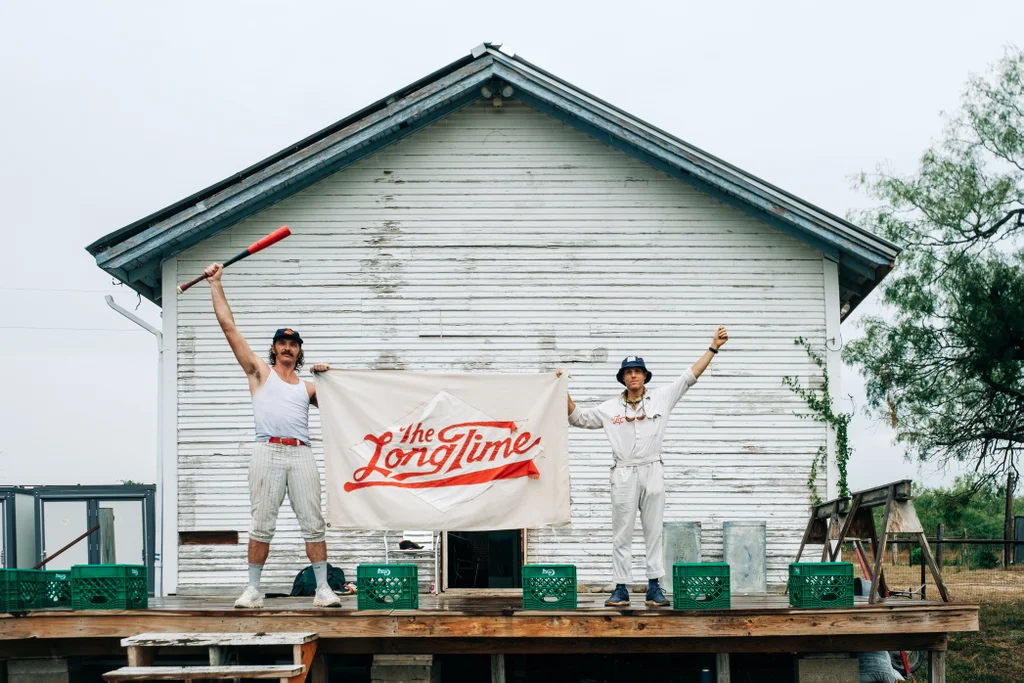
Over nearly a decade, The Long Time has evolved from a local curiosity into an epicenter locus for players, musicians, artists, and public figures. Jack White has played here a few times (and famously socked a homer). So has Beto O’Rourke (who famously didn’t). St. Louis Cardinals great David Freese, an Austin local now, plays on a team. What began as one man’s eccentric experiment is becoming a blueprint for a revivalist sports culture that is, as Morby puts it, “about bringing that childlike wonder for baseball into our adult lives.”
Morby may have been the day’s marquee draw, but Jack Sanders—who purchased the land The Long Time sits on in 2017, built the space, and runs its home team, the Texas Playboys—is the true star of the show, and the person I’d come to see. Walking up to the makeshift ticketing booth (a folding table staffed by a woman with a clipboard), sweat already pooling beneath my arms, I explained that I’m here to speak with him.
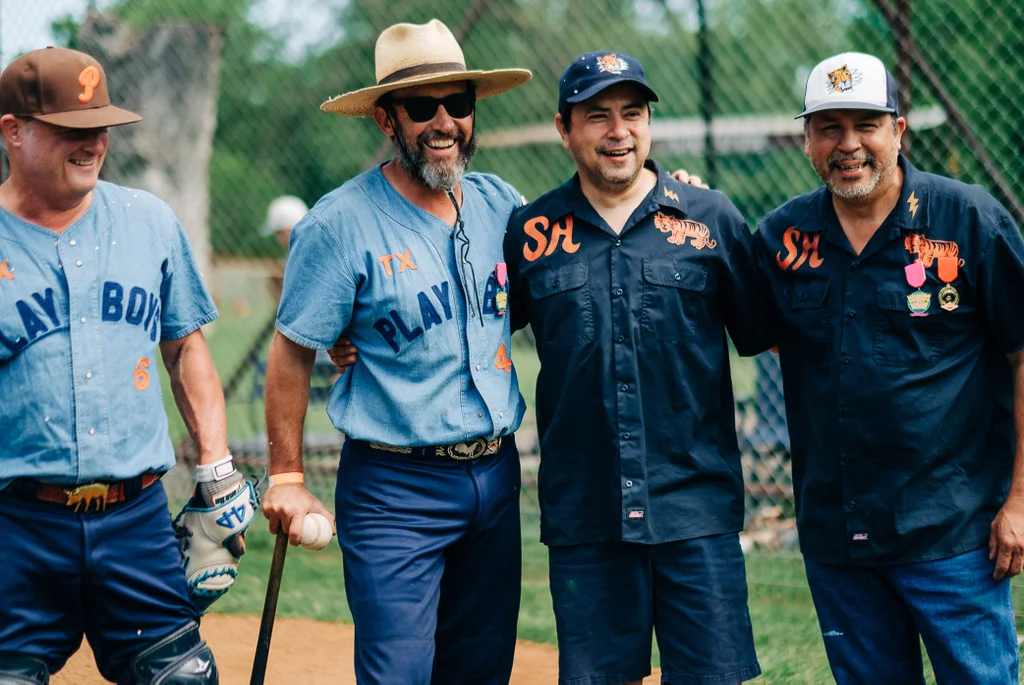
Within seconds, I found myself at a shipping container that had been fashioned into a dugout. Sanders, 49, stood just outside, wearing a straw hat and aviators and a denim jersey with “Playboys” etched across the front. At roughly six feet tall, with a salt-and-pepper beard, he looks like a Depression-era ballplayer.
We chatted for a short time before Sanders was called back to the field. He excused himself in a thick drawl delivered at what feels like 75% of the average conversational speed. (When later I remark on Sanders’ slow cadence to his friend, the Texas hotelier Liz Lambert, she shoots back, “In some places, we call that thoughtful!”)
The Long Time’s playing rules are intended to flatten the talent curve. Hit a home run, and your next at-bat must come from the opposite side of the plate, regardless of your switch-hitting ability. Homer again, and you’re handed Gracie, an enormous, unwieldy bat reserved for repeat offenders. If a team hits five home runs, any additional balls that leave the yard count as outs. Everyone gets a chance to hit.
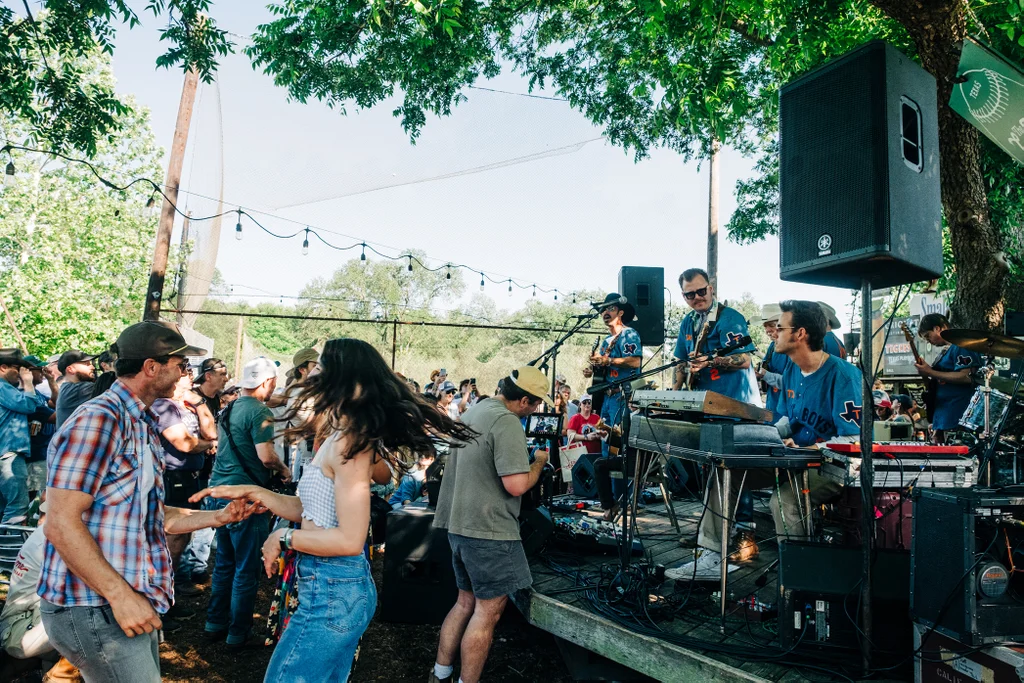
By day’s end, I couldn’t to tell you the final score, and it hardly seemed like anyone else could either. But during the mid-game stretch, my attention held rapt as Morby, who’d had a couple decent at-bats throughout the day, played a short set on a modest wooden stage tucked beneath a towering oak.
A “weirdo” among the jocks
Sanders was 18 when his competitive baseball career came to an ignominious end. It’s a story as old as time—or at least, as old as sports: Sanders had been a pitcher and first baseman on his high school team in Fort Worth, Texas, and one practice, his coach asked Sanders to move to the outfield for a spell and give this younger kid a shot at first base.
The surprise relegation proved too much for Sanders, who, by his own estimation, missed just about every ball hit in his direction. A knee injury soon after finished the job, slamming the door on baseball for good. (For those curious: That younger guy helped lead the team to a state championship the following season and went on to play for Texas Tech.)
Around the time the high school team fell away, Sanders started leaning into his bohemian side: listening to Pink Floyd, smoking weed, taking art classes in school, and settling into his role as the “weirdo” (his noun) among his jock friends.
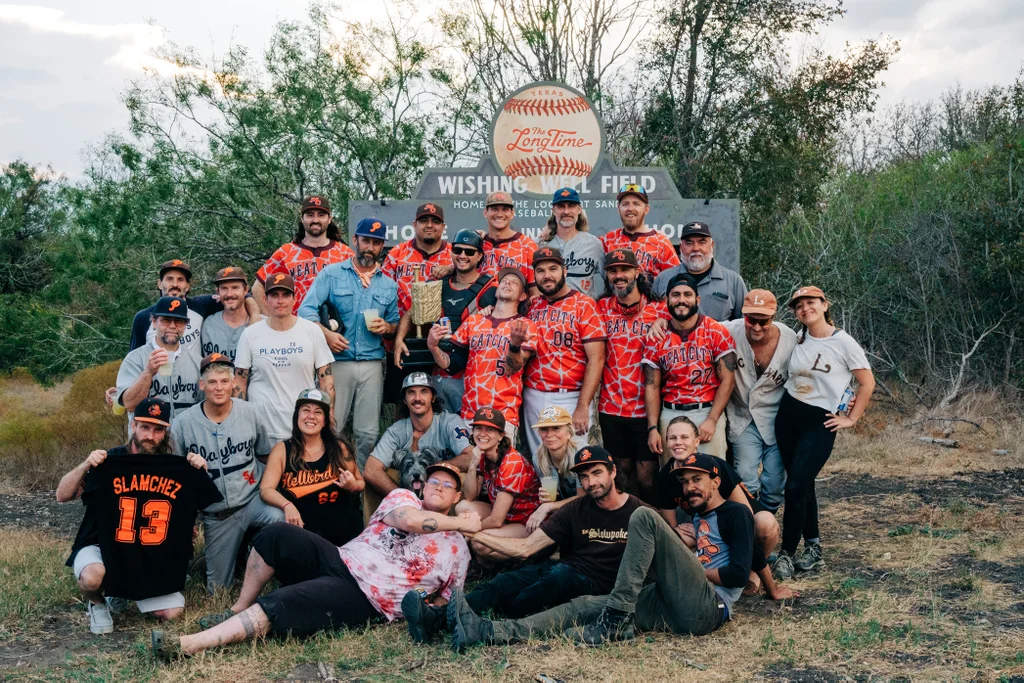
“I didn’t really care too much that baseball was out of my life because I shifted towards art,” Sanders told me a few days after the game against Morby.
Which is a fitting thing to hear as we sat inside another retrofitted shipping container dugout, this one at The Wishing Well, his newer field on the outskirts of Lockhart, about 35 miles south of Austin. Around us, a small crew of Playboys teammates was working through a slate of final preparations ahead of the field’s first game of the season. When I arrived, they were building a makeshift porch roof onto a small building being converted into a gift shop; every so often, the whine of a drill cut through our exchange. “Sorry for the noise,” Sanders says with a grin.
After high school, Sanders enrolled at Auburn University in Alabama, where he found a campus culture that turned out to be, to his dismay, eerily familiar: football, Greek life, Southern orthodoxy. “I got to Auburn and pretty quickly realized that Auburn was not that much different than Fort Worth, Texas,” he admits.
But it was through the school’s architecture program that he discovered Samuel Mockbee’s Rural Studio, an innovative design-build program in Newbern, Alabama, that would fundamentally alter his trajectory. Mockbee, a burly guy whom The New York Times once wrote “reveled in the art of ribald storytelling,” was also a MacArthur “genius” grant-winning architect, and had built Rural Studio around the reformist notion that architecture could serve poor, rural neighborhoods while also functioning as art. For Sanders, Mockbee’s approach landed like a revelation.
“It’s the most impactful architectural relationship that I’ve ever had,” Sanders says, “but I don’t really ever remember talking about architecture at all.”
Mockbee died in December 2001 after a long battle with leukemia, just months before Sanders graduated from the Rural Studio. Sanders stayed on for another three years as an instructor, helping shepherd one of his mentor’s unfinished visions forward by encouraging Mockbee’s daughter, Carol, to complete Subrosa Pantheon, a subterranean concrete meditation space.
Mockbee had built Rural Studio around the idea that design should involve and serve the surrounding community, and Sanders carried that philosophy forward not only in the work itself, but in the way he brought others into it. “Jack was always the creator of his own world,” Carol says, “and he was always welcoming others into it.”
That sense of conviviality makes Sanders a fun hang, the kind of guy who, during college breaks back home, would organize sprawling late-night “Olympics” involving improvised scavenger hunts, tequila shots, whatever idea popped into his head. “Anybody else that came up with that idea, you’d be like, ‘No, that’s the stupidest idea,’” says childhood friend Adam Isbell. “But when he did it, it was like, ‘I’m in.’”
Years later, Sanders even talked Isbell and a crew of old Fort Worth buddies into starting a sandlot team.
“It sort of blew my mind”
Mockbee wasn’t the only one shaping Sanders’ worldview in Alabama. During his sophomore year in 1998, Sanders stumbled onto the Newbern Tigers Baseball Club, a grassroots institution in a town of barely 200 people where game days could draw crowds of 500. Vendors sold catfish and tilapia sandwiches, cold beer, even shots of whiskey, and for the largely older Black players and families who sustained it, baseball functioned as a social glue among neighbors. In a town where 31% of the population was living below the poverty line, the gate money helped fund funerals.
“It sort of blew my mind,” Sanders says.
Soon enough, Sanders began imagining how he might apply his design expertise to the team. At first, he envisioned larger interventions, the kind of upgrades more commonly associated with suburban sports complexes than a rural ballfield. But Newbern quickly altered his assumptions. As Sanders embedded himself more deeply within the Tigers and their fandom, he came to understand that effective design required mindfulness of the landscape and its people, not just the visual considerations.
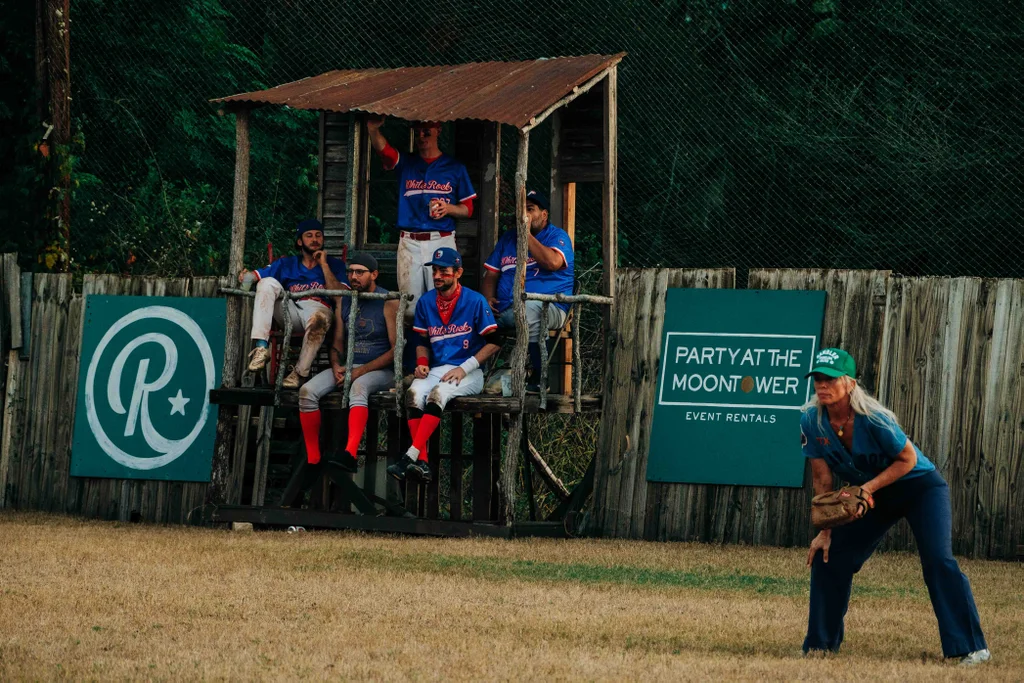
The lights Sanders once envisioned would have extended games after dark, but also invited unwanted police attention. Sanders’ Rural Studio thesis ultimately centered on building a new backstop and dugout system for the field using donated materials like utility wire. (The steel-and-chain-link configuration, which he built alongside two fellow students, would later be featured in the 2002 Whitney Biennial.)
The racial and social dynamics of Newbern sharpened Sanders’ perspective as much as Rural Studio itself. Sanders was a young white outsider stepping into an older Black baseball culture; trust, he felt, had to be earned gradually, which meant spending a lot of time around the team before ever playing on it.
But over the next three-and-a-half seasons, Sanders became just the second white player on the team, and its only regular member under 30. “They really liked me there because they didn’t have any young people,” Sanders says. “The old men that were playing were basically doing what I’m doing now. They’d been doing it for 30 years.”
In 2004, Sanders left for graduate school at the University of Texas at Austin. The city would also become the place where he met his future wife, fellow designer Ann Tucker, and where the two continue to raise their children. Soon after arriving, Sanders founded the creative practice Design Build Adventure, his design and creative practice, which for the past 20 years has done everything from eclectic custom home gigs to boutique hospitality spaces, even a leaderboard for an urban pitch and putt golf course.
“[Design Build Adventure] was very much in the spirit of what we do now,” he says, waving a hand out toward the baseball field around us at The Wishing Well.
Sanders also became an influential figure within Austin’s broader design culture. Liz Lambert, the force behind destinations like Hotel San José and Marfa’s El Cosmico, recalls meeting Sanders in the early 2000s as she began work on the latter property, the quirky campground and hotel filled with vintage trailers and yurts (that is now being reimagined as a 3D-printed resort slated to open next year). Before long, the two were camping on the land, sketching site plans together, and figuring out how to build the place from scratch.
Lambers says Sanders helped shape much of El Cosmico’s distinctive look, conceiving of and building fencing and shade structures from used oil pipe and other regional leftovers. “He’s inventive but he’s also a craftsman,” she tells me. “What looks like you’re just coming up with a solution out of found things from a junk pile ends up being very elegant.”
But it would be a different client, one whose own fixation on baseball had already become part of cinematic lore, that ultimately pulled Sanders back onto the diamond.
Like an Anthony Bourdain episode
The strain of baseball Sanders had fallen in love with in Alabama was once woven into everyday American life. Sandlot ball was, according to the historians, born 1,700 miles from Austin, amid the vacant lots and public parks of San Francisco in the 1870s, where fields sprung up in whatever space was available and rules were negotiated on the fly.
In rural areas, games unfolded in open fields; in dense cities, they morphed into stickball, played in the street with a rubber ball and a broomstick. For much of the early 20th century, this was the pro leagues’ unofficial farm system, where future Hall of Famers like Babe Ruth, Willie Mays, and Dizzy Dean got their start.
But by the 2000s, its popularity had begun to fade. The Associated Press warned in 2008 that sandlot was “on the verge of extinction,” squeezed out by the rise of travel teams and private coaching, and a mounting reluctance among parents to let kids roam unsupervised. (Video games didn’t help.)
“There’s not as much value placed on those types of play that we had when we were growing up,” says Nicholas Mortensen, a kinesiology professor at Michigan State University’s Institute for the Study of Youth Sports. Parents supervise to the point of surveillance. Kids now have fewer chances to “entertain themselves, be creative, be problem solvers.”
Nonetheless, baseball has maintained a powerful grip on the American imagination. Or, at least, a certain type of American’s imagination. Novelists from Bernard Malamud to Chad Harbach have centered their novels around our nation’s pastime. Members of R.E.M. and The Dream Syndicate have a supergroup called The Baseball Project, which basically exists solely to mythologize the game. Perhaps its greatest evangelist, though, is filmmaker Richard Linklater, whose films Dazed and Confused and Everybody Wants Some!! use baseball as a psychic backdrop, a space where wayward young men stretch out the final elasticity of youth.
Shortly after arriving in Austin, Sanders took on a commission building a treehouse for Linklater at his ranch outside the city. After long days of construction, the two would play catch as the sun went down, and Sanders found himself recounting stories about the Newbern Tigers and the baseball culture he’d stumbled into in rural Alabama.
Linklater immediately grasped the appeal. “He said, ‘I’d like to see that,’” Sanders says. “And I went home that night and started the Texas Playboys.”
Sanders assembled the team—named after the country crooner Bob Wills’ band—from the same loose creative circles orbiting Austin’s art, music, and design scenes. Robert Gay, an architect and Playboys teammate who now serves as one of The Long Time’s announcers, jokes that the whole thing began “as a midlife support group.”
He also connected with his old friends in Newbern and organized a friendly double-header between the Playboys and the Tigers. (Though Linklater briefly practiced with the group, a shoulder injury kept him from making the team’s inaugural trek to Alabama.) That first road trip to Newbern proved formative, with hundreds of people showing up to see the scrimmage. The Playboys, for the record, lost pretty badly. But that didn’t matter; the team was “snake bit,” according to Sanders. They immediately wanted to return.
In the years that followed, the Playboys would visit Newbern on an annual basis, but also other cities—places where a Playboy had a friend who was willing to put together a little sandlot squad. The excursions operated almost like traveling cultural exchanges. The Playboys wanted to know where their competition hung out, which restaurants they frequented, where they drank after midnight. Sanders likened the outings to “an Anthony Bourdain episode.”
But those temporary teams tended to stay together afterward, and gradually, those impromptu games helped seed a national network. Sandlot scenes took root in Tulsa, Nashville, the Carolinas, Philadelphia, and across Texas. Teams appeared in Vancouver and outside Mexico City, too, often discovering one another through Instagram long before any formal organization existed around them.
Howard Carey, an early Playboys teammate and creator of the online directory Sandlot Revolution, says many teams initially had no idea they were part of a broader movement at all. “They just thought they were the weird ones in their town doing this,” he says.
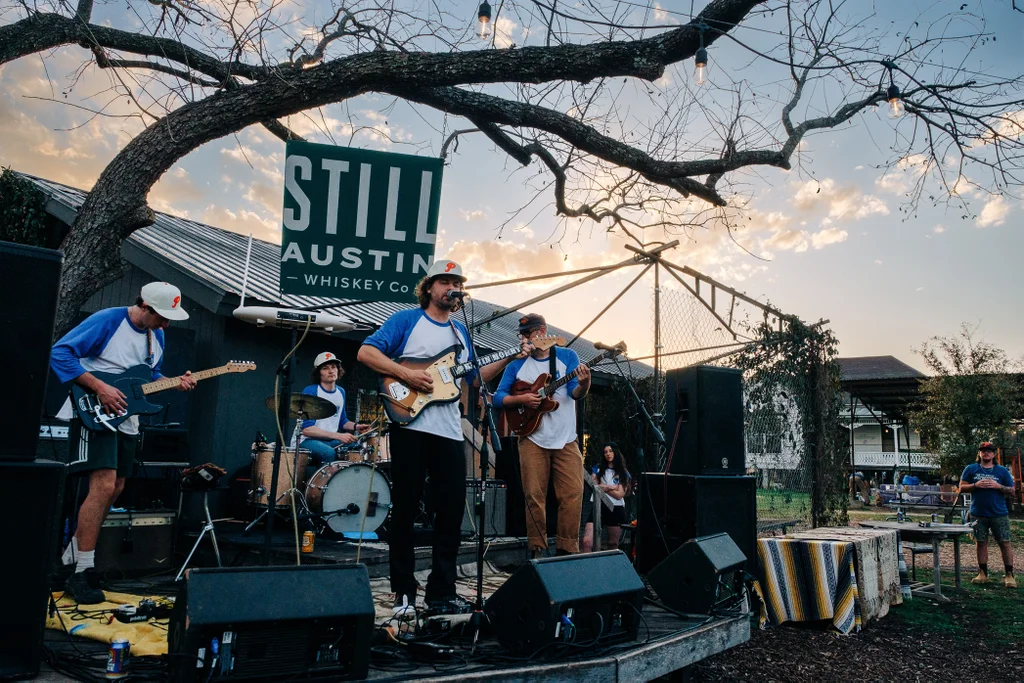
With the Playboys in need of a permanent home, Sanders bought the land that became The Long Time in 2017 and slowly built it out piece by piece, using salvaged materials gathered from scrapyards, open fields, and even castoffs from his design clients, turning the field into what he describes as a “folk art project,” a setting to, in his words, “fall into a conversation, drink a beer, talk about your life.”
The field still bears the marks of Sanders’ handmade sensibility, even as The Long Time has, in the nine years since, evolved into a bona fide business. Major brand partnerships, a robust social media presence, and a flood of national media attention—including a stylish documentary produced by Yeti—have all transformed the field into something closer to a lifestyle brand.
The evidence is everywhere: signs for Rambler Sparkling Water and Madre Mezcal hang above the bar; the outfield fence doubles as ad space for Hattie B’s Hot Chicken, a local record store called Waterloo, and, somehow, Rivian. Companies sponsor tournaments and special events, and the space now hosts everything from weddings (bohemian, presumably) to corporate retreats (also bohemian, presumably).
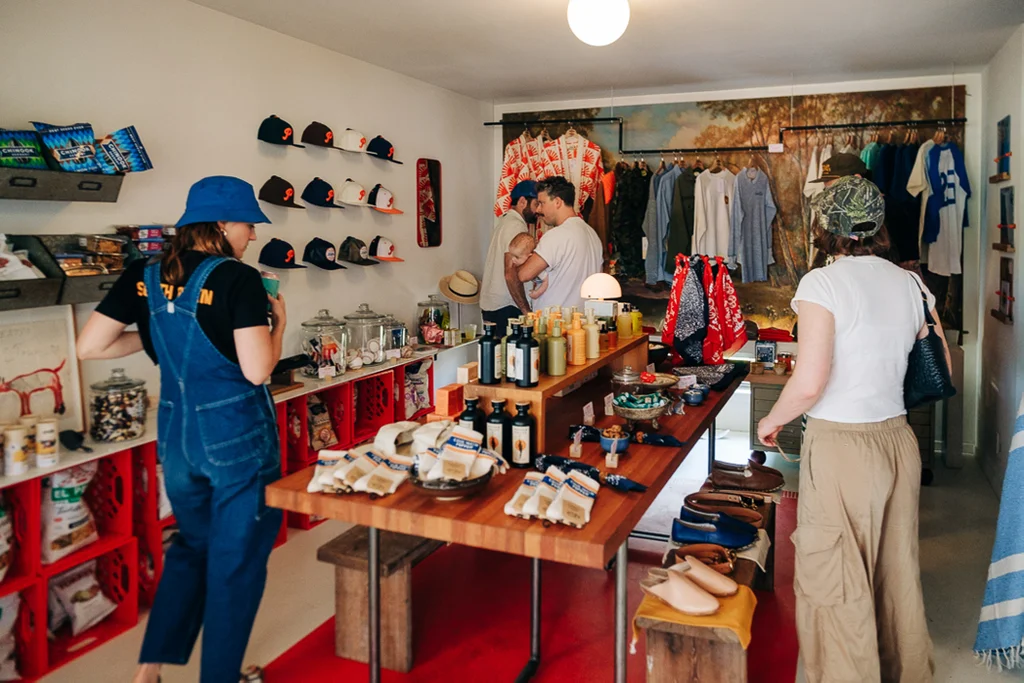
The gift shop, meanwhile, has evolved into its own miniature economy. Overseen by Sanders’ friend Tippi Clark, a former designer for Kate Spade and Marc Jacobs, it sells records by Playboys-affiliated musicians, wool caps (once worn by Pedro Pascal, allegedly), and assorted animal trinkets. “We even sell the little plastic hawks because there are hawks flying around here all the time,” Clark says.
Sanders declines to get too specific about the finances—“We’re not a million-dollar company,” he says with a laugh—but acknowledges that sponsorships have become the operation’s largest revenue stream. That’s owed in large part to Instagram. And while Sanders is careful to note that community baseball has existed long before the Playboys (hell, his own grandfather played on a recreational team in the 1940s), he eventually concedes that, yes, Playboys were one of the earliest drivers of “the social media era of community baseball,” where teams discover one another through Instagram posts.
And boy, are there posts. Between Sanders’ Instagram handle, which has 8,400 followers, and the Playboys’ and Long Time’s accounts (9,000 and 15,500, respectively), you could easily lose an entire day to sandlot-themed content. Many of the posts could just as easily be ads for cowboy boots, craft beer, or artisanal sunglasses. Often enough, they basically are.
To the cynic, it might all seem a bit too nakedly capitalist. Sure enough, One local player, who spoke on the condition of anonymity, bemoaned the self-promotional element. “There are sandlot teams for people who want to play baseball,” he says. “And there are sandlot teams for people who want you to know they play baseball.”
Yet Sanders insists that, beneath all the “micro-influencing,” his sandlot circus has retained its shaggier qualities. And indeed, when I visited on yet another punishingly hot March day, the impromptu mid-game breaks for music and line dancing were still there, as were the children climbing the scaffolding above the bar. The game, he says classic Sanders-speak, remains “the least that it can possibly be, and not even one bit more.”
“I don’t get those kinds of calls at this point in my life”
Whatever one makes of The Long Time’s increasingly polished aesthetic, Sanders’ influence on the modern sandlot scene is difficult to deny. A remarkably broad range of people seem eager to testify to it: Jim Ward, the musician best known for his work with Sparta and At the Drive-In, calls Sanders “the Johnny Appleseed” of sandlot; Risto Lawson, a woodworker who plays for the Texas Tallboys, another Austin club, credits him with building “his Field of Dreams here”; and Joel Manzo, a city employee and Austin sandlot organizer, praises Sanders for building what he sees as “the mecca of sandlot ball.”
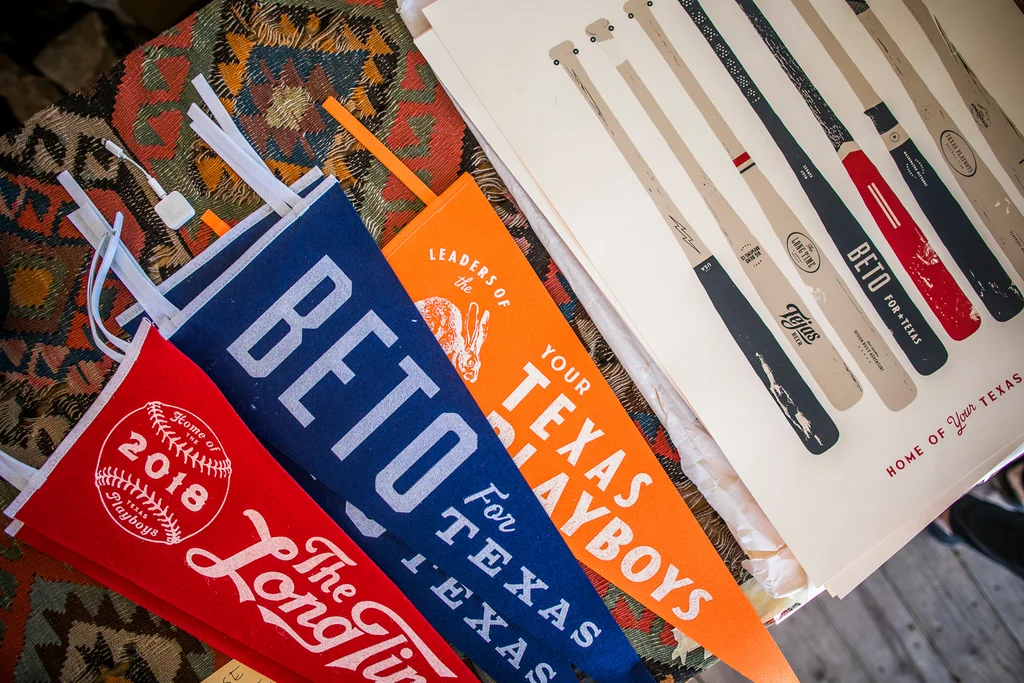
But few people I met for this story seem as genuinely charmed by Sanders as Beto O’Rourke. The former congressman and perpetual Texas political presence first encountered the Playboys through Austin’s overlapping indie-rock and creative circles before eventually joining the El Paso Diablitos. O’Rourke speaks about Sanders with the kind of enthusiasm people usually reserve for old bandmates. “Jack’s able to exude an authentic chill while also being extraordinarily ambitious,” he tells me.
Several years ago, Sanders was working out in Marfa when he called O’Rourke more or less on impulse. As it happens, O’Rourke’s wife and kids were out of town. Sanders drove the three hours to El Paso almost immediately. The two spent the next few days hiking the Franklin Mountains, going to a local Minor League baseball game, listening to music, and talking late into the night. Sanders slept in one of O’Rourke’s kid’s rooms.
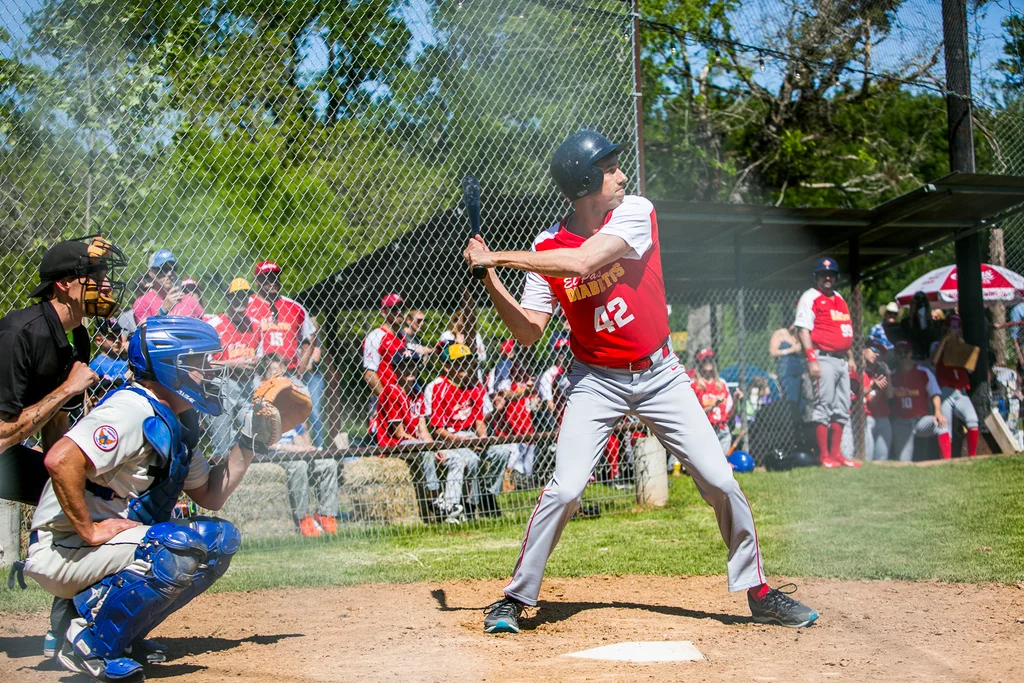
“I don’t get those kinds of calls at this point in my life,” O’Rourke says. “Somebody saying, ‘I don’t want anything from you. I just want to know if you want to hang out and have some fun.’”
When I later bring the story up to Sanders, he laughs at how casually the visit came together. “I was surprised,” he says. “I probably thought I’d have lunch or dinner and he was like, ‘My family’s out of town, why don’t you stay here.’ And I was like, ‘Okay.’” After enough conversations with Sanders, though, you start to understand why this sort of thing might happen a lot.