
This article is republished with permission from Laser Wars, a newsletter about military laser weapons and other futuristic defense technology.
The most critical component to actually fielding high-energy laser weapons at scale isn’t the diode pump, or the gain medium, or the beam director. It isn’t even the power source. In reality, it may actually be this tiny fiber-optic converter.
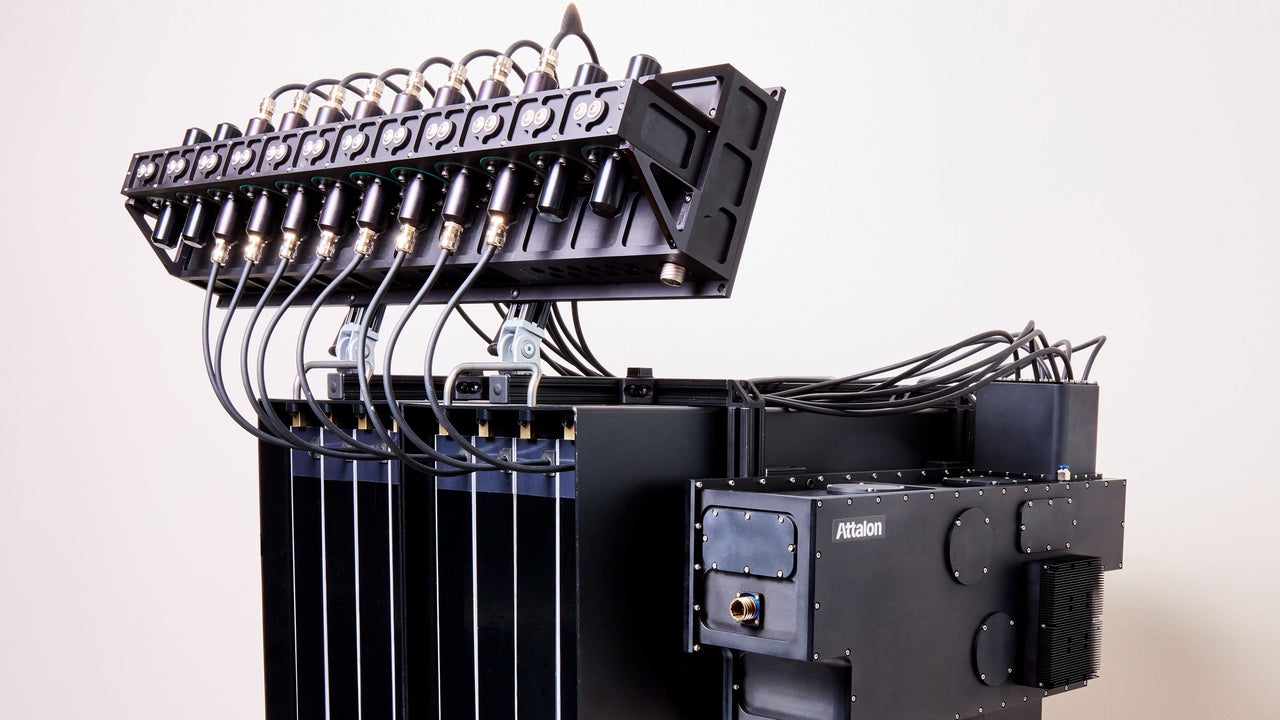
On July 23, defense technology company Attalon—formed earlier this year from the spin-off of American laser company Coherent’s defense business—announced the first shipment of its Kilowatt Interconnect (kWIC) Disconnect subsystem, which it claims will allow operators to rapidly replace faulty or damaged laser amplifiers in order to reduce system downtime and maximize operational readiness.
Previously, fixing a laser amplifier required splicing fiber-optic cable, which is a delicate and tedious job requiring specialized training and equipment—and, in turn, a slow and impractical process for the average U.S. service member on the battlefield looking over their shoulder for hostile drones. kWIC Disconnect is ostensibly a plug that replaces that splice: Instead of fusing fiber back together, an operator can simply unplug the broken amplifier and swap in a new one.
The clearest potential impact of this system is a significant reduction in repair time from potentially days down to just a few minutes so laser weapons can get back in action faster. But the other implication is that it effectively converts an exquisite and highly sophisticated laser amplifier into a line-replaceable unit (LRU), a major step toward building laser systems that the U.S. military can actually field at scale.
The LRU has been a fixture of the American defense industrial base since the 1950s, when the U.S. Air Force adopted modular, self-contained electronics components on the flight line to minimize downtime and enable ground crews to maintain high operational tempos despite the increasing complexity of fighter aircraft. The U.S. Army’s M1 Abrams main battle tank was expressly designed for easy repairs, with only four major maintenance actions requiring more than a day to complete, while the U.S. Navy’s AN/SPY-6 radar system, for example, is built on self-contained radar modular assemblies that can purportedly be repaired with just two tools.
Defense contractors have been chasing the idea of a truly field-serviceable laser weapon for nearly two decades. Northrop Grumman’s “Firestrike” system, developed under the Pentagon’s Joint High Power Solid State Laser and presented as the world’s first weaponized solid-state laser, was marketed as a LRU upon its debut in 2008, and the 60-kilowatt fiber laser Lockheed Martin built for the U.S. Army’s High Energy Laser Mobile Demonstrator (HEL-MD) was designed to scale power through replaceable modules. As early as 2014, Defense officials were explicitly looking for “components necessary for field-swappable fiber connections and disconnections, so you don’t need a clean room to join two fibers together,” as one Air Force Research Laboratory official told Laser Focus World at the time.
But due to their technical and engineering complexity, laser weapons have proven a stubborn exception to the U.S. military’s embrace of LRUs. “The internal mechanisms for DE weapons are sensitive, and typically require a specialized clean room for repairs,” according to a 2023 Government Accountability Office report on U.S. Defense Department directed energy weapon programs. “For example, DOD officials said that one DE weapon fielded to an operational environment encountered challenges with battery charge and cooling, and had to be returned to the manufacturer in the United States for repairs. Ultimately, this challenge reduced system availability, which is key to a successful weapon.”
Indeed, the GAO report indicates that those challenges could doom even the most technologically mature laser weapons to the dreaded valley of death. “Developing maintenance and sustainment processes for weapon systems is a key role for an acquisition program office,” the report says. “The ease of maintaining a weapon may factor into an acquisition program office’s decision to pursue that technology compared with another.”
The Pentagon is clearly hoping that LRUs may help laser weapons finally transition from the lab to the battlefield. The U.S. Army’s Enduring High Energy Laser effort, expected to become the U.S. military’s first official program of record, expressly requires LRUs that can be quickly replaced through soldier-performable sustainment in the field without requiring depot-level maintenance.
“We are stressing in this effort to industry the need for reliability and sustainability, going with a modular approach for components so that we can allow the soldiers to do line replaceable units for certain aspects of these very, very complex technical systems without the need for the clean rooms,” as then-Army Lt. Gen. Robert Rasch said at the 2025 Space and Missile Defense Symposium, in Huntsville, Alabama, in August 2025. “We’ve asked industry to help them where we can help improve the manufacturability of critical components for [directed energy], which will, as we continue to press on this technology, allow us to scale quickly and allow us to continue to reduce costs.”
kWIC Disconnect offers a promising answer to this call. If a fiber laser amplifiers can really be swapped on the battlefield the way a radio card or a radar module can, then the system (and others like it) could prove essential to tipping laser weapons from exquisite prototypes to field-ready capabilities ready for productions and deployment at scale in the way that the Pentagon envisions. In the end, the fight over the future of laser weapons may end up decided less by who has the most kilowatts and more by who solves the boring problem of keeping a system in the fight without a fusion splicer, a clean room, and a PhD.
This article is republished with permission from Laser Wars, a newsletter about military laser weapons and other futuristic defense technology.