
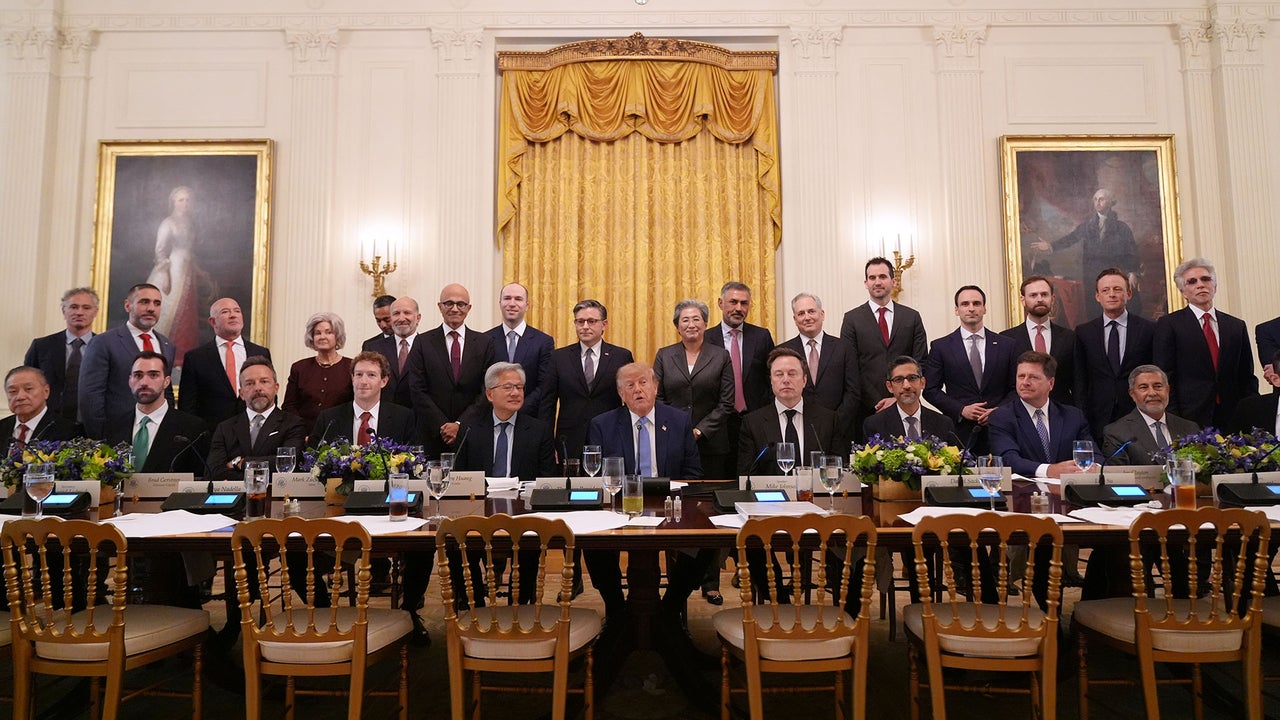
President Donald Trump on Tuesday said that he and a large group of leaders of artificial intelligence companies had signed a voluntary accord that will include internal and external reviews during a meeting at the White House aimed at addressing Americans’ fears about the technology.
“I think I’m seeing tremendous self-policing. And they understand that they have to self-police,” Trump told reporters during an impromptu press conference outside the West Wing.
Trump and House Speaker Mike Johnson met with leading executives from top tech firms that are spending hundreds of billions of dollars to build out AI infrastructure, including data centers in communities across the country, which have sparked grassroots, bipartisan opposition.
The accord was signed by Trump, Anthropic CEO Dario Amodei, Google CEO Sundar Pichai, Meta CEO Mark Zuckerberg, OpenAI President Greg Brockman, Nvidia CEO Jensen Huang, and Elon Musk, founder of xAI, which is now part of SpaceX.
The accord, which Trump posted on his social media site, Truth Social, late Tuesday, opened the door to future regulation but focused on four voluntary steps for the companies to take.
The accord said the companies would implement “robust internal controls,” partner with an “independent external auditor” to assess whether the controls were working, and establish a committee within each company’s board of directors to evaluate reports from internal and external auditors.
“Over time, it may make sense to codify these steps into laws and regulations,” the accord said.
Trump repeatedly praised the business executives for developing a technology that he said would produce “unbelievable growth.” Investment in data centers and the accompanying computer equipment has accelerated the economy and boosted the stock market, which has swelled investment accounts for higher-income Americans and lifted their spending.
Yet there were some notes of caution Tuesday. Amodei, who has been one of the most outspoken voicescalling for a slowdown in AI development, said, “The technology has very real risks.”
“And, you know, the mechanism, how we address those risks is still under discussion,” Amodei said.
Putting faith in ‘self-policing’ AI
Trump suggested that about 10 people would be named to a committee to “watch over the whole enterprise” and said the accord would be “morally binding.” He also said he would name someone to oversee the agreement in coming days after consulting with industry.
Some of the actions outlined in the accord are measures these companies are already taking in some form or have previously committed to doing.
The intention of the accord balances the latitude needed for innovation with regulation, said Shri Narayanan, a university professor of electrical and computer engineering at the University of Southern California. That innovation is not just limited to improving the capabilities of these AI models, Narayanan said, but also to efforts to improve model safety and security.
Other experts are skeptical of putting “so much faith in self-policing,” like Robin Jia, an assistant professor of computer science at the University of Southern California. Jia said it’s crucial to ensure the leading labs’ intentions are “well-aligned with the broader interest of the American public.” He pointed to the recent disclosures of hacking incidents and said: “As the models get better, the consequences of such things are only going to get greater.”
Some also took issue with the accord’s vague, broad language. Alex Pascal, executive director of the Berkman Klein Center for Internet and Society, said: “The only way to reduce the risks and harms of AI to Americans is through robust legal liability, regulation and fundamentally changing the race dynamics that are driving unsafe decision-making by frontier AI developers whose costs are borne by the American people.”
Trump unveils chatbot to help Americans navigate government services
Trump thinks data centers are going to become ‘very popular’
Trump also said the executives had agreed to assuage the bipartisan opposition to data centers cropping up in local communities across the country by providing more financial support to local schools or taking steps to reduce energy costs.
“You’re going to see, data centers are going to be very popular,” Trump said. If the opposition continued, Trump suggested, “they’ll be forced to go overseas or other locations.”
Also Tuesday, OpenAI CEO Sam Altman said in a television interview that the company is increasingly focused on safety. The day before, his company halted the rollout of a new model over safety concerns.
“We are pacing our progress, which includes sometimes not training a model,” he said on CNBC. “We have to do these in a way where we can make very confident safety cases and claims, so that people don’t have a bunch of anxiety.”
For his part, Trump on Tuesday portrayed the race to develop AI as largely a global competition between the United States and China. He said there would be a winner and a loser, with no “second place.”
The two countries agreed last week to establish a channel for handling AI-related incidents during Chinese President Xi Jinping’s visit to Washington. But Trump underscored Tuesday that he didn’t want to cooperate too much with China: “I didn’t want to do anything, because we’re leading. Why would I want to do anything?”
Associated Press journalist Kaitlyn Huamani contributed.
—Christopher Rugaber, Will Weissert and Meg Kinnard, Associated Press Writers