
Our oceans are incredibly hot, and that heat stress is a major threat to coral reefs. To truly protect corals, we need to address climate change as a whole. But in the meantime, scientists say they can give reefs a bit of relief simply by providing them with some shade.
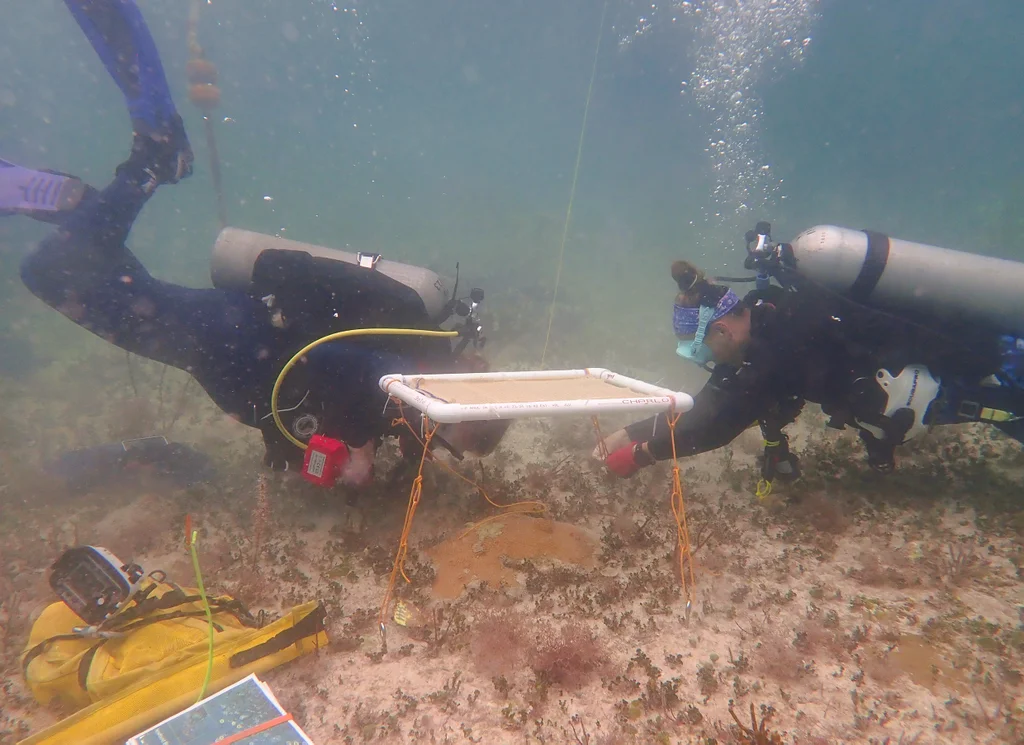
Researchers recently tested this concept in the Florida Keys with underwater “umbrellas” made out of shade cloths—the same textiles used on farms or in home gardens to protect plants from the harsh sun.
Those umbrellas floated above individual corals. Though heat stress during the summer of the study was the second highest on record, the corals under the shade lost less color than expected, and in some cases, even recovered some of their color. That’s significant, because the loss of color results from the death of algae that live with corals.
Providing shade doesn’t actually cool the water, says Karen Neely, a research scientist with Nova Southeastern University in Florida and lead author of the study on this experiment, published today in the journal Frontiers in Marine Science.
But it does minimize the light reaching those corals. The shade cloths reduced light by 60%.
“While heat is the primary driver of coral bleaching, it also works synergistically with the light,” she says. “By minimizing that light, we’re cutting some of that stress that those corals are going through, and therefore minimizing bleaching.”
The impact of heat on coral reefs
Climate change, and the warm ocean temperatures that come with it, are one of the biggest threats to coral reefs worldwide. More than 84% of the world’s reefs have been affected by heat stress, and half of all reefs have experienced major bleaching.
The Florida Keys are no exception. In 2023, a marine heat wave had water temperatures hitting over 90 degrees Fahrenheit. (That coincided with an El Niño year; 2026 is also an El Niño year, which is supercharging oceans already warmed by climate change.)

That summer, Florida’s coral reef experienced “the worst coral bleaching event ever recorded,” according to the state’s Fish and Wildlife Conservation Commission.
Neely has long monitored Florida’s coral reefs for heat stress and damage, but that 2023 bleaching event prompted the idea, she says, “that maybe we need to be a little more proactive in how we can deal with some of these stressors.”
Shading coral reefs isn’t a totally new concept; researchers have looked into this technique in Australia, for the Great Barrier Reef, as well as in various places in the Indo-Pacific region.
But there are different species of corals around the world, and it hadn’t been tried before in the Caribbean or around Florida.
Underwater umbrellas
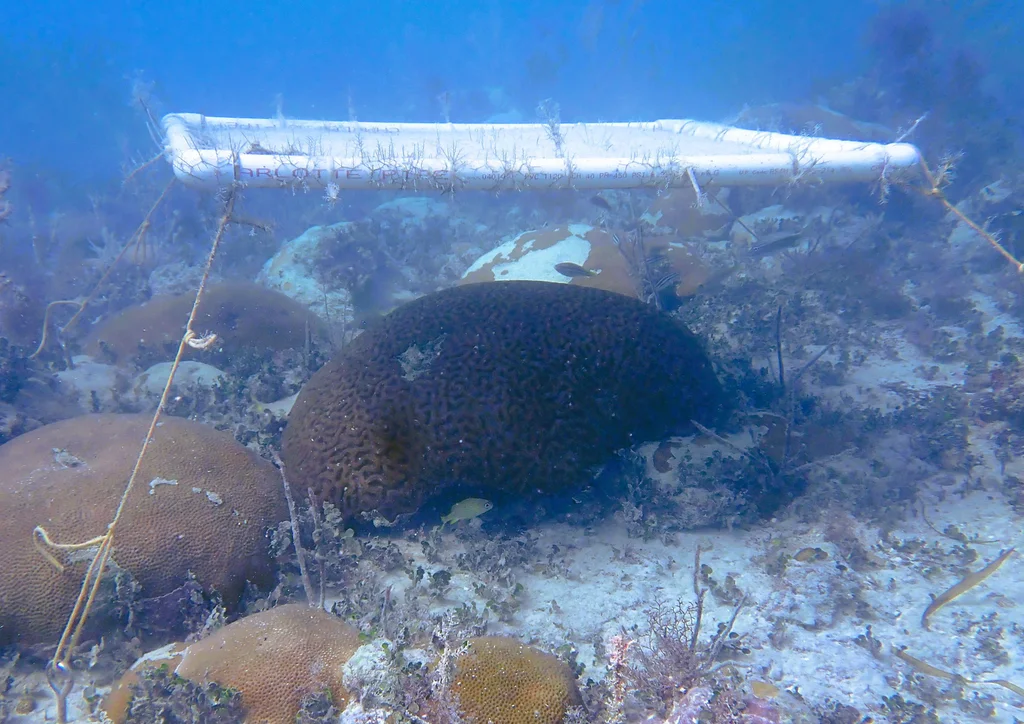
Neely and her team ran the shading experiment in the summer of 2024. They built frames out of PVC pipe, using shade cloths for the umbrellas.
They attached the shades to rope, and tied them to eye screws that they put in the substrate around the corals. The shade umbrellas floated about 30 centimeters (12 inches) above the coral.
Corals do need some light; the algae that live symbiotically with corals (and that give reefs their color) need to photosynthesize. When these algae die, that’s when a coral reef turns white, or bleached.
But by minimizing the harsh Florida sun, particularly during the long, especially bright days of summer, “we’re really giving [coral reefs] a helping hand,” Neely says. The shaded corals essentially experienced as much light as they would usually get in the winter. “We’re just minimizing their stress,” she says.
Neely wasn’t totally surprised that the shades helped protect the corals from bleaching, compared with the unshaded coral. What was surprising, though, was “how easy it was to be effective,” she says.
“We honestly thought these shades were going to be a way bigger hassle, but they were surprisingly easy to install,” she says. “They came out really easy at the end of the study. They didn’t require a lot of maintenance. They didn’t really present any of the problems that we thought they might.”
The researchers also didn’t observe any negative impacts from these shades to the larger ecosystem.
Keeping coral reefs alive
Shading coral reefs with underwater umbrellas may be a simple way to mitigate coral bleaching, but it also may be tricky to scale up.
Neely admits it’s a targeted approach, focused on protecting individual corals, even though there are millions of corals around the world.
Still, it’s an example of a climate change intervention that can make a tangible impact now. Cutting fossil fuel use, on the other hand, takes time—and even if we were to end all fossil fuel use today, our climate would still be affected for years to come.
Coral reefs take up less than 1% of the ocean floor but support 25% of the ocean’s biodiversity, and also provide food, tourism, and shoreline protection. For them, the immediate impact of an intervention of this kind is crucial.
“Reefs are already not what they were 50 years ago, and there’s no indication that they’re going to go back to that,” Neely says.
Intervention or mitigation efforts like this are also more cost effective than coral restoration. The researchers found that shading a coral costs about $100. If that coral died, though, replacing or restoring it would cost more than $1,000.
“We can’t restore our way out of everything,” Neely says. “We have to try to keep what’s already out there alive, from a cost and effort perspective. Not to mention the fact that these are some of the largest, oldest animals on the planet.”