
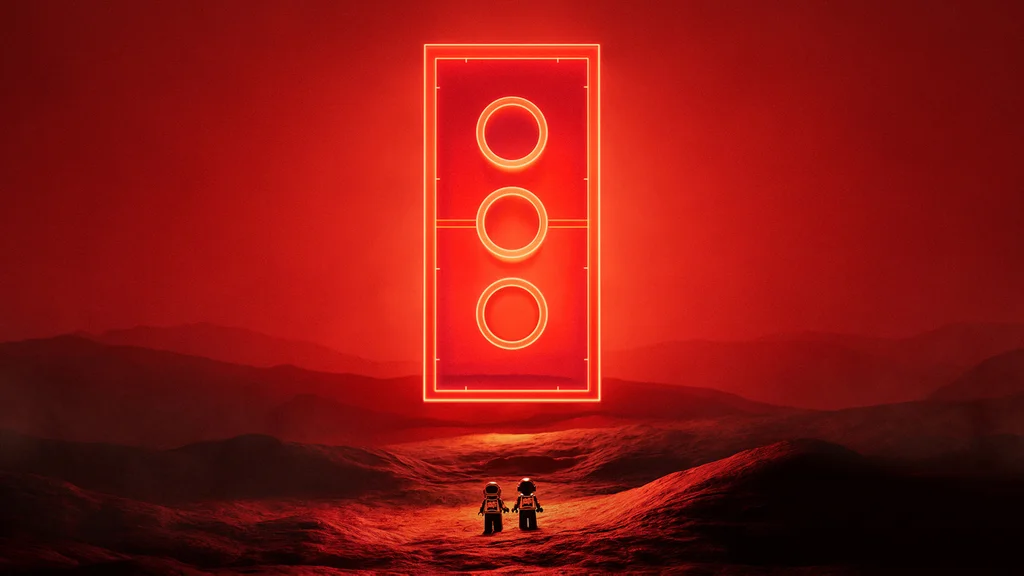
Lego recently announced that Daft Punk, the French electronic duo that split up in 2021, is entering the Lego universe in a partnership that spans “product, content and brand experiences.” What the brick is this, you ask? Yet another damn licensing deal, now absurdly mashed up with a defunct electronica band?
As much as I dislike Lego’s reliance on IP licensing, this one makes all the sense in the world from a pure creative philosophy perspective. After speaking with Daft Punk’s and Lego’s creative leads, I think this is a contender for Lego’s best collab yet.
The first release will be a model of the pyramid stage from the duo’s Alive 2007 tour. At this point, Lego is not saying what it will cost, how big it is, or when it ships. Samuel Liltorp Johnson, the Lego creative lead on the project, says the design is still in development with the Daft Punk team and Patrick Harboun, a dad from Luxembourg who submitted it to Lego Ideas, the company’s platform on which Lego fans vote for the best models from other fans to be made into real commercial sets. For now, there’s just a short film of two robot minifigures following a glowing red brick to a DJ console, set to “Voyager” and “Human After All,” and a promise of more in 2027.
Cédric Hervet, Daft Punk’s creative director, tells me Daft Punk’s camp approached Lego back when the band was still active, but the timing wasn’t right. “For me, the end of the band was never the end of the robots,” he says. “A legacy keeps living through the people who take it on.” It was the fans who made it happen, he adds, by voting for a submission of the pyramid on Lego Ideas.
For Hervet, this “might be the best life the robots could have” after the band’s end. That’s because this mash-up goes deeper than just merch. It’s a matter of creative and design philosophies that go together as perfectly as Nile Rodgers and Daft Punk itself.

Faceless smiles and helmets
When the Lego designer Jens Nygaard Knudsen’s first minifigure went into production in 1978, it had the barest face imaginable: a pair of black dots and a painted smile on a yellow head. That was deliberate. “Sex, race and role were not to be part of the figure—they would be formed by the child’s imagination and play,” Lego explained in 2003.
The same smiling head worked as a cop, a knight, or an astronaut, depending on the hat and the story a kid had in mind. The face never changed, so the kid’s imagination did all the work. Most of today’s figures come with specific expressions and character features which, as I griped about back in 2013, suck. An angry minifig is stuck being angry forever, while the classic smile was a neutral placeholder.
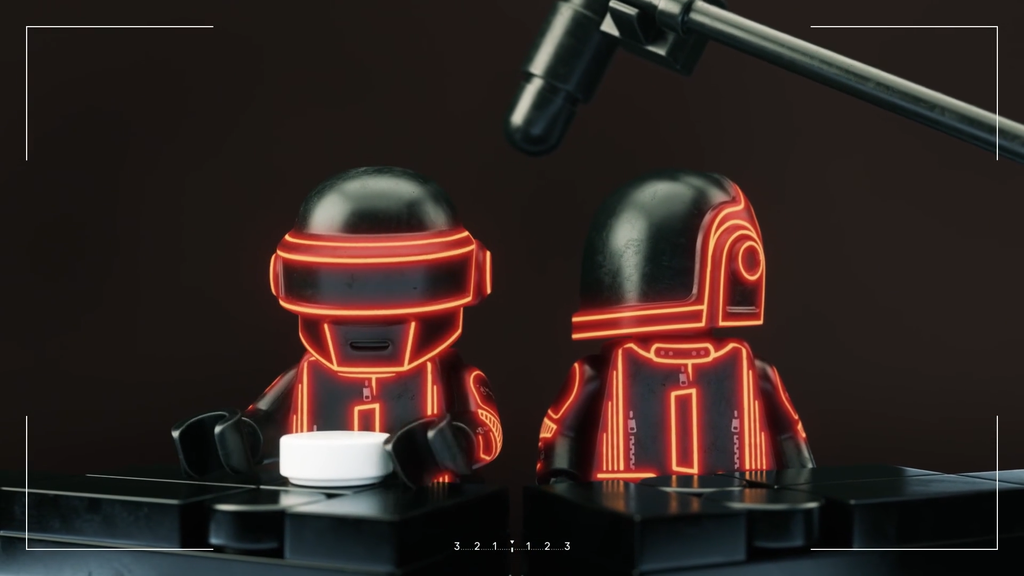
Daft Punk built their identity on an idea similar to Knudsen’s, only they replaced the face with an icon. Thomas Bangalter and Guy-Manuel de Homem-Christo spent the late ’90s hiding behind masks and bags, then unveiled their robot helmets in 2001 with the album Discovery. Silver for Bangalter, and gold for Homem-Christo, both were engineered with help from the special effects designer Tony Gardner and wired with LED displays. For the next two decades, those two robots were Daft Punk. The helmets changed a bit over the years; the LED screens shrank and eventually went dark, but the robots never aged, never had a bad hair day, and never showed a human face.

“I almost consider the character of the robots like a Marina Abramović performance art installation that lasted for 20 years,” Bangalter told the BBC in 2023, two years after the breakup. The robots became a fixed, faceless character and, eventually, a totem. That’s exactly what the 1978 minifig was for a generation of kids.
Daft Punk’s helmets let two guys from France become no one. The helmets erased the people inside and turned the duo into a blank screen for the audience. “The helmets left all the room for the fans; everyone could project whatever they wanted onto them,” Hervet says. “And without the helmets, the robots might never have made it into the Lego universe.”
A minifig wearing a Daft Punk helmet is two of the most famous blank faces in pop culture stacked on top of each other: a plastic person with no fixed identity, inside a pop star with no visible one. That stacking is the point, according to Hervet. What Daft Punk always protected, he says, “wasn’t access to the robots, it was their integrity.”
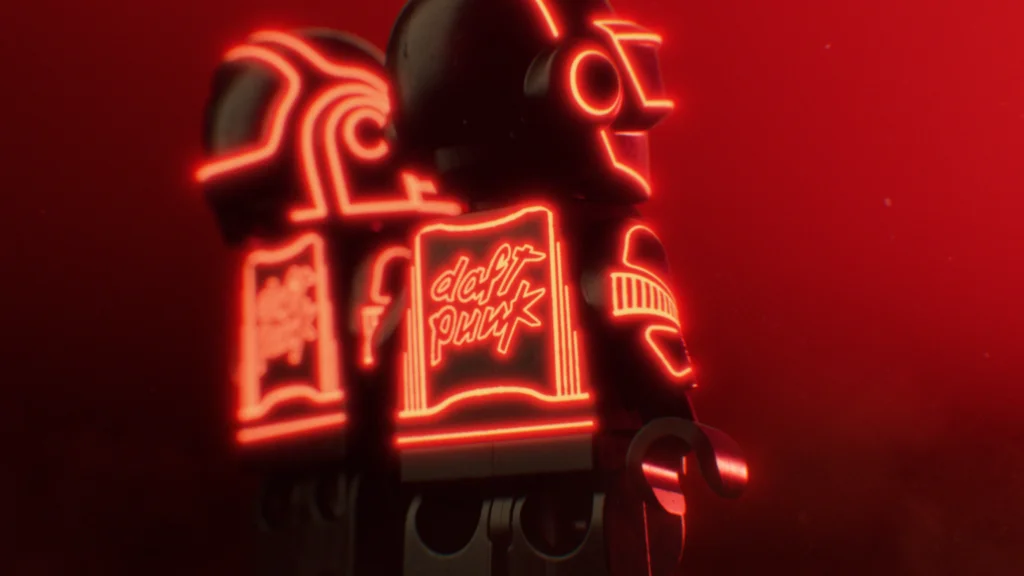
Lego is also the perfect physical metaphor for the band. Hervet says that swapping pieces between figures is “a bit like sampling in music. You take an element, put it somewhere else, and it becomes something new.” Liltorp Johnson makes the same comparison: “Designing Lego sets is a lot like creating an electronic dance track. We sample from different elements and build them together to make the perfect composition.” They even remixed one of the band’s tracks, “Human After All,” into the partnership’s slogan, “Builders After All.”
Amid the brickstorm of movie, clothing, and comics licensing, consider this new collab the rare IP set that feels less like a brand stamping its logo on another brand, and more like two old design ideas finally meeting.