
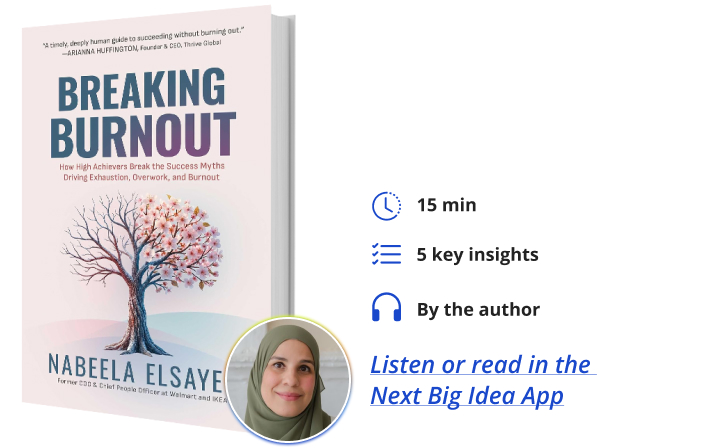
Below, Nabeela Elsayed shares five key insights from her new book, Breaking Burnout: How High Achievers Break the Success Myths Driving Exhaustion, Overwork, and Burnout.
Nabeela is a recovering workaholic and former C-suite executive. She began her career as a barista making $6.50 an hour and spent the next 20-plus years climbing the corporate ladder until she ran operations and people at companies including Walmart Canada and IKEA.
What’s the Big Idea?
Burnout isn’t a stamina problem. It isn’t a boundaries problem. It’s what happens when the definition of success you were handed was never survivable in the first place. Getting off the burnout loop isn’t a dramatic leap. It’s a series of small choices toward a life that no longer costs you yourself.
Listen to the audio version of this Book Bite—read by Nabeela herself—in the Next Big Idea App, or buy the book.
1. Fix your relationship with work, not just your job.
When I lived in Sweden, I learned about lördagsgodis—Saturday candy. Kids and grown-ups skip sweets all week and enjoy them on Saturdays. This is a country with a pastry shop on every corner, yet an entire society says “not today” six out of seven days. That’s not willpower. Back in the 1940s and 1950s, dental researchers discovered that how often you eat sugar does more damage than how much. Health authorities said: if you’re going to have it, have it once a week. That became a ritual in families.
Sugar is not a villain, and neither is work itself. We need to work, but like food, it can nourish or poison you depending on how often and how intensely you consume it. Most of us assume the problem is the job—the toxic boss or impossible workload—and sometimes it is, but usually it is a toxic relationship with work itself.
You can be in a great company with a great boss, or even be the boss, and have an unhealthy relationship with work. Chris Raney built the world’s largest HR podcast platform. He owns the company. No one’s forcing him to do anything. And one morning he got up, did his workout, took a shower, and tried to head to work, but he couldn’t move. He was having a major anxiety attack, frozen at the threshold of his front door. When I talked to him about it, he said, “It’s self-inflicted. It’s all self-inflicted.”
Changing jobs rarely fixes burnout because you bring your relationship with work with you. So before you update your resume, ask yourself: how healthy is your relationship with work?
2. Ask whether rest restores you.
The sports world has figured out something the rest of us haven’t. Athletes don’t wait for an injury to find out that they’ve been overloaded. Lauren Bushman, director of sports science for Canada Basketball, and her team work backward from the moments that matter—the playoffs or Olympics—and build capacity slowly over years. Recovery isn’t a reward. It’s part of the training plan. As Lauren told me, “You never mess with a basketball player’s pre-game nap.” And her measure of success is beautifully simple: Are her players healthy and ready when it counts?
“Recovery isn’t a reward. It’s part of the training plan.”
Now, think about how most of us work. We run an endless marathon at sprint speed. Nobody’s tracking our load, and we’re usually the last to notice something’s off. But a simple question can improve self-awareness; ask yourself: Does rest restore you? Exhaustion is running out of gas. You can refill the tank with sleep or a weekend off or a real vacation, and your energy comes back. But burnout is the engine breaking down completely. You rest, and nothing changes. The cynicism is still there, the detachment is still there, and the joy doesn’t come back.
Horacio Barbeito, my former CEO at Walmart Canada, spent more than 30 years learning this the hard way. At one point, just hours before a flight, he cancelled a major conference trip rather than pushing through. He explained it perfectly: “I need to slow things down to go fast.” If rest restores you, then you’re tired, and that’s normal. If it doesn’t, that’s your signal to stop, act, and talk to a medical professional.
3. Trace your wiring.
Chester Elton is known worldwide as the Apostle of Appreciation. So when he told me that for the first part of his career he was “an absolute jerk,” I almost fell out of my chair.
Chester had what he calls a magical childhood—a big, loving family filled with faith and service. But he was the youngest of five boys, and if you didn’t eat fast, you didn’t eat. You worked hard, you competed, and you won. That followed him to school and into his career, and it paid off. Bigger house, great vacations, and the corner office. What he couldn’t see was who he was becoming. His wife Heidi would catch him yelling in the shower, replaying work conversations. Then one evening on a walk around the neighborhood, she said, “I don’t care what we do, but we are not doing this anymore. I want my husband back. This is not who you are.”
Even a happy childhood can teach you that effort is how good people prove they’re good, and that worth is something you earn. For a lot of us, the wiring goes back generations. Marj Rehman, founder of Envoi, comes from four generations of immigrants: India to Pakistan to Dubai to Canada. He told me there has always been an urgency in life, a feeling that there is no rest. As a child of immigrants myself, I know that feeling in my bones.
This is where the burnout loop starts. The wiring is set in childhood. Then a culture that celebrates overwork rewards it. Over time, a sacrifice starts to feel like obligation—until something forces you to stop. Ask yourself: who taught me what success looks like? And did anyone ever tell me when to stop?
4. Refuse to be a stump.
Years ago, I was driving home on a 10-lane highway in Houston, Texas, after a brutal day at work, and suddenly I couldn’t breathe. My chest was tight. I was dizzy. My whole body was shutting down. I pulled over and called 911 because I thought I was having a heart attack. The hospital discharged me, and the next morning I went back to work like nothing had happened. This is what I call the sacrifice myth in action. It’s the belief that if you want to be successful, it’s supposed to hurt.
“Over time, a sacrifice starts to feel like obligation—until something forces you to stop.”
You may have grown up with The Giving Tree. It’s a book about a boy and a tree, and the tree loves the boy. As the boy grows up, he takes her apples to sell, her branches to build a house, and her trunk to build a boat. At the end, there’s nothing left of her but a stump—and we’re told she’s happy. As a child, I thought it was a beautiful story of love. Now, as an adult, it makes me want to scream. It teaches us that love and loyalty are proven by disappearing. My teenager and I have a saying. When she sees me self-sacrifice, she puts her arm on my shoulder and she says, “Mom, don’t be a stump.”
We do this with work all the time. We give pain and sacrifice a purpose, and that’s supposed to make it better. We treat the suffering itself as proof that we’re serious, committed, and worthy. But work is an exchange. You give it your skill, your time, and your commitment. In return, you get a livelihood, growth, recognition, agency, and impact. When the price is your health, relationships, or humanity, it’s no longer an exchange. That is self-abandonment. That’s becoming a stump.
The opposite of martyrdom isn’t quiet quitting or bed rotting. It’s stewardship—taking care of your energy, knowing your limits, and building a life you can actually sustain.
5. Be more than your title.
Stacy Brown-Philpot spent nearly two decades climbing from Google to CEO of TaskRabbit, where she led the company through its acquisition by IKEA. When she stepped down, it was the first time in almost twenty years she didn’t have a title. She found herself asking, “If I’m not a CEO, then who am I?”
The offers kept coming—a public company, a private company, each one exactly what she was “supposed” to do next. People told her, “We don’t have enough Black women CEOs. You need to get back in there.”
That’s the identity myth: the idea that what I do is who I am. What makes it so insidious is that we’re rewarded for it. If you start disappearing into a romantic relationship, someone who loves you will pull you aside; if you disappear into your work, you’ll get applauded.
“What makes it so insidious is that we’re rewarded for it.”
Every job has an end, whether that means a layoff or retirement. If your whole self lives in one role, losing that role feels like losing yourself. Think of it like a house: work isn’t the foundation. It’s an important room that, during some seasons, you’ll spend a lot of time in. But you can’t board up every other room for 20 years.
I once opened a session for senior leaders with a simple question: “Tell me who you are without telling me what you do.” Long pauses. Nervous laughter. Most of them had never reflected on that question. So try it. You might be someone’s steady presence, the friend who remembers birthdays, the neighbor who shovels the snow, or the person in your family who makes a mean stack of pancakes. Those aren’t small things. Those are the joys that life is built on.
Stop pretending you’re fine. Stop pretending your life can wait until the next milestone.
This article originally appeared in Next Big Idea Club magazine and is reprinted with permission.
Enjoy our full library of Book Bites—read by the authors!—in the Next Big Idea app.
Source link