
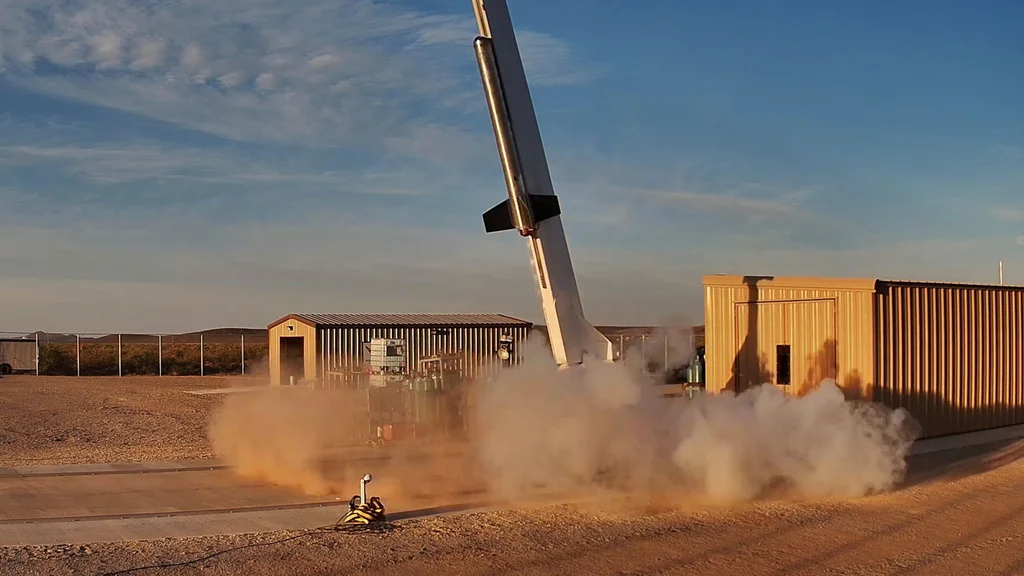
One early morning in May 2025 at Spaceport America, a desert basin on the outskirts of Las Cruces, New Mexico, a silver rocket shot through the air.
Launches aren’t a rare occurrence at the commercial launch site, but this test flight wasn’t an everyday event. A century after Robert Goddard launched his first liquid-fueled rocket, the flight by Venus Aerospace, a Texas-based startup, may have heralded a new kind of rocket, a new technology, and maybe a new era.
“It’s a step change in combustion physics,” says Sarah Duggleby, a Venus Aerospace cofounder along with her husband, Andrew Duggleby, a rocket engineer.
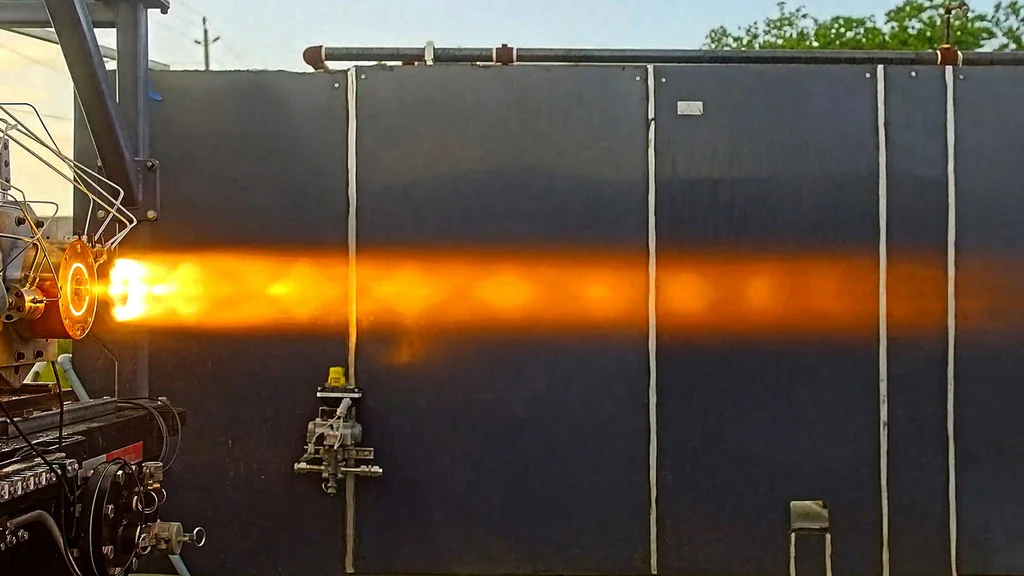
The rocket launch represented the first successful U.S. flight of a rotating detonation rocket engine (RDRE). Venus predicts this tech—which harnesses a continuous detonation wave around a ring-shaped chamber, generating increased thrust with less fuel—can achieve hypersonic flight. The startup has seen interest in its technology soar at a time when spending on defense, commercial space development, and aerospace technology is rapidly accelerating.
Duggleby estimates that Venus RDRE rockets can double the payload that rockets can take into space.
“It turns out when you build the most efficient liquid rocket engine in the world, defense and space companies start coming to you like, ‘Hey, could you sell us engines?’” she says. “We’ve pivoted, but at the core, it’s always been about, if you want to go fast, you need a new engine.”
The company has raised just shy of $140 million, including a $91 million Series B this June, and employs 113 people, per PitchBook. It struck a development deal with Lockheed Martin this past summer to integrate RDRE tech into precision long-range missiles.
In 2018, Andrew Duggleby was a Navy Reserve officer and the family was stationed in Japan. He and Sarah realized they wouldn’t be able to make it home for a grandmother’s birthday. Andrew joked that while it was going to be an excruciating 13 hours to fly home to the States, there was a new rocket engine technology being developed that could theoretically do the flight in an hour. They laughed, but the idea stuck with them, and they founded Venus two years later.
The rocket he was talking about was the RDRE. Theorized since the 1980s and finally cracked by a team of researchers from Purdue University and University of Central Florida, RDRE relies on a precisely timed ring of subsonic explosions, calibrated and choreographed to very rapidly detonate in a circular pattern, creating more thrust with less fuel use.
Traditional rocket engines, from the Saturn V to SpaceX’s Falcon, rely on a combustion process called deflagration, where a flame is exposed to a mixture of fuel and oxidizers. To put it simply: traditional rockets involve a continuous burn, RDRE rockets involve a series of explosions, Sarah Duggleby said an RDRE launch even sounds different; she can tell when a test flight is successful when it hits a certain whistling sound.
Venus’s rockets have achieved 15% more energy efficiency than the Saturn V, the rocket that launched astronauts to the moon in the ‘60s and ‘70s. For comparison, the new SpaceX rockets are just 2% more efficient than their Saturn forebears, Duggleby says.
The Dugglebys were both working for Virgin Orbit when Sarah read a news item about university researchers proving this new type of engine. In June of 2020, the couple decided to take the leap, quit Virgin, and pursue development of a high-speed plane using this new RDRE technology.
They chose the Houston Spaceport for the combination of aerospace talent and facilities; currently, from their headquarters at the spaceport, they can test-fire mounted rocket engines right outside their hangar door at Ellington Field. By contrast, Duggleby cited her experience with Virgin and Southern California aerospace, where the developers and startups worked in the South Bay or Long Beach but had to drive hours to test in the Mojave Desert. That added time and cost to development.
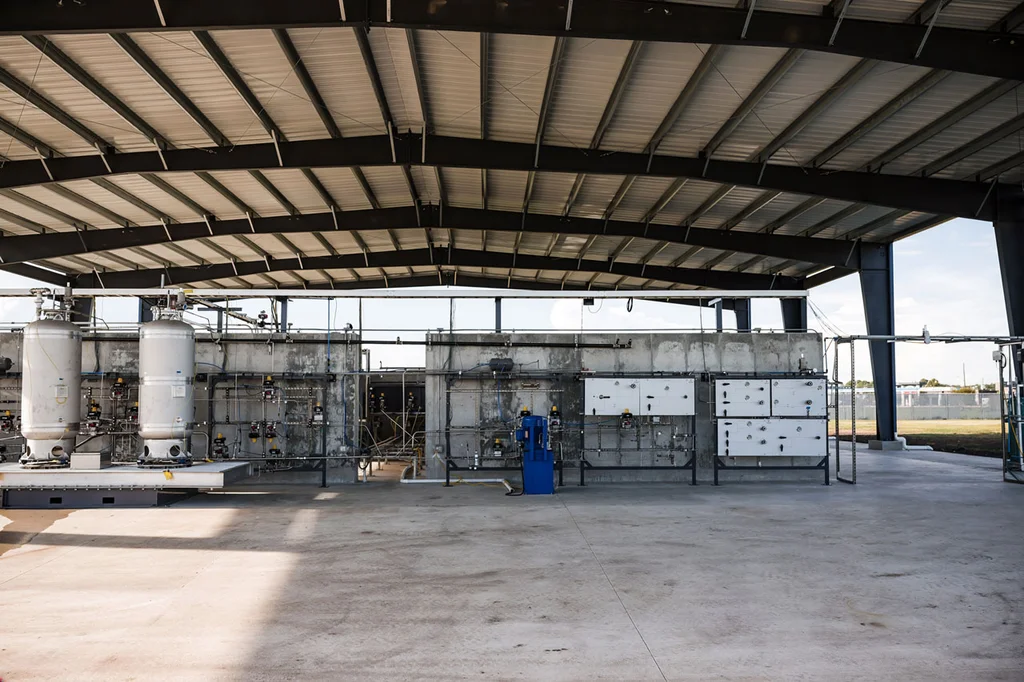
The close physical connection between Venus staff and the test site in Houston has allowed the company to iterate and develop very efficiently, said Duggleby; they developed the new rocket concept in roughly four years with $80 million.
Along with the theoretical blueprint from researchers, Venus Aerospace needed to engage in extensive testing, as well as materials science experiments and analysis with high-speed cameras, to develop a rocket that was commercially viable. Designing the chamber for the rotating supersonic explosions required deft engineering and new kinds of materials.
“Here’s an analogy about the challenge of building a rocket,” says Duggleby. “ A rocket’s like lighting a fire in a wax fireplace, and you have to keep the wax from melting.”
Venus is seeking to develop and test rocket models that can work across defense, space, and aerospace, and devise a manufacturing process to manufacture them at scale. As Duggleby puts it, they’re trying to work with numerous customers to incorporate Venus’s rockets into customers technology, and build a platform to serve all these different industries and engineering challenges.
“We have a current opportunity with what’s going on geopolitically to get our engine into systems,” she said. “But my hope and dream is that we will . . . not let go of that north star: that this is the engine that will ultimately unlock high-speed global travel.”