
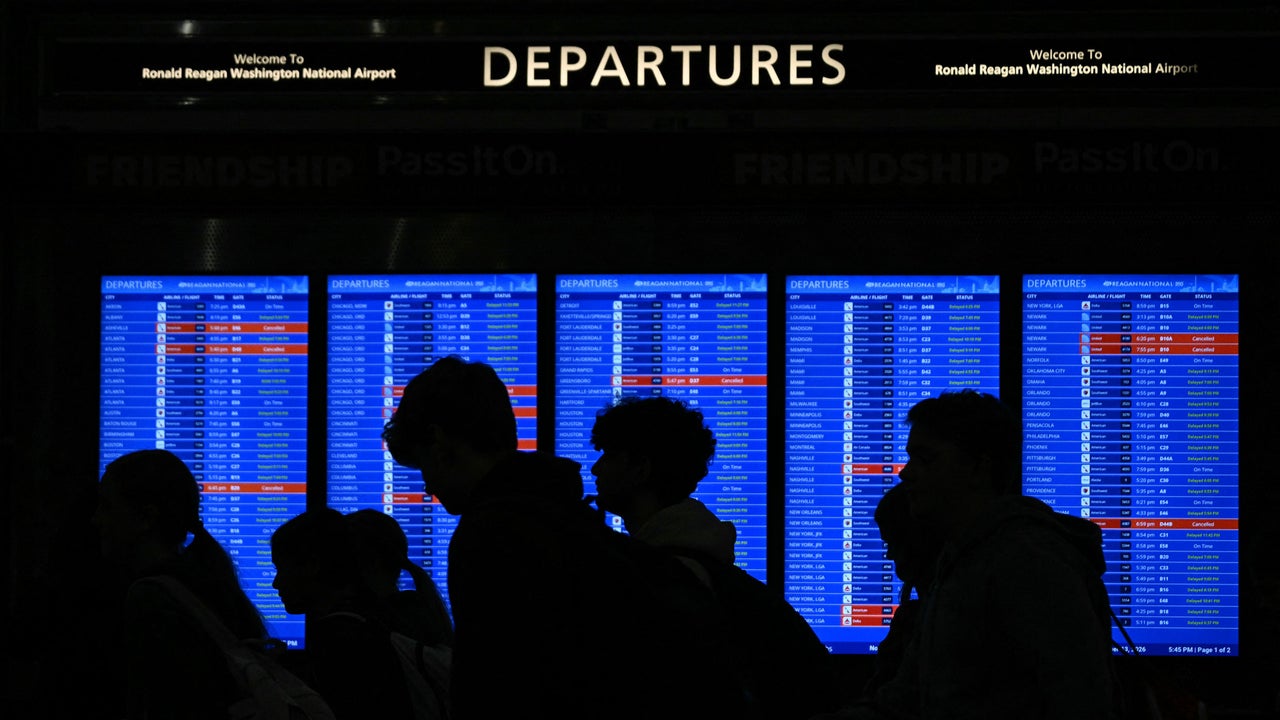
U.S. airlines are still reeling from a nationwide groundstop issued late Friday night that interrupted weekend travel and wreaked havoc on schedules. The culprit, the Federal Aviation Administration says, was simply outdated tech.
The groundstop was followed by eager speculation on social media about what might have caused the issue. Some pointed a finger at a new AI system that the FAA integrated earlier this week; others blamed foreign adversaries. At the same time, a range of tech companies that contract with the FAA (like Microsoft) were quick to distance themselves from the agency’s problems.
Later Friday evening, Transportation Secretary Sean Duffy told reporters the outage occurred after an old Time-Division Multiplexing (TDM) analog system, an arcane system of processing data signals over a network, became overloaded. This, in turn, impacted the telecommunications systems used by TRACONs, the air traffic control facilities that help direct flights at airports. Duffy noted that systems that had already been upgraded to new internet protocol-based systems did not experience the outage. “This is all the old legacy equipment,” he said Friday. “All of the new equipment that’s been deployed did not go down.”
Officials, at least for now, insist there’s no evidence anything nefarious happened. Instead, the Transportation Department is, once again, begging Congress for more money to overhaul FAA tech.
Duffy urged Congress to provide additional funding to modernize the nation’s air traffic control system, arguing that the issue should transcend partisan politics. He noted that the FAA had received $15 billion for modernization efforts over the past 25 years, with little to show for it. “It’s not red, it’s not blue, it’s not Democrat, it’s not Republican, it’s American,” he told reporters. “Give us the money to fix it.”
Indeed, the FAA’s tech problems are way bigger than AI. Instead, they have a lot more to do with the challenges of updating technology while it’s actively being used.
Our pilots guidance system is ancient and isn’t designed to handle upgrades
This isn’t the first time the FAA has experienced a major outage that’s brought flights across the country to a halt. Back in 2023, the U.S.’s Notice to Airmen system (NOTAM)—which alerts pilots to potential hazards in American airspace—came offline, after contractors accidentally deleted files that disrupted the program’s core technology.
There’s been an ongoing effort to improve the NOTAM system, but it’s moving at a snail’s pace. The FAA has brought in private industry for help and engaged in an effort to modernize the system, but that process has only brought to light myriad other problems. For one, at least according to contract paperwork obtained last year, NOTAMs weren’t exclusively being stored in a virtual environment or in an entirely-digital format. Another aspiration the FAA was working on, at least at the time: making sure that upgrades to some systems didn’t disrupt, well, all of air traffic control.
“Everyone will say, ‘well, there’s backups in place,’” Shawn Pruchnicki, a former pilot atOhio State’s Center for Aviation Studies, told FedScoop at the time. “But we’ve also seen time and time again where those things have been said and things have gone horribly wrong.”
Poor AI rollout
Like a lot of other federal agencies, the Federal Aviation Administration has been inching toward deploying artificial intelligence for a host of applications. Back in 2023, the Transportation Department, which the FAA sits under, even disclosed using ChatGPT for certain purposes (which the FAA, at the time, denied). Since then, though, the FAA begun to embrace AI: A use case inventory released by the government references several use cases, including AI-powered pilot voice transcription, systems for detecting drones, and meteorology.
But the FAA hasn’t been the best at communicating how it plans to use AI safely to the public, without falling susceptible to the risks of the technology, as Friday’s ground stop made clear.
Many people, early on, suspected that the outage might have had something to do with the SMART system, an AI-based airspace planning tool the agency debuted earlier this week. The FAA explains that the tool is designed to “analyzes airline schedules, weather, airport capacity, airspace conditions, and operational constraints to predict traffic flows and identify potential conflicts before they occur.” SMART doesn’t appear to be related to the ground stop, though.
Bad wires and old hardware
The deficiency of the FAA’s timeworn infrastructure was on full display in April 2025, when a burnt copper wire triggered a communications blackout at Newark Liberty International Airport. For some 90 seconds, air traffic controllers lost radar and radio contact with planes approaching one of the nation’s busiest airports. The incident triggered weeks of delays and cancellations. Another communications failure followed in May.
Newark’s hiccup problem was the sign of a much more endemic problem: Some of the FAA’s copper wiring dates back to the 1960s, and according to a September 2026 Government Accountability Office (GAO) report, the FAA had replaced just 2,560 of its 5,170 aging copper wires. That’s not even half.
And it’s not just wires. Back in 2007, the FAA began a sweeping technological overhaul known as NextGen, which aimed to reduce its reliance on ground-based radar in favor of satellite navigation and digital communications. Nearly two decades later, that effort remains unfinished, thanks in part to years of inadequate funding. Just earlier this month, the FAA proudly announced it had finally begun retiring floppy disks.
“What we’re doing is hard and it hasn’t happened in the past because it is hard. But I’ll tell you by doing nothing, you inject way more risk into the system,” Duffy said on Friday. “To use 1980s technology, 1990s software … 1970s radar that we don’t even make parts for anymore, to have an old network configuration from the 1980s versus re-networking the air traffic control system through the FAA, I believe that should be a priority.”
The FAA’s tech is the problem no one wants to fix
Transportation Secretary Sean Duffy came into office promising to overhaul the FAA’s aging technology. In May 2025, he unveiled an ambitious plan to rebuild the nation’s air traffic control system by 2028 and replace critical infrastructure like radars and radios. Congress approved an initial $12.5 billion for the effort, but the price tag quickly jumped: Just two months later, Duffy told lawmakers that the full overhaul would cost an estimated $31.5 billion. Even his 2028 deadline comes with an asterisk: It covers only the first phase of modernization, with no timetable yet established for the second, which includes new software to track aircraft and manage air traffic.
The GAO put it most damningly in its September 2026 report, writing that the FAA “doesn’t have a lifecycle cost estimate or master schedule for related projects,” which “could end up causing air traffic disruptions or prolonging reliance on severely outdated systems.” These tech problems only exacerbate the FAA’s other endemic challenges, including overworked air traffic control offices and a controller recruitment crisis.
Meanwhile, Republican Sen. Eric Schmitt’s $30 billion Modern Skies Act, which would fund upgrades on everything from air traffic control software to airport terminals, has yet to advance out of committee. And on November 13, the White House asked Congress for another $30.1 billion for aviation infrastructure, including $10.1 billion for air traffic control technology.
When asked about whether Americans could be sure that the issues seen Friday wouldn’t occur again, Duffy was blunt: “I can’t build things if I don’t have money.”