
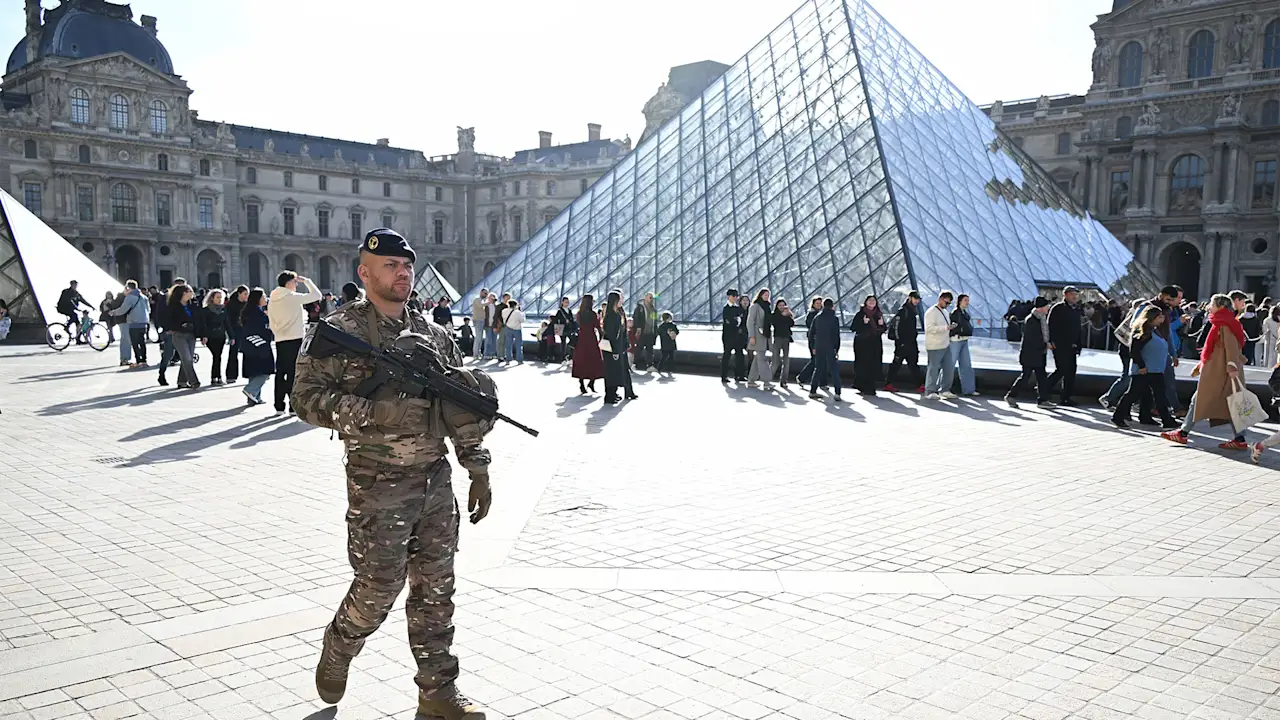
The day after the jewelry heist at the Louvre in Paris, officials from across Washington’s world-famous museums were already talking, assessing and planning how to bolster their own security.
“We went over a review of the incident,” said Doug Beaver, security specialist at the National Museum of Women in the Arts, who said he participated in Zoom talks with nearby institutions including the Smithsonian and the National Gallery of Art. “Then we developed a game plan on that second day out, and started putting things in place on Days 3, 4 and 5.”
Similar conversations are happening at museums across the globe, as those tasked with securing art ask: “Could that happen here?” One California museum knows the answer is yes—police are investigating the theft of more than 1,000 items just before the Louvre heist.
At the same time, many were acknowledging the inherent, even painful tension in their task: Museums are meant to help people engage with art—not to distance them from it.
“The biggest thing in museums is the visitor experience,” Beaver said. “We want visitors to come back. We don’t want them to feel as though they’re in a fortress or a restrictive environment.”
It’s an issue many are grappling with—most of all, of course, the Louvre, whose director, Laurence des Cars, has acknowledged “a terrible failure” of security measures.
It was crystallized in a letter of support for the Louvre and its beleaguered leader, from 57 museums across the globe. “Museums are places of transmission and wonder,” said the letter, which appeared in Le Monde. “Museums are not strongholds nor are they secret vaults.” It said the very essence of museums “lies in their openness and accessibility.”
Aging security systems
A number of museums declined to comment on the Louvre heist when contacted by The Associated Press, to avoid not only discussing security but also criticizing the Louvre at a sensitive time.
French police have acknowledged major security gaps: Paris Police Chief Patrice Faure told Senate lawmakers Wednesday that aging systems had left the museum weakened.
François Chatillon, France’s chief architect of historical monuments, noted nonetheless that many museums, especially in Europe, are in historic buildings that were not constructed with the goal of securing art. The Louvre, after all, was a royal palace—a medieval one at that.
“Faced with the intrusion of criminals, we must find solutions, but not in a hasty manner,” Chatillon told Le Monde. “We’re not going to put armored doors and windows everywhere because there was this burglary.”
The architect added that demands on museums come from many places. “Security, conservation, adaptation to climate change—they are all legitimate.”
Prioritizing protection
Even within security, there are competing priorities, noted attorney Nicholas O’Donnell, an expert in global art law and editor of the Art Law Report, a blog on legal issues in the museum and arts communities.
“You’re always fighting the last war in security,” said O’Donnell. For example, he noted museums have lately been focusing security measures on “the very frequent and regrettable trend of people attacking the art itself to draw attention to themselves.”
O’Donnell also noted that the initial response of Louvre security guards was to protect visitors from possible violence. “That’s an appropriate first priority, because you don’t know who these people are.”
But perhaps the greatest battle, O’Donnell said, is to find a balance between security and enjoyment.
“You want people interacting with the art,” he said. “Look at the ‘Mona Lisa’ right around the corner (from the jewels). It’s not a terribly satisfying experience anymore. You can’t get very close to it, the glass . . . reflects back at you, and you can barely see it.”
O’Donnell says he’s certain that museums everywhere are reevaluating security, fearing copycat crimes. Indeed, the Prussian Cultural Heritage Foundation, which oversees Berlin’s state museums and was hit hard by a brazen robbery in 2017, said it was using the Louvre heist “as an opportunity to review the security architecture of our institutions.” It called for international cooperation, and investments in technology and personnel.
Creating a balance
Beaver, in Washington, predicts the Paris heist will spur museums to implement new measures. One area that he’s focused on, and has discussed with other museums, is managing the access of construction teams, which he says has often been loose. The Louvre thieves dressed as workers, in bright yellow vests.
It’s all about creating a “necessary balance” between security and accessibility, Beaver says. “Our goal isn’t to eliminate risk, it’s to really manage it intelligently.”
Soon after he took the security post in 2014, Beaver said that he refashioned the museum’s security and notably added a weapons detection system. He also limited what visitors could carry in, banning bottles of liquid.
He said, though, that the reaction from visitors had been mixed—some wanting more security, and others feeling it was too restrictive.
Robert Carotenuto, who worked in security for about 15 years at New York’s Metropolitan Museum of Art running the command center, says museums have become increasingly diligent at screening visitors, as they try to thwart protesters. But that approach alone doesn’t resolve risks on the perimeter—the Paris thieves were able to park their truck right outside the museum.
“If you’re just going to focus on one risk, like protesters . . . your security system is going to have a lapse somewhere,” he said. “You can stop the protesters . . . but then you’re not going to pay attention to people who are phony workers breaking into the side of your building.”
The magic of museums
Patrick Bringley also worked at the Met, as a security guard from 2008 to 2019 — an experience that led to a book and an off-Broadway show, “All the Beauty in the World.”
“Museums are wonderful because they are accessible,” he said. “They’re these places that will put things that are thousands of years old and incomprehensibly beautiful in front of visitors—sometimes even without a pane of glass. That’s really special.”
The tragedy of the Louvre heist, Bringley said, is that such events make it harder for museums to display all their beauty in a welcoming way.
“Art should be inviting,” Bringley said. “But when people break that public trust, the Louvre is going to have to step up their procedures, and it will just become a little less magical in the museum.”
—R.J. Rico and Jocelyn Noveck, Associated Press