
AI-generated content is making it harder to trust what we see and hear. But at the South by Southwest (SXSW) festival, a new installation is using the same tech to place people inside history’s most defining moments.
“The Great Dictator,” which premiered this week in Austin, flips the script on what deepfakes have come to represent. Instead of using generative AI to create misinformation, it uses AI video and voice tools to blend participants into archival footage to experience history through their own voice and likeness.
It’s the latest project from filmmaker and artist Gabo Arora, who wanted to show how emerging tech can be used for something other than profit, warfare, or propaganda.
“This is an exhibit that examines something that was as powerful 3,000 years ago with no technology, with the ancient Greeks,” Arora says. “It really shows you we might have all the technology we want, and humans don’t change. We have something hardwired in us about rhetoric and power and someone speaking up.”
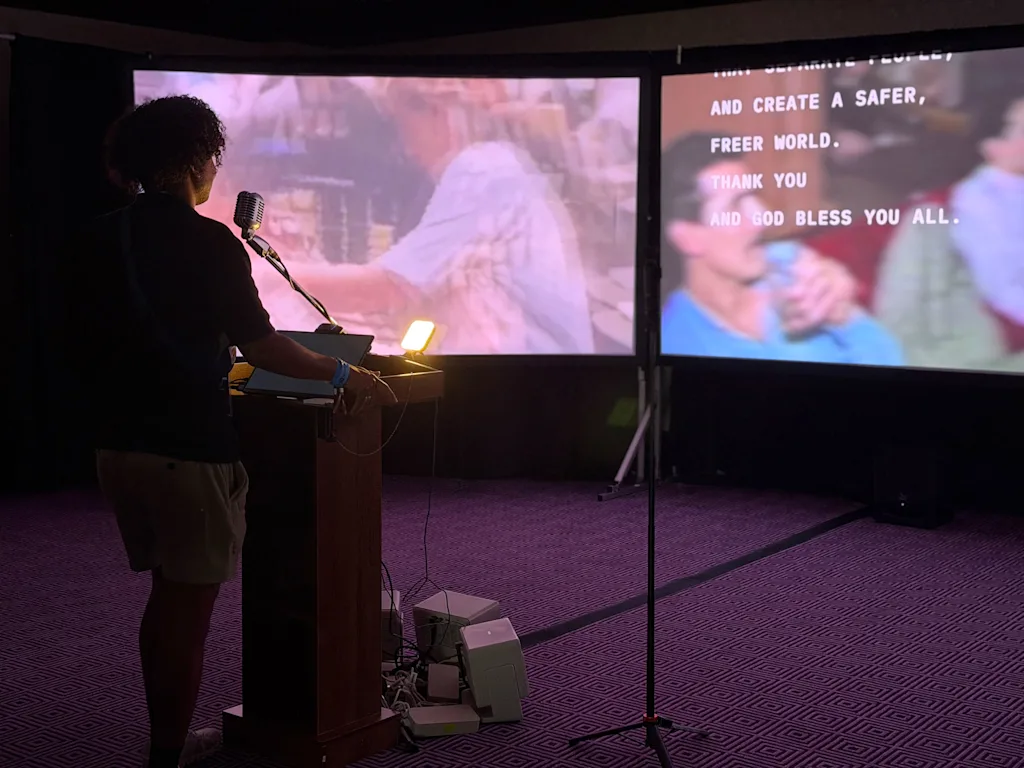
At a hotel in downtown Austin, attendees step up to a podium flanked by three large screens cycling archival footage. After consenting for their voice and likeness to be used, the person then chooses one of three speeches from three very different eras: Malcolm X’s 1964 “The Ballot or the Bullet” speech in Cleveland, Ronald Reagan’s 1987 “Tear down this wall” speech in Germany, and Zohran Mamdani’s 2024 victory speech in New York City.
Participants then recite a 90-second excerpt from a teleprompter while an AI-generated crowd reacts with cheers at some moments and falls silent at others, based on the speaker’s words and tone. Minutes later, they are shown a short film in which their cloned voice continues the speech while their likeness is seamlessly inserted into the original footage. The project relies on several generative AI platforms, including ElevenLabs to capture a participant’s vocal signature and Runway for video generation.
Part art project, part film, and part immersive experience, the project takes its title from Charlie Chaplin’s 1940 film The Great Dictator, a bold satire that used performance and cinema to confront Hitler and fascism at the height of Nazi power.
“We wanted Hitler to haunt over this project without having Hitler in it,” Arora says. “And I think calling it ‘The Great Dictator’ kind of makes you realize that someone used art and rhetoric and performance to kind of counter what was happening. And I think we can do that now.”
‘You realize there’s power in words’
SXSW attendees who experienced “The Great Dictator” describe it as both empowering and surprisingly emotional. Greg Swan, a senior partner at Finn Partners and longtime SXSW attendee, was struck by how the project highlights human-to-human delivery, even in the AI era.
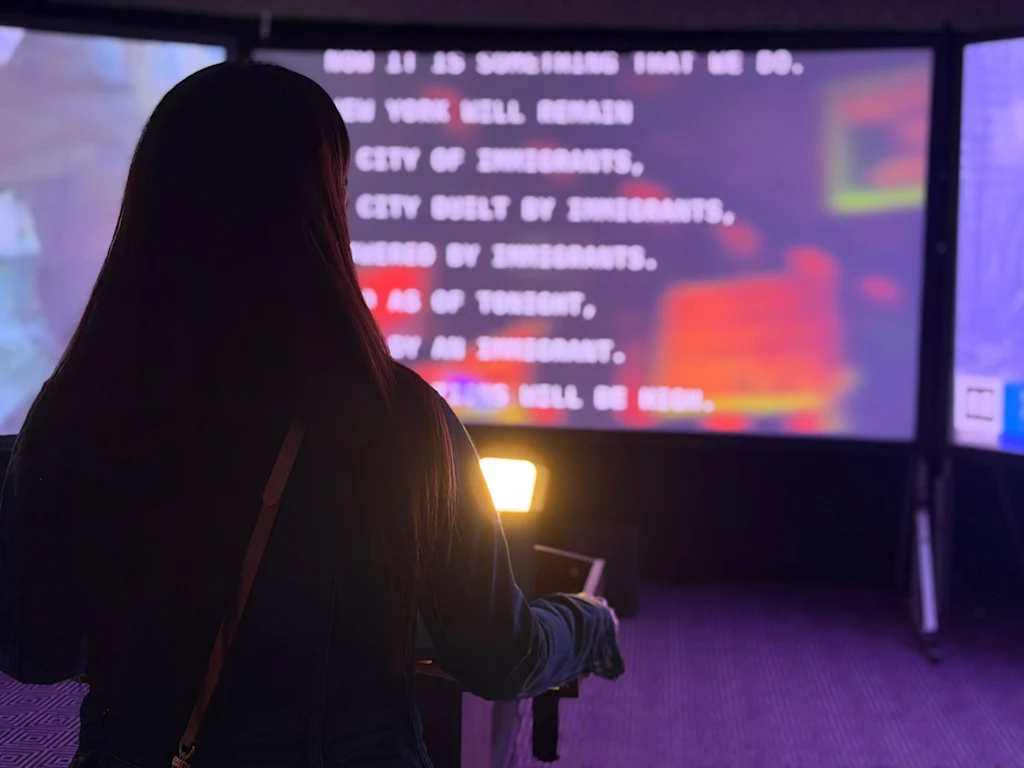
“What a brilliant concept to let everyday people see what it’s like to speak emotional, persuasive words in a venue where every word, inflection, and breath matters,” says Swan, who is based in Minneapolis and chose Mamdani’s speech. “I found myself getting choked up as I spoke Mamdani’s words about an immigrant leading a city of immigrants, knowing the context that those words were spoken last year and how they still pack a punch today.”
The project is a powerful social critique to counter today’s increasingly distorted digital and political landscape, says Rayme Silverberg, founder and CEO of Paradigm Shift, a startup focused on rethinking how cultural institutions are funded and sustained.
“There’s this brief window where you realize there’s power in words and that what you say in front of a group of people at a podium really does matter,” says Silverberg, who chose Reagan’s speech. “It renews that relationship to words, and therefore, it renews our relationship to the meaning behind those words and the semblance of reality that words then shape.”
‘My through line is empathy’
“The Great Dictator” builds on Arora’s decade-long exploration of using emerging technologies—including artificial intelligence, virtual reality, spatial audio, and augmented reality—to connect audiences with the world’s most urgent issues. Past projects have placed viewers inside stories about war, displacement, and historical trauma.
As the United Nations’ first creative director, Arora helped pioneer virtual-reality documentaries like Clouds Over Sidra, which gave viewers an immersive story about the Syrian refugee crisis. He also worked with Steven Spielberg’s Shoah Foundation to create The Last Goodbye, an immersive VR experience that follows a real-life Holocaust survivor’s return to a former Nazi concentration camp.
“My through line is empathy,” Arora says. “How do we connect to each other and to the important stories of our time?”
Scaling immersive experiences beyond film festivals can be a challenge, but “The Great Dictator” was designed to be adaptable across venues. After SXSW, the team plans to bring it to museums, libraries, and public squares. It is already in discussions with institutions including the Museum of the Moving Image in Queens, New York; the Brooklyn Public Library; and the MIT Media Lab in Cambridge, Massachusetts. Longer term, the creators hope to expand to a browser-based experience by 2027 and potentially to streaming or gaming platforms by 2028.
Future versions will likely feature many more speeches, including both well-known addresses and lesser-known “deep cuts,” Arora says. Among the possibilities are speeches by environmentalist Rachel Carson and Russian author Aleksandr Solzhenitsyn. The team also explored including a 1979 speech by Iran’s first supreme leader, Ayatollah Ruhollah Khomeini, though Arora says they ultimately could not make it work aesthetically.
The way Arora sees it, AI creates a new lens that helps people see and feel parts of history in ways that weren’t previously possible.
“We default to the archives just being these videos you never watch on YouTube,” Arora says. “If you’re a researcher, how do you make them come to life? How do you make these very powerful moments? How do you build curiosity? For me, it is a way for people to understand the power of good and bad on both sides. It’s still the technology of rhetoric.”