

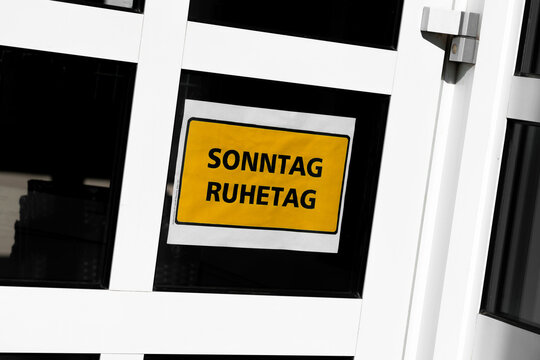
Germany’s political class has finally discovered the source of the nation’s economic collapse, and naturally, it is everyone except the politicians who created it. Germany is considering weakening its revered Sonntagsruhe, or “Sunday rest,” as officials search desperately for some way to revive an economy they have suffocated with high taxes, unaffordable energy, endless regulation, and ideological nonsense. Their brilliant solution is to keep stores and businesses operating seven days a week, tighten sick-leave rules, push people to work longer, and gradually raise the retirement age. They destroyed the German economic model and now expect the German people to surrender their Sundays to repair it.
Let us be clear about what is actually being proposed because this is not yet a literal order requiring every German to work seven consecutive days. The government is moving toward a seven-day commercial economy by expanding Sunday opening, creating incentives for holiday work, weakening traditional restrictions on Sunday labor, and shifting working-time rules from a daily limit toward a more flexible weekly calculation. Once Sunday becomes merely another commercial day, the pressure will spread from retailers to suppliers, warehouses, delivery companies, security firms, cleaners, transportation workers, and families expected to arrange their lives around rotating schedules. That is how governments destroy social custom.
Sonntagsruhe is not some meaningless inconvenience left over from another century. The protection of Sunday as a day of rest and spiritual reflection is incorporated into Germany’s Basic Law through Article 140 and Article 139 of the Weimar Constitution. It created one common day when families could gather, churches could function, clubs and communities could meet, and people could participate in society without arranging their lives around an employer’s schedule. Even those who are not religious benefit from a shared day of rest because a society is more than a collection of workers, taxpayers, and consumers whose only purpose is to keep money circulating.
Destroying that common day will not restore productivity. It will merely spread the same amount of consumption across seven days instead of six while increasing labor, energy, transportation, and operating costs. A German family does not magically receive more disposable income because a department store opens on Sunday. If households are being crushed by taxes, housing costs, food inflation, and energy bills, opening the doors for another 12 hours does not create purchasing power. It simply forces retailers to compete over the same depleted pool of money while paying to keep the lights on for another day.

Germany’s economy has barely moved since 2019. The IMF calculated that German output grew by only 0.1% over five years while the United States expanded by 12% and the euro area by roughly 4%. German industry has contracted every year since 2022, and the Federation of German Industries warned that 2026 may bring stagnation at best, with manufacturing potentially shrinking for a fifth consecutive year. Industrial capacity utilization is sitting only slightly above 78%, yet the politicians apparently believe the problem is that Germans are resting on Sunday.
Factories are not leaving because the local bakery closes one day each week. Industry is leaving because Germany deliberately destroyed its access to dependable and competitively priced energy. Berlin shut down the last nuclear reactors, abandoned the Russian energy relationship without securing an affordable replacement, imposed the costly Green agenda on producers, and then acted astonished when chemicals, steel, glass, machinery, and automobile production became uncompetitive. You cannot operate an industrial economy on speeches about climate virtue while importing more expensive energy and pretending the cost does not flow through every product made in the country.
The government is simultaneously preparing €10 billion in tax relief while increasing the top income-tax rate from 45% to 47%. This is the standard European shell game. They take from one pocket, return a fraction to another, and announce a historic reform while the bureaucracy continues consuming the economy. A two-parent family with two children and €60,000 in taxable income may eventually receive about €600 a year in relief, which comes to roughly €11.50 per week. That will not compensate for soaring energy costs, lost purchasing power, or the growing burden of financing pensions, welfare, government debt, mass migration, and military expansion.
The Organisation for Economic Co-operation and Development expects Germany to grow by only 0.7% in 2026 on a working-day-adjusted basis and 1.1% in 2027. Much of even that weak expansion is expected to come from debt-financed government spending rather than a genuine revival of the productive private economy. Berlin has created a €500 billion infrastructure and climate fund while planning to increase defense spending from 2.1% of GDP in 2024 to 3.5% by 2029. The political class will borrow hundreds of billions for its chosen projects and military ambitions, yet it tells workers that they must sacrifice Sunday because they are not producing enough to sustain the state.
Chancellor Friedrich Merz previously admitted that Germany’s welfare state “can no longer be financed with what we produce in the economy.” That admission is correct, but the response is completely backward. The productive economy should not exist merely to satisfy the endless demands of government. The government must be reduced to what the productive economy can reasonably support. Instead, politicians preserve the bureaucracy, protect their political programs, expand military expenditures, and then demand more hours from the people who already finance the entire circus.
The attacks on sick leave reveal the same contempt. Germany does have an absenteeism problem, but politicians have seized upon it as a convenient excuse to blame workers for national stagnation. The government wants employers to demand a medical certificate on the first day of illness and to abolish the ability to obtain short-term sick notes by telephone. Yet telephone sick notes reportedly account for less than 1% of all certified leave. This is political theater designed to create the impression that lazy workers destroyed the economy when the people writing these policies refuse to accept responsibility for anything.
A society cannot tax work relentlessly, increase the cost of living, erode the value of wages, make housing unaffordable, demand that parents both work, raise the retirement age, and then confiscate the one day when families can reliably be together. The result will not be a stronger work ethic. It will be burnout, lower birth rates, more illness, less community participation, and deeper resentment toward a government that treats human beings as units of taxable production.
Germany already faces a severe demographic crisis, and dismantling Sunday rest will make that problem worse. Young people are delaying families because housing, childcare, and basic living costs have become prohibitive. Women account for a large majority of part-time workers, often because they are caring for children or elderly relatives. Rather than repair the care system or reduce the tax penalty imposed on working families, politicians condemn “lifestyle part-time work” and demand that people spend more of their lives laboring for a system that offers them less security every year.
Culture matters because it is the glue that holds a nation together when government fails. Sonntagsruhe created a predictable rhythm of life that survived wars, political upheaval, reunification, and enormous economic change. Once that shared rhythm is destroyed, it will not easily return. Small family businesses will be pressured to open merely because multinational chains can absorb the additional staffing costs. Employees will lose weekends with their children. Churches, clubs, sports organizations, and local communities will compete with rotating work schedules. Germany will gain another shopping day while losing another piece of itself.
Politicians always demand sacrifice from everyone beneath them. They never propose closing ministries, abolishing useless agencies, ending failed climate programs, reducing their own salaries, dismantling Brussels’ bureaucracy, or admitting that sanctions and geopolitical adventures carried an enormous domestic cost. They tell the factory worker to labor longer, the sick employee to prove he is not lying, the pensioner to retire later, and the family to surrender Sunday, while the people responsible for the disaster remain comfortably protected by the state.
Germany cannot work its way out of political stupidity by operating seven days a week. Until Berlin restores affordable energy, cuts taxes, slashes regulation, permits capital formation, and stops subordinating the national economy to every ideological order issued by Brussels, additional working hours will merely produce additional misery. The politicians burned down the engine of Europe and are now blaming the passengers because they refuse to push the wreckage on Sunday. That is not economic reform. It is the organized transfer of suffering from those who made the decisions to those who were forced to live with them.