Close Menu
    Facebook X (Twitter) Instagram
    TRENDING :
    • All 55 European Football Federations Voted to Boycott FIFA
    • The Service Business That Wins AI Search Does These 3 Things
    • The Growth Trap Founders Fall Into When Every Opportunity Looks Too Good to Ignore
    • Market Talk – July 30, 2026
    • That cringey LinkedIn post? You can now report it as ‘AI slop’
    • 5 Ways the Sales Funnel Broke (and How AI is Replacing It)
    • JetZero Lands $3 Billion Deal to Build Blended-Wing Aircraft
    • How This Colorful, High-Energy Drink Chain Is Disrupting Coffee
    Compatriot Chronicle
    • Home
    • US Politics
    • World Politics
    • Economy
    • Business
    • Headline News
    Compatriot Chronicle
    Home»Business»Housing market squeeze: The income needed to purchase a typical U.S. home is up 79% since 2020
    Business

    Housing market squeeze: The income needed to purchase a typical U.S. home is up 79% since 2020

    March 14, 20263 Mins Read
    Share Facebook Twitter Pinterest LinkedIn Tumblr Telegram Email Copy Link
    Follow Us
    Google News Flipboard
    Share
    Facebook Twitter LinkedIn Pinterest Email


    Want more housing market stories from Lance Lambert’s ResiClub in your inbox? Subscribe to the ResiClub newsletter.

    Here’s the annual U.S. household income needed to purchase the typical valued U.S. home:

    • January 2020: $52,041
    • January 2021: $52,087
    • January 2022: $63,111
    • January 2023: $87,092
    • January 2024: $93,227
    • January 2025: $98,900
    • January 2026: $93,061

    While the income needed to buy the median-priced U.S. home is +78.8% higher than it was in January 2020, it’s down -5.9% year over year.

    Methodology: This Zillow calculation is conservative and assumes a 20% down payment and that the homebuyer spends less than 30% of their monthly income on the total monthly payment. This is a financed purchase, of course. For typical home value, Zillow economists used the latest Zillow Home Value Index reading.

    window.addEventListener(“message”,function(a){if(void 0!==a.data[“datawrapper-height”]){var e=document.querySelectorAll(“iframe”);for(var t in a.data[“datawrapper-height”])for(var r,i=0;r=e[i];i++)if(r.contentWindow===a.source){var d=a.data[“datawrapper-height”][t]+”px”;r.style.height=d}}});

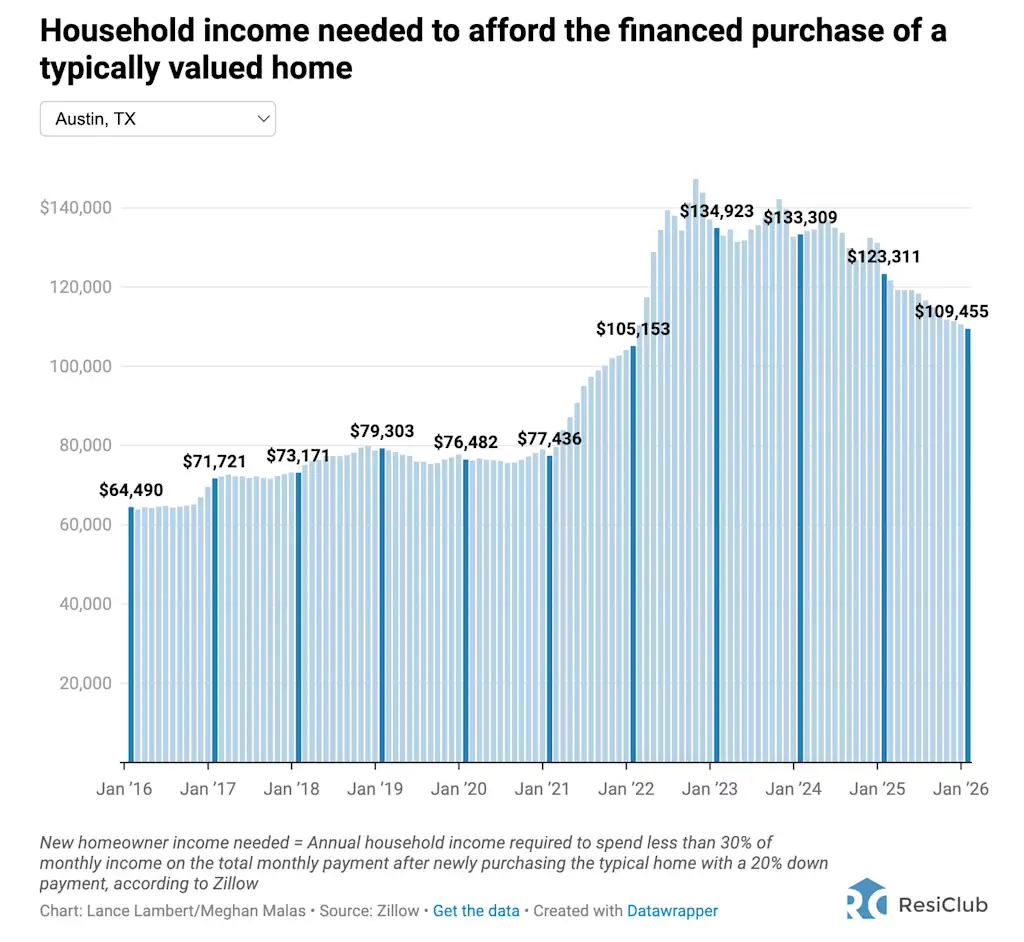
    Regional housing markets that have experienced outright home price corrections since the end of the pandemic housing boom have seen faster affordability improvements. That said, many of those places—like the Austin, Texas, metro area—also experienced greater home price overheating during the pandemic housing boom.

    How did we get here?

    During the pandemic housing boom, housing demand surged rapidly amid ultralow interest rates, stimulus, and the remote work boom. Federal Reserve researchers estimate that “new construction would have had to increase by roughly 300% to absorb the pandemic-era surge in demand.”

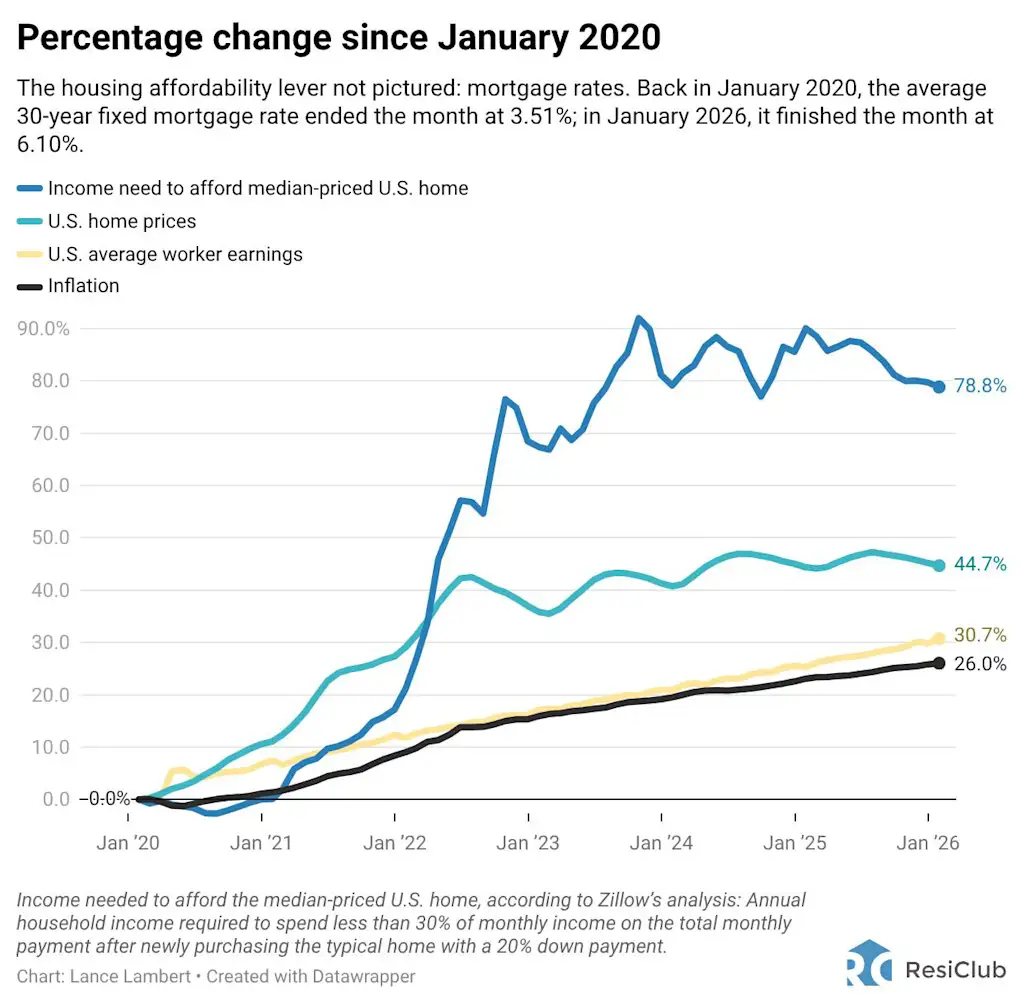
    Unlike housing demand, housing supply isn’t as elastic and can’t quickly ramp up like that. As a result, the heightened pandemic-era demand drained the market of active inventory and sent national home prices soaring. The typical U.S. home value measured by the Zillow Home Value Index in January 2026 is still a staggering +44.7% greater than in January 2020.

    That overheated home price growth, coupled with the ensuing mortgage rate shock, with the average 30-year fixed mortgage rate jumping up from under 3% to over 7%, created the fastest-ever deterioration in housing affordability in 2022. Over the past two years, housing affordability has improved some; however, it still remains challenged.

    While the exact hit has varied, this decade’s affordability squeeze has spread across much of the country—just look at the two maps below.

    window.addEventListener(“message”,function(a){if(void 0!==a.data[“datawrapper-height”]){var e=document.querySelectorAll(“iframe”);for(var t in a.data[“datawrapper-height”])for(var r,i=0;r=e[i];i++)if(r.contentWindow===a.source){var d=a.data[“datawrapper-height”][t]+”px”;r.style.height=d}}});

    window.addEventListener(“message”,function(a){if(void 0!==a.data[“datawrapper-height”]){var e=document.querySelectorAll(“iframe”);for(var t in a.data[“datawrapper-height”])for(var r,i=0;r=e[i];i++)if(r.contentWindow===a.source){var d=a.data[“datawrapper-height”][t]+”px”;r.style.height=d}}});

    The challenge, of course, is that incomes haven’t kept up. The gap has narrowed since the end of 2022; however, it’s still wide.

    While the annual U.S. household income needed to purchase a typical U.S. home increased by +78.8% between January 2020 and January 2026, average weekly earnings of U.S. workers have risen by +30.7%, and overall U.S. consumer inflation has grown by +26% during the same period.


    Source link

    Share. Facebook Twitter Pinterest LinkedIn Tumblr Email

    Related Posts

    All 55 European Football Federations Voted to Boycott FIFA

    July 30, 2026

    The Service Business That Wins AI Search Does These 3 Things

    July 30, 2026

    The Growth Trap Founders Fall Into When Every Opportunity Looks Too Good to Ignore

    July 30, 2026
    Top News

    Here’s how much the 2026 World Cup will cost companies in lost employee productivity—the number is staggering

    By Staff WriterJune 12, 2026

    The 2026 FIFA World Cup kicks off Thursday, June 11, to much fanfare, but one…

    7 Inexpensive Craft Supplies for Your Next Project

    November 16, 2025

    Top 10 Christmas Crafts Supplies You Need This Holiday Season

    December 13, 2025

    Why staying solo is a strategic decision

    February 20, 2026
    Top Trending

    All 55 European Football Federations Voted to Boycott FIFA

    By Staff WriterJuly 30, 2026

    Last week, FIFA announced plans to sell a $20 billion stake in…

    The Service Business That Wins AI Search Does These 3 Things

    By Staff WriterJuly 30, 2026

    Opinions expressed by Entrepreneur contributors are their own. Key Takeaways Answer the…

    The Growth Trap Founders Fall Into When Every Opportunity Looks Too Good to Ignore

    By Staff WriterJuly 30, 2026

    Opinions expressed by Entrepreneur contributors are their own. Key Takeaways Founders are…

    Categories
    • Business
    • Economy
    • Headline News
    • Top News
    • US Politics
    • World Politics
    About us

    The Populist Bulletin serves as a beacon for the populist movement, which champions the interests of ordinary citizens over the agendas of the powerful and entrenched elitists. Rooted in the belief that the voices of everyday workers, families, and communities are often drowned out by powerful people and institutions, it delivers straightforward, unfiltered, compelling, relatable stories that resonate with the values of the American public.

    The Populist Bulletin was founded with a fervent commitment to inform, inspire, empower and spark meaningful conversations about the economy, business, politics, inequality, government accountability and overreach, globalization, and the preservation of American cultural heritage.

    The site offers a dynamic mix of investigative journalism, opinion editorials, and viral content that amplify populist sentiments and deliver stories that echo the concerns of everyday Americans while boldly challenging mainstream narratives that serve the privileged few.

    Top Picks

    All 55 European Football Federations Voted to Boycott FIFA

    July 30, 2026

    The Service Business That Wins AI Search Does These 3 Things

    July 30, 2026

    The Growth Trap Founders Fall Into When Every Opportunity Looks Too Good to Ignore

    July 30, 2026
    Categories
    • Business
    • Economy
    • Headline News
    • Top News
    • US Politics
    • World Politics
    Copyright © 2025 Populist Bulletin. All Rights Reserved.

    Type above and press Enter to search. Press Esc to cancel.