Close Menu
    Facebook X (Twitter) Instagram
    TRENDING :
    • If You’re Not Using Chatbots, You’re Failing Your Customers
    • Iran’s Economy Is Unraveling | Armstrong Economics
    • Why Being “Reliable” Is Quietly Sabotaging Ambitious Leaders — and How to Break the Pattern
    • Ukraine Is Taking The War Deep Into Russia
    • Run This Simple Stress Test on Your Business (Before the Market Does It for You)
    • Europe Destroyed Its Auto Industry—China Did Not
    • By Year Three, Half of Founders Are No Longer CEO. Here’s How to Be in the Other Half.
    • What Judge Judy Can Teach Senior Leaders About Strong Executive Communication
    Compatriot Chronicle
    • Home
    • US Politics
    • World Politics
    • Economy
    • Business
    • Headline News
    Compatriot Chronicle
    Home»Business»Japan’s beautiful cherry blossoms are facing an ugly threat
    Business

    Japan’s beautiful cherry blossoms are facing an ugly threat

    April 8, 20265 Mins Read
    Share Facebook Twitter Pinterest LinkedIn Tumblr Telegram Email Copy Link
    Follow Us
    Google News Flipboard
    Share
    Facebook Twitter LinkedIn Pinterest Email


    The spring bloom of cherry blossoms are known to be a stunning sight. Across Japan, Korea, and places like Washington, D.C., the trees burst with dense, pink flowers for just one or two weeks, bringing millions of tourists.

    But climate change is threatening these blooms.

    As the planet warms, our winters are getting milder. And those mild winters can delay the flowering of cherry blossom trees by up to 32 days, according to a new study from researchers at the Forestry and Forest Products Research Institute in Kyushu, Japan, and at Boston University. 

    Without enough cold weather, the trees don’t know that winter has passed, and so they don’t know to come out of their winter dormancy state.

    But more than just delaying blooms, mild winters are also making cherry blossoms less dramatic, affecting how many buds bloom and causing the trees to look less flush with flowers—which could have huge implications for tourism.

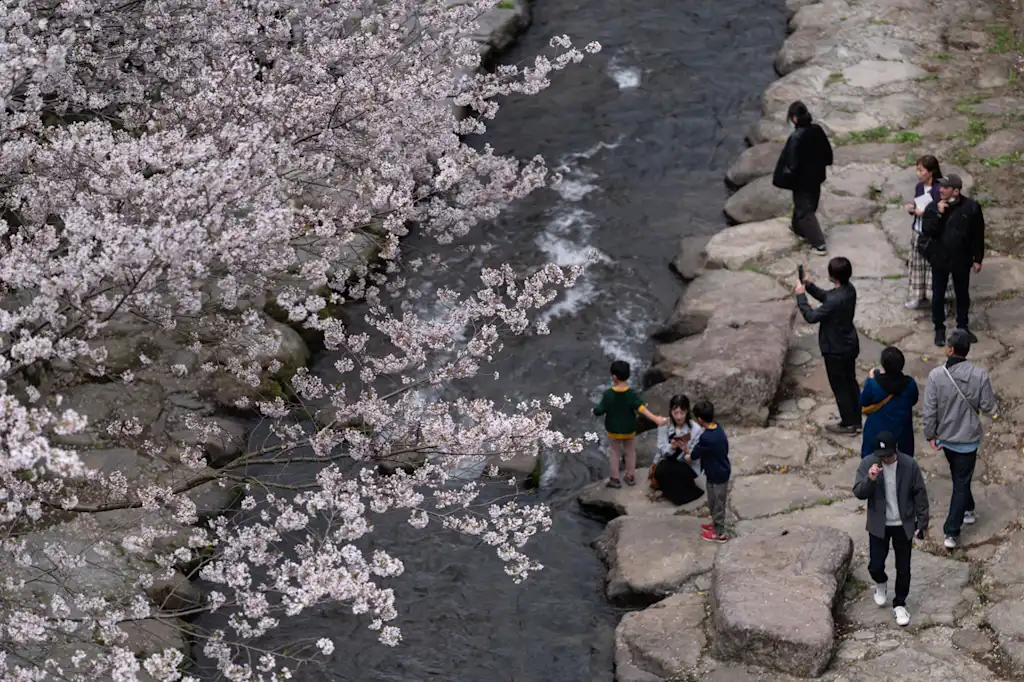
    People watch cherry trees in bloom during the Kanoukaen Fire Festival on March 29, 2025 in Unzen, Nagasaki Prefecture, Japan. The fire festival which is based on a story depicted in a historical scroll over 400 years old, was held in the cherry blossom season in the country. [Photo: Tomohiro Ohsumi/Getty Images]

    A less dramatic display

    The study, published in the International Journal of Biometeorology, specifically looked at Yoshino cherry trees, a hybrid species developed in 19th-century Japan and the most popular varietal.

    “What’s really unique about these cherry trees is they flower in a huge burst, like all the flowers open just at once, within a day or so,” says Richard Primack, a Boston University biology professor and coauthor of the study. “It’s an absolutely unbelievable flower display.”

    But if there’s a very mild winter, the buds aren’t ready to respond to warmer temperatures. Instead of flowers opening over just days, they open up over the course of a couple of weeks.

    A longer flowering period sounds good in theory, but it’s less dramatic. Because the flowers don’t last long, they die off as new ones bloom. That change leaves cherry trees looking “kind of bedraggled,” Primack says, with just a “scattering” of flowers.

    Cherry trees, then, never reach “peak bloom,” meaning 80% of their flowers open at once. Flower buds will even fall off of the trees without ever opening.

    [Image: courtesy Boston University]

    Impacts on cherry blossom tourism

    The southern boundaries of these trees are already being affected, with a less reliable display of blooms. As the planet continues to warm, there will be years where cherry blossoms just don’t give off dramatic displays of their pink flowers at all.

    That could affect all sorts of tourism, and also disrupt cultural practices. Across Japan, some 37 million tourists travel to see the cherry blossoms bloom, and residents even get off work to have cherry blossom parties, or gather with friends and family to picnic under the flowers. 

    There are also multiple cherry blossom festivals, with food, drinks, and performances. In 2025, Japan’s cherry blossom season had an economic impact of $9 billion.

    In the United States, Washington’s cherry blossoms alone bring about 1.5 million visitors, which translates to more than $200 million in visitor spending.

    “If the cherry blossoms aren’t as dramatic, then it means that the hotels aren’t filled, the restaurants aren’t filled with people, the merchants aren’t selling as much stuff, and so it has a big drag on the economy,” Primack says.

    “People have to be prepared for this,” he adds. “It either means that you don’t have these flower displays every year and people just accept that. Or, it means that in these places, people have to start planting other species that are more tolerant of mild winters.”

    An example of climate change disruption

    The study was able to understand what’s happening with yoshino cherry trees because Japanese meteorologists have been closely monitoring when these trees flower for decades. Researchers analyzed nearly 60 years of Japanese meteorological data. (Lead study author Toshio Katsuki, from Japan’s Forestry and Forest Products Research Institute, is a noted expert on cherry trees.)

    “You have more information about the yoshino cherry flowering than really almost any plant species in the world,” Primack says.

    But they’re not the only trees affected by climate change. All sorts of species are seeing effects from our warming world, particularly along the southern edge of their ranges.

    The study suggests that warming climate is disrupting the trees’ reproduction. If trees don’t flower as well after warm winters, they might not be pollinated effectively either. 

    Ultimately, what’s happening with cherry blossoms illustrates the reality of climate change, and the way it impacts all sorts of species and industries. 

    “It’s an indicator,” Primack says, “that climate change has the potential to disrupt natural systems in unexpected ways.”


    Source link

    Share. Facebook Twitter Pinterest LinkedIn Tumblr Email

    Related Posts

    If You’re Not Using Chatbots, You’re Failing Your Customers

    August 11, 2026

    Why Being “Reliable” Is Quietly Sabotaging Ambitious Leaders — and How to Break the Pattern

    August 11, 2026

    Run This Simple Stress Test on Your Business (Before the Market Does It for You)

    August 11, 2026
    Top News

    Chaos And Disorder Prohibited By National Guard

    By Staff WriterOctober 17, 2025

    The party of chaos and disorder is furious that the National Guard has been restoring…

    Wall Street rebounds from Friday’s drop after Trump says ‘it will all be fine’ with China

    October 14, 2025

    Blue Light’s Shadow: A Weapon of Social and Technological Control | Elijah Schaffer | The Gateway Pundit

    August 31, 2025

    Britain Wants To Control Your Algorithm

    July 15, 2026
    Top Trending

    If You’re Not Using Chatbots, You’re Failing Your Customers

    By Staff WriterAugust 11, 2026

    Opinions expressed by Entrepreneur contributors are their own. Key Takeaways The chatbot…

    Iran’s Economy Is Unraveling | Armstrong Economics

    By Staff WriterAugust 11, 2026

    Iran International reports that the average advertised monthly rent in Tehran has…

    Why Being “Reliable” Is Quietly Sabotaging Ambitious Leaders — and How to Break the Pattern

    By Staff WriterAugust 11, 2026

    Opinions expressed by Entrepreneur contributors are their own. Key Takeaways When sustained…

    Categories
    • Business
    • Economy
    • Headline News
    • Top News
    • US Politics
    • World Politics
    About us

    The Populist Bulletin serves as a beacon for the populist movement, which champions the interests of ordinary citizens over the agendas of the powerful and entrenched elitists. Rooted in the belief that the voices of everyday workers, families, and communities are often drowned out by powerful people and institutions, it delivers straightforward, unfiltered, compelling, relatable stories that resonate with the values of the American public.

    The Populist Bulletin was founded with a fervent commitment to inform, inspire, empower and spark meaningful conversations about the economy, business, politics, inequality, government accountability and overreach, globalization, and the preservation of American cultural heritage.

    The site offers a dynamic mix of investigative journalism, opinion editorials, and viral content that amplify populist sentiments and deliver stories that echo the concerns of everyday Americans while boldly challenging mainstream narratives that serve the privileged few.

    Top Picks

    If You’re Not Using Chatbots, You’re Failing Your Customers

    August 11, 2026

    Iran’s Economy Is Unraveling | Armstrong Economics

    August 11, 2026

    Why Being “Reliable” Is Quietly Sabotaging Ambitious Leaders — and How to Break the Pattern

    August 11, 2026
    Categories
    • Business
    • Economy
    • Headline News
    • Top News
    • US Politics
    • World Politics
    Copyright © 2025 Populist Bulletin. All Rights Reserved.

    Type above and press Enter to search. Press Esc to cancel.