Close Menu
    Facebook X (Twitter) Instagram
    TRENDING :
    • LinkedIn’s new anti-slop button is coming to every platform
    • She Spent Years at Uber Eats Watching Businesses Win and Lose Customers. Here’s What She Says Most Get Wrong.
    • The Fauci Pardon Cannot Silence The States
    • Why Most Companies Have Fallen Behind on Customer Experience
    • Moderna Has Found Another Virus To Monetize
    • Stop Leading Like You’re Protecting Your Job. Start Making the Decisions That Actually Drive Growth
    • Zelensky Pushing For WWIII | Armstrong Economics
    • The Invisible Tax Every Black Woman Leader Is Paying — and How to Stop
    Compatriot Chronicle
    • Home
    • US Politics
    • World Politics
    • Economy
    • Business
    • Headline News
    Compatriot Chronicle
    Home»Business»LinkedIn’s new anti-slop button is coming to every platform
    Business

    LinkedIn’s new anti-slop button is coming to every platform

    August 5, 20264 Mins Read
    Share Facebook Twitter Pinterest LinkedIn Tumblr Telegram Email Copy Link
    Follow Us
    Google News Flipboard
    Share
    Facebook Twitter LinkedIn Pinterest Email


    LinkedIn knows it has a slop problem. It has a button for that. 

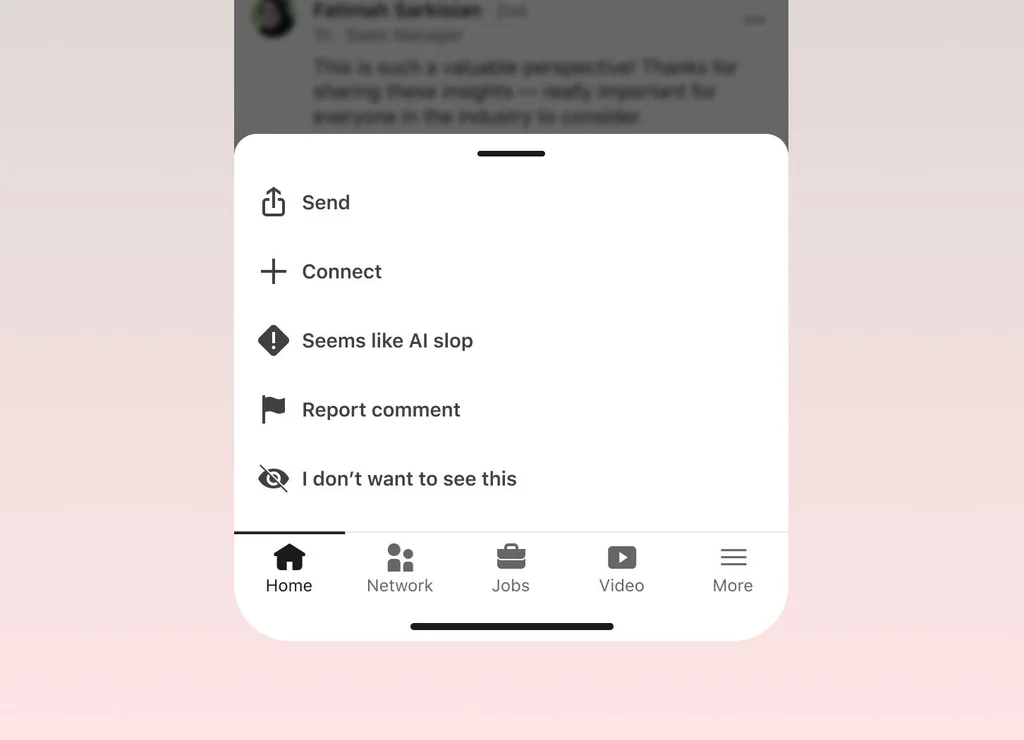
    The button, which debuted the week of July 27, allows users to flag content on LinkedIn that they believe may be “AI slop.” The option appears in a three-dot menu in the top right of any post, and shows a diamond with an exclamation point, followed by the phrase, “Seems like AI slop.” 

    In a post to the platform on July 30, Hari Srinivasan, LinkedIn’s chief product officer, explained that the button will help LinkedIn “tune our models and make better feeds.” It’s just one part of the brand’s overall strategy to reduce AI slop or “generally low-quality content.” Essentially, LinkedIn is using an AI-versus-AI approach by training its own detection models to distinguish between content that contains original thinking and content that’s just regurgitating existing thinking. 

    As AI-written content begins to take over social media, platforms like LinkedIn are faced with the challenge of bringing human ideas back to the surface. For several sites, that means baking AI detection and mediation features directly into the UX, allowing individual users to have some say in how AI content is handled.

    [Image: LinkedIn]

    Care for some LinkedIn with your slop?

    Any LinkedIn user knows that the platform has long suffered with an AI slop epidemic. According to a July study from AI detection service Pangram, one in four long-form posts on LinkedIn, Medium, X, Reddit, and Substack were flagged as AI over the past two months. Of those total flagged posts, a whopping two-thirds came from LinkedIn. 

    LinkedIn may be an AI slop hot spot, but the whole internet is suffering with a similar problem. In June, tech company Cloudfare, which manages traffic for millions of websites, reported that bots now generate 57.5% of web page requests. That finding is essentially proof of the “dead internet theory,” or the idea that most activity online today is generated by nonhumans.

    Right now, platforms are actively in the thick of dealing with this influx of automated content, and there don’t seem to be many cut-and-dry answers. Per Srinivasan’s post, “On comments alone, everyday we are now catching hundreds of thousands of automated comment attempts, and have blocked billions of other automation attempts (posting at scale, slop) in the last couple months alone.”

    As brands work through this conundrum, several are opting to hand some of the moderating power back to users—which presents a novel UX challenge. Though there can be overlap, AI slop often lives in a separate category from the kinds of posts that social media platforms are used to moderating, like violent or threatening content. Thus, brands need to create entirely new visual markers and categories to help users recognize AI moderation features.

    How AI slop is presenting a novel UX challenge

    Last October, Pinterest approached this problem by creating a new section in settings titled “AI content” and allowing users to toggle AI recommendations off by category, like “Art” and “Sports.” TikTok followed suit by testing an “AI-generated content” slider feature under its “Manage content” category in settings, letting users dictate their feed’s concentration of AI on a sliding scale. Most recently, during the week of July 20, Substack announced an integration with Pangram that gives users the ability to scan newsletters for an estimate of how much was written by AI.

    All of these features are designed to hand the reins of AI moderation over to users in some capacity. The same can be said for LinkedIn’s  “Seems like AI slop” button, which, according to Audrey Davis, LinkedIn’s director of product design and creative systems, is purposefully placed in a flow where members would typically report or provide content feedback, to make it easy to find. 

    “We are starting with the exclamation point, as that is indicative of an alert or caution, but also wanted to make sure it felt different from a formal report which uses a flag,” she explains. In other words, the AI slop button isn’t necessarily designed for narcing on individual users, but rather to help LinkedIn formulate a broader approach to cutting back on low-quality content. Davis says the platform “may explore other icon options in the future based on member feedback.”

    Social media brands are in the thick of dealing with the AI slopification of their platforms. For users, that means a rare opportunity to peek behind the curtain at how their feeds are made. 


    Source link

    Share. Facebook Twitter Pinterest LinkedIn Tumblr Email

    Related Posts

    She Spent Years at Uber Eats Watching Businesses Win and Lose Customers. Here’s What She Says Most Get Wrong.

    August 5, 2026

    Why Most Companies Have Fallen Behind on Customer Experience

    August 5, 2026

    Stop Leading Like You’re Protecting Your Job. Start Making the Decisions That Actually Drive Growth

    August 5, 2026
    Top News

    Quiet housing market pullback: Wall Street firms’ net selling jumps 408%

    By Staff WriterJuly 7, 2026

    Want more housing market stories from Lance Lambert’s ResiClub in your inbox? Subscribe to the…

    JPMorgan to invest up to $10 billion in U.S. national security

    October 13, 2025

    Why the Browser Company thinks Dia is the best layer for AI

    December 4, 2025

    A rare weather phenomenon is on track for a ‘hostile’ clash with the Super El Niño

    July 17, 2026
    Top Trending

    LinkedIn’s new anti-slop button is coming to every platform

    By Staff WriterAugust 5, 2026

    LinkedIn knows it has a slop problem. It has a button for…

    She Spent Years at Uber Eats Watching Businesses Win and Lose Customers. Here’s What She Says Most Get Wrong.

    By Staff WriterAugust 5, 2026

    Opinions expressed by Entrepreneur contributors are their own. Key Takeaways Define the…

    The Fauci Pardon Cannot Silence The States

    By Staff WriterAugust 5, 2026

    Biden’s autopen granted Anthony Fauci a “full and unconditional pardon” for any…

    Categories
    • Business
    • Economy
    • Headline News
    • Top News
    • US Politics
    • World Politics
    About us

    The Populist Bulletin serves as a beacon for the populist movement, which champions the interests of ordinary citizens over the agendas of the powerful and entrenched elitists. Rooted in the belief that the voices of everyday workers, families, and communities are often drowned out by powerful people and institutions, it delivers straightforward, unfiltered, compelling, relatable stories that resonate with the values of the American public.

    The Populist Bulletin was founded with a fervent commitment to inform, inspire, empower and spark meaningful conversations about the economy, business, politics, inequality, government accountability and overreach, globalization, and the preservation of American cultural heritage.

    The site offers a dynamic mix of investigative journalism, opinion editorials, and viral content that amplify populist sentiments and deliver stories that echo the concerns of everyday Americans while boldly challenging mainstream narratives that serve the privileged few.

    Top Picks

    LinkedIn’s new anti-slop button is coming to every platform

    August 5, 2026

    She Spent Years at Uber Eats Watching Businesses Win and Lose Customers. Here’s What She Says Most Get Wrong.

    August 5, 2026

    The Fauci Pardon Cannot Silence The States

    August 5, 2026
    Categories
    • Business
    • Economy
    • Headline News
    • Top News
    • US Politics
    • World Politics
    Copyright © 2025 Populist Bulletin. All Rights Reserved.

    Type above and press Enter to search. Press Esc to cancel.